His name has practically become a byword for “original” and “weird.” He’s also one of our greatest film masters, with an untouchable filmography and a reputation that, if anything, improves every year. We’re lucky to have him among us, still working and still giving us the most accurate weather report of all at age 70.
Here are some photos of Lynch behind the scenes of his films.
If you’ve watched 35mm feature films presented you have perhaps seen “Leader Ladies” or “China Girls.” These are the colloquial terms for the test frame attached to each reel processed in a color lab. Color and light density tend to be perceived subjectively by the mind, so a uniformly colored photograph is used to gauge the quality and density of color information of processed motion picture stock. It has been traditional to use photographs of young women for this, sometimes young Asian women, hence the appellation “China Girl.”
Even though you have seen them, you have likely never noticed it because they would have only been shown for 1/24th of a second, and only then at the beginning or end of a reel. Some of the photographs used are quite beautiful and the “Leader Lady” has become kind of a talisman of projection booths. They can often be seen taped to the walls with splicing tape.
Julie Buck and Karin Segal have given these anonymous models starring roles in their short film GIRLS ON FILM (2008). It’s great to see so many beautiful frames in one place.
Werner Herzog has never been averse to new technology in his own work (his 2010 CAVE OF FORGOTTEN DREAMS was the first arthouse feature made in the contemporary 3D climate) so it’s not surprising that he is interested in the implications of Virtual Reality, which is on the cusp of becoming a mainstream phenomenon. He elaborates in an interview with Patrick House of the New Yorker.
He is especially interested in the fact that the expressive power of the medium will lead creators to express new things:
“I am convinced that this is not going to be an extension of cinema or 3-D cinema or video games. It is something new, different, and not experienced yet. The strange thing here is that normally, in the history of culture, we have new stories and narrations and then we start to develop a tool. Or we have visions of wondrous new architecture—like, let’s say, the museum in Bilbao, or the opera house in Sydney—and technology makes it possible to fulfill these dreams. So you have the content first, and then the technology follows suit. In this case, we do have a technology, but we don’t have any clear idea how to fill it with content.
“The Prussian war theoretician Clausewitz, in Napoleonic times, famously said, “Sometimes war dreams of itself.” Does the Internet dream of itself? That’s a big question. Now let me ask the Clausewitz question about virtual reality. Does virtual reality dream of itself? Do we dream or express and articulate our dreams in virtual reality? It remains to be seen.”
The news of David Bowie’s death has been like an all-day, slow-motion explosion. The man had such a pervasive hand in popular culture, music, style and film. There have been pop stars in movies before but how many have made anything like Bowie’s impact?
Putting aside his own career in front of the camera for a moment – though we’ll get back to it – consider these uses of Bowie songs in film:
CHRISTIANE F. (1981): Bowie is all over this film about a teenage drug addict, perhaps most memorably in a scene where a group of teenagers run through a train station and smash a ticket booth while “Heroes” plays. More than any other, this film gives us a sense of how essential and what a lifeline Bowie’s music was to young people of the ’70s and ’80s.
DOGVILLE (2003): At the end of Lars von Trier’s harrowing indictment of small town America, we hear a joyous piano arpeggio and Bowie’s bittersweet “Young Americans” plays over a montage of stark photos of Americans in trouble.
WORLD’S GREATEST DAD (2009): At a moment of extreme personal crisis, Robin Williams’ character takes off his clothes and dives into a school swimming pool while “Under Pressure” plays. It’s a (toweringly great) song that’s used a lot, but for once it is not wasted.
INGLOURIOUS BASTERDS (2009): In an inspired music choice, Bowie’s song “Cat People: Putting Out Fire”) is used in a scene where a character is preparing for a dangerous life-or-death mission.
This is not even to mention the sneakily pervasive LABYRINTH (1986), where in addition to playing an iconic role he sings several songs. It’s one of many unforgettable onscreen appearances. Some of the best of these are:
THE MAN WHO FELL TO EARTH (1976): Bowie was born to play an alien, and he is brilliant at it in Nicolas Roeg’s wiggy sci-fi classic.
THE HUNGER (1983): Bowie plays a 200-year old vampire in a frantic search for a means to prolong his eternal youth in this ultra-stylish vampire movie costarring Catherine Deneuve and Susan Sarandon.
MERRY CHRISTMAS MR. LAWRENCE (1983): Bowie is exceptionally good in Nagisa Ôshima story of relationships between captured British soldiers and their Japanese captors in a WWII P.O.W. camp.
THE LAST TEMPTATION OF CHRIST (1988): In Martin Scorsese’s flawed but ambitious adaptation of Nikos Kazantzakis’ novel, Bowie plays Pontius Pilate.
TWIN PEAKS: FIRE WALK WITH ME (1991): Bowie makes a cameo appearance as a mysterious figure in one of agent Dale Cooper’s dreams. He affects a southern drawl and says the unforgettable line, “Wayull now, I’m not gonna tawlk about Judeee.”
BASQUIAT (1996): Bowie was a strangely appropriate choice to play Andy Warhol, whom he had celebrated in song 25 years earlier.
Many of Bowie’s film and television appearances to follow were more-or-less cameos. He had become an icon too big to be contained in a character. But Bowie was a fine actor with a commanding presence and sense of movement. In roles like the Goblin King in LABYRINTH he throws off rock-star sparks, but in character. That’s a testament to the skill of this man who played many roles onscreen and off.
It’s interesting how some films can emerge from obscurity and muddy critical opinions to become recognized classics. Reading this fine essay on BALL OF FIRE by Jeremy Carr, reminds me that a few short years ago it was not considered one of Howard Hawks’ most enduring classics and it was not very well known by modern audiences. Critical fashion changes and good word of mouth among audiences can help even a 70 year old film rise to restored prominence.
Over the past three of four years BALL OF FIRE has probably been shown as often as its 1941 Barbara Stanwyck-starring contemporary THE LADY EVE (AFS has screened both). While THE LADY EVE is probably the better film, mainly due to a superior romantic interest, BALL OF FIRE is inarguably a crowd-pleasing film. The Wilder/Brackett screenplay is a bit hackneyed, maybe a lot hackneyed; the supporting players are up and down; Hawks is sometimes careless in his direction; Gary Cooper’s chemistry with Stanwyck is not exactly smoldering (see Stanwyck/Fonda for comparison); and it goes on 10 minutes too long; but Stanwyck, playing a character of comic-strip level complexity, brings so much raw energy, charisma, sex appeal and, before it’s all over, genuine emotion, that audiences are won over every time.
Has any performer had a better year than Stanwyck’s 1941. THE LADY EVE, BALL OF FIRE and Frank Capra’s MEET JOHN DOE in the same year. If Stanwyck was the best actress to work in Hollywood films, and I say she was, this was her finest hour. Her Sugarpuss O’Shea, a nightclub dancer being hidden by her gang-boss boyfriend from a grand jury investigation in which she could provide damning testimony, would be a rank cliche in the hands of most other performers, maybe all. But Stanwyck has it all, the dance steps, the seduction wiles, the rapport with the audience. It’s a virtuoso turn by a maestro who is her own instrument, and a perfectly tuned one at that.
Steven Soderbergh has retired from filmmaking, kind of, but he is still updating his infrequent blog Extension 765. Yesterday he posted his annual Seen, Read list detailing which films, plays and television shows he has watched, what books or storied he read and what music he listened to.
All kinds of people make similar lists but of course it’s interesting reading what a working filmmaker who has proven himself to have pretty good taste chooses to watch, read, etc.
It’s a little surprising to see that he watched, in addition to many fine films, the Justin Bieber Comedy Central Roast and the World Figure Skating Championship. He watched a lot of TV, in fact, and a bunch of his own movies and TV shows. No word on what he ate while he watched them.
We all have our lists of filmmakers whose work we keep up with. There are 15 or 20 filmmakers I follow avidly, with an eager eye towards their latest film. But in 1966 that list would have been much longer. In fact, for me, all of the following films would have been must-sees.
It’s a little overwhelming to look back at the U.S. release schedule in 1966 and see how many major filmmakers were working. The year was a bit of a generational crossroad. Many in the old guard tried to adapt to the new youth market, masters with long track records tried to stay in the game, and the next generation of auteurs took early steps.
Here’s the auteur scorecard for 1966, a head-spinningly great year in film:
The past week has been hard on the art of cinematography. Two of its mightiest masters have gone. First, last week Haskell Wexler died, then a few days later Vilmos Zsigmond followed. They were both advanced in age and had done enough good work for ten normal lives, but they have left a mighty example for those to follow. When the members of the International Cinematographers Guild were polled in 2012 both men were included on their list of Most Influential Cinematographers of all time, alongside the likes of Gregg Toland, James Wong Howe, Vittorio Storaro and Sven Nykvist.
These were giants. Wexler shot such immaculate films as THE LOVED ONE, WHO’S AFRAID OF VIRGINIA WOOLF, IN THE HEAT OF THE NIGHT, MEDIUM COOL (which he also wrote and directed), BOUND FOR GLORY, ONE FLEW OVER THE CUCKOO’S NEST and MATEWAN, among many others. He won two Oscars and was given the Lifetime Achievement Award by The American Society Of Cinematographers. He was also an outspoken activist and campaigner for social justice.
Zsigmond was a well respected Cinematographer in his native Hungary but when he emigrated to America in the early ’60s there were few opportunities open to him so he made his living shooting industrial films and low budget films such as THE SADIST and THE INCREDIBLY STRANGE CREATURES WHO STOPPED LIVING AND BECAME MIXED-UP ZOMBIES. Robert Altman gave Zsigmond his big break in the U.S., hiring him for McCABE & MRS. MILLER. He went on to shoot THE HIRED HAND, DELIVERANCE, THE LONG GOODBYE, SUGARLAND EXPRESS, CLOSE ENCOUNTERS OF THE THIRD KIND, THE DEER HUNTER, HEAVEN’S GATE and many more.
Here is a candid master-class with Zsigmond from 2014 where he shares his thoughts, experiences and opinions:
A sample: “It (cinema) is an art form. And unfortunately today we are losing it. We think now that with special effects we can do everything… effects are overtaking everything. And I think the problem is that (in the past) films started to be about images, and we forgot about that. Also they started to be stories about people, and we forgot about that. And you know the effects are becoming the people. I don’t know how many explosions, how many killings… it’s amazing. What happened to my darling artistic movies, you know? It was gone. It is gone. So how do we get it back?”
Seasoned theatrical and radio impresario Orson Welles, aged 23
As a teenaged stage actor in the ’30s, Orson Welles helped pay the bills by lending his mellifluous baritone voice to scores of radio programs in New York. Before too long was a genuine radio star, making over $1500 a week in Depression dollars.
In 1935 he joined the newly created Federal Theater Project, a division of FDR’s Works Progress Administration. The Federal Theater Project was designed to put skilled people to work staging plays. Performances were open to the public and often took place in areas that had been deprived of any kind of theater, let alone great theater. Welles first production was Macbeth, performed in Harlem with an all African-American cast. Not only did it draw audiences, it became a bona fide break-out success, and toured the country. Welles continued to work in radio and used his earnings to supplement the show’s budget. President Roosevelt, according to Welles, called him “the only operator in history who ever illegally siphoned money into a Washington project.”
After two years of success, the Federal Theater Project ran into political objections in Washington, ironically for criticism of Italian dictator Benito Mussolini, and was defunded. Welles and his favorite collaborators defected and created the Mercury Theater in 1937. The Mercury Theater now benefited from Welles’ years of experience staging and directing plays, and of course his genius. The productions were modern, innovative and breathtaking.
The Mercury became so famous and esteemed that radio, Welles’ constant source of funding during these creative years, came calling and Welles and company were engaged to create a 13 week series of literary adaptations called “The Mercury Theater On The Air.” One of the most famous broadcasts in history was a Mercury episode, the famous and brilliant “War Of The Worlds” adaptation that many listeners believed to be real.
The series ran for 22 episodes before creative differences impelled Welles to pull the plug on it.
“I took LSD when I was working on RETURN OF THE JEDI. I could communicate with my cat Brian and Brian took me on a journey… I crawled into this cupboard with Brian the cat and we went to the center of the earth for like three billion years.”
Friend of AFS Evan Husney has made a great new short doc for Vice Films about the man who created, either alone or in tandem with others, some of the most impressive movie special effects of all time. It’s always been a little baffling how so many modern CGI effects look so terrible when clearly the technology was there to make the JURASSIC PARK dinosaurs look realistic decades ago.
In the doc, Tippett takes us into his workshop, shows us his models and shares his process and, maybe more interestingly, his philosophy.
New Yorker Film Critic Pauline Kael, so often prescient in her evaluation of talent and so precise in writing about performers, wrote in 1969 of Jane Fonda in THEY SHOOT HORSES, DON’T THEY?
“Fortunately, Gloria, who is the raw nerve of the movie, is played by Jane Fonda, who has been a charming, witty nudie cutie in recent years and now gets a chance at an archetypal character. Sharp-tongued Gloria, the hard, defiantly masochistic girl who expects nothing and gets it, the girl who thinks the worst of everybody and makes everybody act it out, the girl who can’t ask anybody for anything except death, is the strongest role an American actress has had on the screen this year. Jane Fonda goes all the way with it, as screen actresses rarely do once they become stars. She doesn’t try to save some ladylike part of herself, the way even a good actress like Audrey Hepburn does, peeping at us from behind “vulgar” roles to assure us she’s not really like that. Jane Fonda gives herself totally to the embodiment of this isolated, morbid girl who is determined to be on her own, who can’t let go and trust anybody, who is so afraid of being gullible that she can’t live.
“Jane Fonda makes one understand the self-destructive courage of a certain kind of loner, and because she has the true star’s gift of drawing one to her emotionally even when the character she plays is repellent, her Gloria, like Bogart’s Fred C. Dobbs, is one of those complex creations who live on as part of our shared experience. Jane Fonda stands a good chance of personifying American tensions and dominating our movies in the seventies as Bette Davis did in the thirties; if so, Gloria will be but one in a gallery of brilliant American characters.”
Later, Kael wrote in her 1971 KLUTE review:
“Jane Fonda’s motor runs a little fast. As an actress, she has a special kind of smartness that takes the form of speed; she’s always a little ahead of everybody, and this quicker beat–this quicker responsiveness–makes her more exciting to watch. This quality works to great advantage in her full-scale, definitive portrait of a call girl in Klute. It’s a good, big role for her, and she disappears into Bree, the call girl, so totally that her performance is very pure–unadorned by “acting.” As with her defiantly self-destructive Gloria inThey Shoot Horses, Don’t They?, she never stands outside Bree, she gives herself over to the role, and yet she isn’t lost in it–she’s fully in control, and her means are extraordinarily economical. She has somehow got to a plane of acting at which even the closest closeup never reveals a false thought and, seen on the movie streets a block away, she’s Bree, not Jane Fonda, walking toward us.
“… I wish Jane Fonda could divide herself in two, so we could have new movies with that naughty-innocent comedienne as well as with this brilliant, no-nonsense dramatic actress. Her Gloria invited comparison with Bette Davis in her great days, but the character of Gloria lacked softer tones, shading, variety. Her Bree transcends the comparison; there isn’t another young dramatic actress in American films who can touch her….”
These quotes help to provide a road map to appreciating Fonda’s special talent. In addition to her onscreen work, of course she has also been an icon of style, fitness guru and flashpoint in the culture wars. She’s a giant in her field and at 78 she’s almost as famous now as ever.
This will be the first and last link to anything Oprah Winfrey related on these pages, but the story she tells here of meeting Greta Garbo tell us something about Fonda’s strength of character and philosophy of life. I love it. Hope you enjoy it too:
Hot off the presses, here are the programming notes for this January’s much-anticipated Essential Cinema screening series. Screenings are open to the public. Click on links below for more information.
Blake Edwards’ name is synonymous with the kind of sophisticated yet physical comedy he mastered as a writer and director. The urbane and the profane coexist in the Edwards universe, and frequently prove to be opposite sides of the same coin.
Born in Tulsa but raised in Hollywood, young Blake Edwards knew the studio back lots like the palm of his hand. As soon as he was old enough to work he became a messenger, delivering script pages and dailies to the various studio offices. Soon he became a bit part actor, then a writer and director of B-movies, radio and television. The success of his television series PETER GUNN and subsequent early films like OPERATION PETTICOAT and BREAKFAST AT TIFFANY’S made him a sought-after comedy director, and then the first two installments of his PINK PANTHER series, featuring Peter Sellers as the bumbling Inspector Clouseau, carried him to the top of the heap.
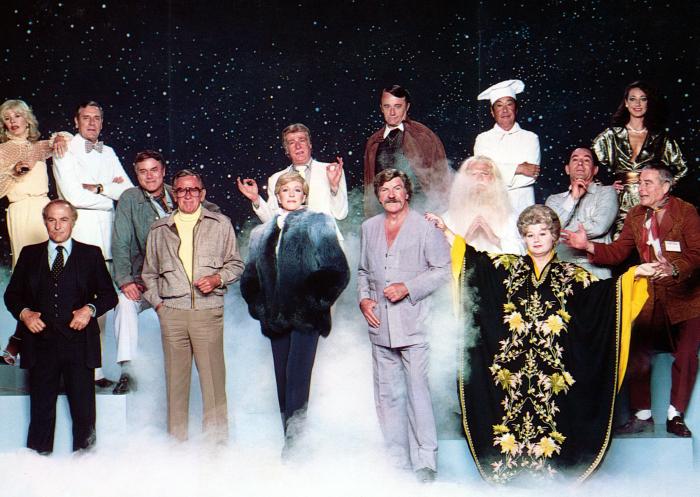
THE GREAT RACE followed, a (for its time) massively budgeted comedy. It turned a profit but was critically unpopular. His next few films did not satisfy critics or audiences much. Edwards had come to a turning point by the end of the sixties. His next film, DARLING LILI, encountered a number of costly shooting delays and, making matters worse, studio management changed before the release and the new brass did not much care about making DARLING LILI a success. The movie was released, with cuts made by the studio, and underperformed at the box office. Seen today in Edwards’ preferred cut, it’s a minor masterpiece. Julie Andrews, making her first appearance in one of her husband’s films, is remarkable, demonstrating her acting, singing and even sex appeal. This last attribute was very controversial at the time, and the studio management’s discomfort with Andrews’ sexual side will come up again in S.O.B.
Subsequent Clouseau-free projects proved unsuccessful as well and Edwards found himself at the cusp of the ‘80s without a studio and without many prospects. Outside of the dependable PANTHER films, which were becoming a little worn at the edges, Edwards had presided over a string of flops, and his latest script, about a man having a midlife crisis, seemed like another box-office depth charge. The small production unit Orion Pictures took a gamble on Edwards’ talent (and his not inconsiderable anchor star and wife Andrews). 10 became a massive box office sensation, raking in $75 million dollars, the equivalent of a quarter of a billion dollars today. New discovery Bo Derek became ubiquitous in the national media after this film’s success and Ravel’s Bolero became one of the best selling classical compositions of all time.
Written by Edwards. Starring Dudley Moore, Julie Andrews, Bo Derek, Robert Webber, Dee Wallace, Brian Dennehy
Dudley Moore plays a successful songwriter, blessed with a loving partner (Julie Andrews), who spies beautiful young bride Bo Derek at a wedding and loses his mind. Unbeknownst to her, he follows her and her husband on their Mexican honeymoon trip. Between awkward encounters and many, many strong drinks he finds where his true happiness lies.
Rather than rest on his laurels or begin a new, profitable franchise, Edwards went his own way yet again, featuring Andrews in the acidic, brilliant and completely uncommercial satire S.O.B., which, unsurprisingly, was dumped by the studio and lost money but which today seems ripe for rediscovery. The central character, a director played by Richard Mulligan, is very much based on Edwards and the plot events reflect the aftermath of the DARLING LILI debacle.
Written by Edwards. Starring Julie Andrews, Richard Mulligan, William Holden, Robert Preston, Marisa Berenson, Larry Hagman
After a long and remunerative career in Hollywood, director Felix Farmer (Robert Mulligan) is at the end of his rope. His latest film, a musical called NIGHT WIND, is a flop, his personal life falls apart and he finds he has few friends. Then Farmer has the insane idea to recall NIGHT WIND, add pornographic sequences starring his wife, a goody-goody Julie Andrews type (played by Julie Andrews, of course), and rerelease it. It’s an act of madness, of course, but then all of Hollywood is mad, unscrupulous and desperate in Blake Edwards’ deeply bitter, dark farce.
The Edwards/Andrews team followed this with sizeable hit and critical success VICTOR VICTORIA, which brought old-fashioned big-movie craftsmanship and talent back to the top of the box office charts again. It’s an extraordinary showcase for Julie Andrews and Robert Preston. This is top of the line stuff, as proficient an example of grown-up entertainment as Hollywood had ever managed.
Written by Blake Edwards from a story by Hans Hoemburg and Reinhold Schünzel. Starring Julie Andrews, Robert Preston, James Garner, Lesley Ann Warren, Alex Karras
In Paris between the wars, a British singer – an operatic soprano – (Julie Andrews) slogs from dive to dive looking for work. She becomes friends with gay cabaret pianist Toddy (Robert Preston) who comes up with the idea of having her impersonate a man who in turn performs onstage in female “drag.” The act is a sensation and the gender reversal causes a lot of personal turmoil for smitten American gangster King Marchand (James Garner) and his retinue.
VICTOR VICTORIA was a pinnacle of sorts for Edwards. His next projects must have been pretty dispiriting – one Pink Panther movie largely constructed of deleted scenes from other films in the series, a necessity created by the premature death of star Peter Sellers; and another Pink Panther movie starring Ted Wass as the lead investigator. Edwards’ next film betrays some of the ennui he felt during this period.
Written by Blake Edwards, Milton Wexler and Geoffrey Edwards. Suggested by a film written by François Truffaut, Michel Fermaud and Suzanne Schiffman. Starring Burt Reynolds, Julie Andrews, Kim Basinger, Marilu Henner, Cynthia Sikes, Jennifer Edwards, Sela Ward
A psychoanalyst played by Julie Andrews relates in flashback the tale of one of her most interesting patients, a wealthy sculptor who is obsessed by beautiful women and who pursues them even when it places his life in jeopardy. The film is told in a series of vignettes.
THE MAN WHO LOVED WOMEN is an Americanization of François Truffaut’s 1977 film, released stateside under the same title. Though he was a box office star, Burt Reynolds is not ideal casting. In fact Blake Edwards wanted Warren Beatty or Dustin Hoffman. Reynolds does his best though and the rest of the cast does very well at times, especially Andrews and Kim Basinger. This is a minor Edwards film, and chiefly interesting as the film that closes this cycle, but taken with the right attitude it is a lot of fun, it is well shot by the great Haskell Wexler, and there are several classic sequences.