Filmmaker Ana Lily Amirpour visited us here at AFS shortly after completing filming on her new movie THE BAD BATCH which stars Jason Momoa, Keanu Reeves and Jim Carrey. She presented a screening (with an unforgettable Q&A) of her film A GIRL WALKS HOME AT NIGHT and then sat with AFS members at Austin Studios for a Moviemaker Dialogue. The discussion was no less funny or vulgar than the raucous session at the theater the night before, but her advice was sincere and should be taken to heart by everyone who makes films or wants to.
The part about how filmmakers need to be like BACK TO THE FUTURE’s Doc Brown will stick with me forever. Doc Brown is not motivated by money or fame. He lives a hermit’s existence. But he is obsessed with his work. That, according to Amirpour, is an apt metaphor for the life and work of a filmmaker.
Barbara Loden, who was born on this day in 1932, had one of the most interesting career trajectories we can think of. From her beginnings as a teenage dancer and pin-up model through to her Actor’s Studio training and first roles on the legitimate New York stage to her television work as a bit player on Ernie Kovacs’ show, generally wearing tiny outfits and getting hit by pies or sawed in half.
After a few bit film roles she was cast by director Elia Kazan as a Marilyn Monroe type in the Broadway production of AFTER THE FALL, written by Monroe’s erstwhile husband Arthur Miller. She won a Tony Award and wowed audiences and critics. She also wowed Kazan, who became her second husband.
A promising film role in Frank Perry’s oddball John Cheever adaptation THE SWIMMER was squelched, possibly as a result of Kazan’s interference, and the part was recast. Loden’s film career was obviously not headed in a positive direction so she took the reins of production herself, rewriting one of Kazan’s stories until it truly became her own, full of autobiographical details, putting together a small crew and making her own film, WANDA for a microscopic budget.
WANDA (released in 1970) is now considered one of the touchstone films of American independent cinema. At the time it received little attention in the states, though it won a Best Foreign Film Award at Venice, but the years have been kind to the film and it is now seen as a very special, ahead-of-its-time work. Its roughness and obvious economy were not seen as assets at the time, but today we see them as so. Most impressive of all is Loden’s performance, though there today is a tinge of sadness that we do not have more Loden films. She died in 1980, aged 48, before making any other feature films.
Here is a really interesting TV interview from the Mike Douglas talk show, during that bizarro-world period when John Lennon and Yoko Ono co-hosted. Lennon and Ono asked all manner of interesting people on the show and as a result here we have Barbara Loden on national television talking at length about WANDA and even playing extended clips.
“Maybe in our films we put our hearts… our desires, everything that we love or that has betrayed us. And I think one day, if there is someone who could analyze us, you and me, maybe he would know. I don’t know why I’ve made my films. Do you know?” – Fritz Lang
Below is a very interesting video – an hour long – of Jean Luc Godard and Fritz Lang having an open ended discussion about film and life. Such a meeting of filmic minds certainly does not happen very often and so it is presented here in its entirety.
Here is an excerpt:
Lang: I think in that respect films are like loaves of bread. They’re good. They’re made to be consumed today… in a week, six months, a year…
Godard: But a film that lives on isn’t just a loaf of bread.
Lang: But I think only time and the public can tell. But when a film lives on like a film by Abel Gance, NAPOLEON, it is a work of art.”
Godard: Abel Gance’s NAPOLEON will live on.
Lang: It is a work of art. But how many such films do you know?
Some of us are guilty of sounding the death knell of Hollywood (as a business concept, not a geographic location) ever more loudly as each year pours out its cornucopia of overprocessed, not-very-nourishing entertainment offerings onto our summer picnic blanket. Because we care a lot about the art of film and the experience of going to the movies, most of us take at least a bite or two. Occasionally we find a nice morsel, but more often it’s just the same old summer sausage, full of rendered cliches.
Personally, before I let myself roll too far down this hill of despair, I remember that Hollywood has always had its mix of good and bad, and the old philosophy “nothing succeeds like excess” is not new. Hollywood had, by 1965, been taken over by the second generation of moguls, finance men by and large, who had never known the hardscrabble immigrant life experienced by the first generation.
Below are the top 10 box office performers of 1965 for instance. How many of these are really classics that stand the test of time? Not many, if any at all. They are (with one exception) all expensive, star laden and calculated to sell, sell, sell.
Their international appeal has been built in from the start. In the same way that Hollywood blockbusters are pre-sold in China and elsewhere and must contort themselves to suit the populace of other countries, so were big international co-productions like THE SOUND OF MUSIC, DR. ZHIVAGO and THE GREAT RACE designed to knock them dead in the UK and Europe.
The 10 Top Grossing Films of 1965
1. THE SOUND OF MUSIC – A game-changing hit. This relies on the star power and exceptional singing talent of Julie Andrews. It landed like a perfect storm, was a major hit, and helped sow the seeds for a harvest of big-budget family musicals for years after.
2. DOCTOR ZHIVAGO – Certainly a beautifully made film, but not one of Lean’s best. Studio marketing departments threw out their backs on this. Its success was as much a function of hardline publicity and cross-marketing as anything else.
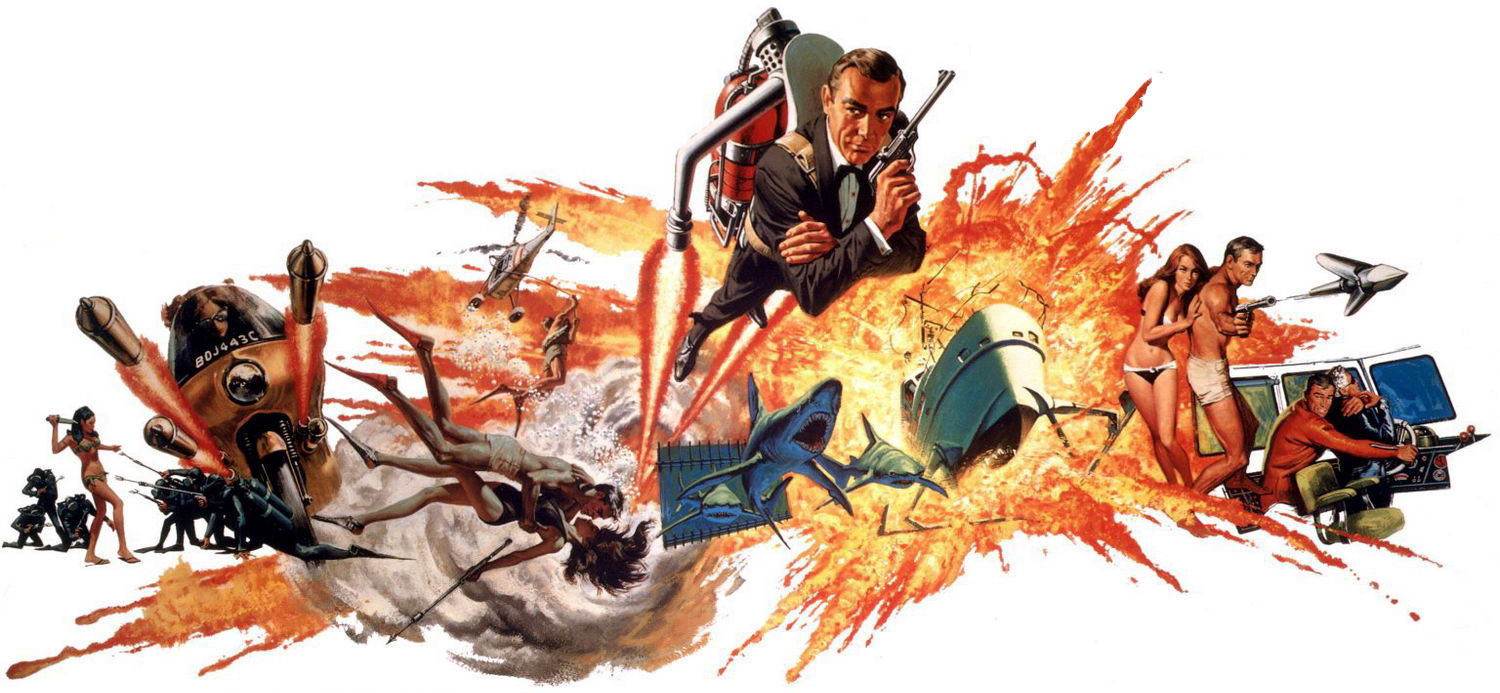
3. THUNDERBALL – The fourth in the Sean Connery Bond series. Was this the first real big-budget action/sci-fi franchise? Completely RAGING poster and display artwork for this movie by the way.
4. THOSE MAGNIFICENT MEN IN THEIR FLYING MACHINES – Few people have even heard of this film today. An enormous film, especially by British standards. Few name stars. The most strenuous roles are played by aircraft.
5. THAT DARN CAT! – The inevitable and eternal Disney formula picture.
6. THE GREAT RACE – Very similar to (and released two weeks after) THOSE MAGNIFICENT MEN IN THEIR FLYING MACHINES. Blake Edwards’ film at least has vitality, good humor, terrific actors and a Henry Mancini score. This film was a disappointment at the box office, but only because cost overruns made it a poor candidate to succeed.
7. CAT BALLOU – The least expensive movie on this list. What it lacked in international locations and lavish production values it made up for in what audiences really want anyway – appealing, talented performers. Jane Fonda and Lee Marvin (and his horse) are far more interesting to watch than any number of flying circuses or underwater espionage operations.
8. WHAT’S NEW PUSSYCAT – Big stars like Peter Sellers and Peter O’Toole, eye-popping sets, and a very amusing script by Woody Allen made this a grown-up hit.
9. SHENANDOAH – James Stewart in a western still meant boffo B.O. in 1965. The anti-war stance of the film didn’t hurt either.
10. VON RYAN’S EXPRESS – War movies were always popular items with the generations who fought in wars and we have to imagine that the theaters were full of men in their 40s who had themselves served in uniform. The ironically cast (because he dodged the draft and was not loved by many servicemen) Frank Sinatra leads a great escape. The pro-war stance of the film didn’t hurt either.
As the Old School Kung Fu Weekend approaches (July 24 and 25), our thoughts turn to these classic martial arts films and the people who made them. There were a ton of producers in Hong Kong and Taiwan who cranked out a lot of Kung Fu movies, but the best of the batch were the members of the Shaw Brothers organization. The original Shaw Brothers began making films in 1924 and by the time the big martial arts boom hit they were seemingly well suited to ride the wave. But in fact their films did not become breakout hits in the US and other export markets while the less polished and more sensational movies made by their low-budget competitors turned big profits.
The Shaw operation was run like a factory, with standing sets, a heavy production schedule, all technical facilities on premises and even dormitories for their star prospects, many of whom were attractive young women from the provinces. It was an old-fashioned, top heavy studio and it could not ride out the glutted market of the mid-70s, a time when every camera in Asia was cranking out martial arts films to sate the post-Bruce Lee international appetite for more.
This British TV documentary takes a very plodding and didactic approach to the subject, but it’s tough to beat the access to the Shaw backlot, dubbing studios and talent development classes. The hand of the publicist is visible in the foregrounding of action star David Chiang, whom the Shaws wanted to position as the successor to Bruce Lee. It did not work – as good as Chiang was, Bruce Lee was a one-of-a-kind commodity – but the Shaws had some major hits with the 5 DEADLY VENOMS movies and kept the doors open for several more years.
Ana Lily Amirpour, photo credit Charles Ramírez Berg
First off – if you don’t want to hear a bunch of off-color language, drug references and vulgar sexual metaphors, go watch something else right now. It’s cool. However, to really get an idea about Ana Lily Amirpour’s aesthetic, you kind of need to ride along on this bumpy road for a while.
On Friday night, 280 people joined us for a screening of A GIRL WALKS HOME ALONE AT NIGHT with Amirpour.
After the thunderous applause died down, she and I sat down for a very memorable Q&A. She extolled the creative virtues of certain hallucinogens, used very precise salty language to describe abstract filmmaking concerns and even gave a couple in the audience a suggestion for making their intimate moments “juicier.”
It was really special and no one who was there will forget the experience, or the brilliance and exuberance of Lily’s spirit. We’re all waiting for her next film impatiently.
“I’m the greatest actress in the world and the greatest failure, and nobody gives a damn.”
Chances are, unless you came across this post while looking for information about Jeanne Eagels, that you’ve never heard the name, let alone known the reputation that Eagels enjoyed among her contemporaries as an incandescent, proto-method actress. She was beautiful and brilliant, acclaimed as a great genius, and yet she also seemed to be in a hurry to destroy her career and her life.
She was born into a poor family in Kansas, ran off to join a traveling theatrical company at age 12, landed in New York, remade herself, became a chorine and a Ziegfeld Girl, studied acting and became a sought after theatrical name. As her heavy schedule – which soon included silent films – began to weigh on her, she self-medicated with pills, alcohol and possibly harder stuff.
Soon, after dozens of successful roles, she became a Broadway super-star playing Sadie Thompson in Somerset Maugham’s “Rain.” As her fame increased, so did her reputation for temperamental behavior and even unreliability. She drank even during performances and made work difficult for her co-stars and directors, but she also focused her performance like a laser and communicated her great reserves of emotional pain in a focused way that had scarcely been seen before. The word “genius” became permanently attached to her name.
Her “Rain” director John C. Williams said of her, “First off, she knew to perfection, and adhered to as to a religion, the art of listening in acting. At every performance, whether the first, or the hundredth, the speeches of the character addressing her were not merely heard but listened to. Hence there was always thought and belief and conviction behind every speech and scene of her own– the essence of theater illusion.”
This was not always so typical of stage divas, and it gives an idea of why young Barbara Stanwyck, for one, was so enthralled by Eagels, and why she emulated her acting style throughout her career. It’s one of the keys to good acting, and Eagels mastered it early on.
Her self-destructive behavior, not helped a bit by an abusive marriage to an ex-football hero, helped drive her out of Hollywood. She would disappear for days on end during shoots, a thought that must send shivers up the spine of anyone who has ever worked in films. But one producer, Monta Bell, thought that no-one as talented, well-spoken, and glamorous should be kept from the screen and he cast her in Paramount’s very first talkie THE LETTER. It was a smash hit and Eagels’ performance was electric.
It was to be her next-to-last job. She made one more film, JEALOUSY, but no one considered it a worthy successor to THE LETTER. She died on the night of October 3, 1929, aged 39. Her death was variously attributed to alcohol, sleeping pills and heroin. It was as sensational a story as can be imagined, made all the more so because it happened in New York, the hub of gutter journalism*. She was posthumously nominated for an Academy Award for her performance in THE LETTER, but did not win.
Today we can only gauge Eagels’ power from anecdotal remembrances and a couple of films. A biopic of her life was made in 1957, starring Kim Novak. It was primarily a work of fiction and fetishized her Fitgerald-era beautiful damned life.
The following clip, and the movie it is excerpted from, gives us an idea of the rare combination of talent, beauty and emotional power Eagels contributed to her work and, through the example set by Stanwyck and other acolytes, to the art itself. This is her big speech from THE LETTER. It spoils the plot, so if you want to watch the whole film – and you should – watch it here. Otherwise, enjoy the majesty of Jeanne Eagels in THE LETTER:
*Interesting factual tidbit provided by Jeanne Eagels superfan Richard Linklater – the young reporter who got the scoop about Eagels’ death was none other than Samuel Fuller.
Nearly 14 years after her death, film critic Pauline Kael still inspires controversy. During her lifetime she was loved by many, hated by some and feared by studios and publicists (much of Hollywood felt, with some justification, that she could make or break a movie with her New Yorker reviews).
One matter than nearly everyone agrees on is that she was an exceptionally good and forceful writer. Her collections fall in and out of print, but just as every generation of theater people discovers Shakespeare anew, so does every new cycle of film people find its way to Kael. And if those copies of “I Lost It At The Movies” or “Kiss Kiss Band Bang” are a little dog-eared and foxed, then so be it, the contents are immortal.
Kael began writing about film professionally when she managed and programmed a small two-screen theater for the Berkeley Cinema Guild from 1955 to 1960. She wrote beautiful, insightful and persuasive capsule notes for the films she chose. At around the same time she became the on-air film critic for Berkeley’s community radio station KPFA. A number of the reviews Kael read on-air are collected in her first books and her capsule reviews can be found in the invaluable collection “1001 Nights At The Movies,” revised as “5001 Nights At The Movies.”
She had an 8-year run as unpaid film reviewer for KPFA before quitting in 1963. Some of the frustrations that led to her resigning the post are apparent in this broadcast, recorded just before she quit. Kael’s legendary wit, incisiveness and truculence are here, in a giant-sized portion. All of us who replay an argument in our heads afterwards, thinking, “I should have said that!” will appreciate the precision and sickness of the burn she administers here.
I sheared the existing broadcast recording of a few minutes of KPFA business. Her full broadcast script (including the portion not available on tape) is reprinted here:
I am resolved to start the New Year right; I don’t want to carry over any unnecessary rancor from 1962. So let me discharge a few debts. I want to say a few words about a communication from a woman listener.
She begins with, “Miss Kael, I assume you aren’t married—one loses that nasty, sharp bite in one’s voice when one learns to care about others.” Isn’t it remarkable that women, who used to pride themselves on their chastity, are now just as complacently proud of their married status? They’ve read Freud and they’ve not only got the idea that being married is healthier, more “mature,” they’ve also got the illusion that it improves their character. This lady is so concerned that I won’t appreciate her full acceptance of femininity that she signs herself with her husband’s name preceded by a Mrs. Why, if this Mrs. John Doe just signed herself Jane Doe, I might confuse her with one of those nasty virgins, I might not understand the warmth and depth of connubial experience out of which she writes.
I wonder, Mrs. John Doe, in your reassuring, protected marital state, if you have considered that perhaps caring about others may bring a bite to the voice? And I wonder if you have considered how difficult it is for a woman in this Freudianized age, which turns out to be a new Victorian age in its attitude to women who do anything, to show any intelligence without being accused of unnatural aggressivity, hateful vindictiveness, or lesbianism. The latter accusation is generally made by men who have had a rough time in an argument; they like to console themselves with the notions that the woman is semi-masculine. The new Freudianism goes beyond Victorianism in its placid assumption that a woman who uses her mind is trying to compete with men. It was bad enough for women who had brains to be considered freaks like talking dogs; now it’s leeringly assumed that they’re trying to grow a penis—which any man will tell you is an accomplishment that puts canine conversation in the shadows.
Mrs. John Doe and her sisters who write to me seem to interpret Freud to mean that intelligence, like a penis, is a male attribute. The true woman is supposed to be sweet and passive—she shouldn’t argue or emphasize and opinion or get excited about a judgment. Sex—or at least regulated marital sex—is supposed to act as a tranquilizer. In other words, the Freudianized female accepts that whole complex of passivity that the feminists battled against.
Mrs. Doe, you know something, I don’t mind sounding sharp—and I’ll take my stand with those pre-Freudian feminists; and you know something else, I think you’re probably so worried about competing with male egos and those brilliant masculine intellects that you probably bore men to death.
This lady who attacks me for being nasty and sharp goes on to write, “I was extremely disappointed to hear your costic speech on and about the radio station, KPFA. It is unfortunate you were unable to get a liberal education, because that would have enabled you to know that a great many people have many fields of interest, and would have saved you from displaying your ignorance on the matter.” She, incidentally, displays her liberal education by spelling caustic c-o-s-t-i-c, and it is with some expense of spirit that I read this kind of communication. Should I try to counter my education—liberal and sexual—against hers, should I explain that Pauline Kael is the name I was given at birth, and that it does not reflect my marital vicissitudes which might over-complicate nomenclature?
It is not really that I prefer to call myself by my own name and hence Miss that bothers her or the other Mrs. Does, it is that I express ideas she doesn’t like. If I called myself by three names like those poetesses in the Saturday Review of Literature, Mrs. Doe would still hate my guts. But significantly she attacks me for being a Miss. Having become a Mrs., she has gained moral superiority: for the modern woman, officially losing her virginity is a victory comparable to the Victorian woman’s officially keeping hers. I’m happy for Mrs. Doe that she’s got a husband, but in her defense of KPFA she writes like a virgin mind. And is that really something to be happy about?
Mrs. Doe, the happily, emotionally-secure-mature-liberally-educated-womanly-woman has her opposite number in the mailbag. Here is a letter from a manly man. This is the letter in its entirety: “Dear Miss Kael, Since you know so much about the art of the film, why don’t you spend your time making it? But first, you will need a pair of balls.” Mr. Dodo (I use the repetition in honor of your two attributes), movies are made and criticism is written by the use of intelligence, talent, taste, emotion, education, imagination, and discrimination. I suggest it is time you and your cohorts stop thinking with your genital jewels. There is a standard answer to this old idiocy of if-you-know-so-much-about-the-art-of-the-film-why-don’t-you-make-movies. You don’t have to lay an egg to know if it tastes good. If it makes you feel better, I have worked making movies, and I wasn’t hampered by any biological deficiencies.
Others may wonder why I take the time to answer letters of this sort: the reason is that these two examples, although cruder than most of the mail, simply carry to extremes the kind of thing so many of you write. There are, of course, some letter writers who take a more “constructive” approach. I’d you to read you part of a long letter I received yesterday:
I haven’t been listening to your programs for very long and haven’t heard all of them since I began listening … But I must say that while I have been listening, I have not heard one favorable statement made of any “name” movie made in the last several years…. I have heard no movie which received any kind of favorable mention which was not hard to find playing, either because of its lack of popularity or because of its age. In your remarks the other evening about De Sica’s earlier movies you praised them all without reservation until you mentioned his “most famous film—The Bicycle Thief, a great work, no doubt, though I personally find it too carefully and classically structured.” You make me think that the charge that the favorability of your comments on any given movie varies inversely with its popularity, is indeed true even down to the last nuance. But even as I write this, I can almost feel you begin to tighten up, to start thinking of something to say to show that I am wrong. I really wish you wouldn’t feel that way. I would much rather you leaned back in your chair, looked up at the ceiling and asked yourself, “Well, how about it? Is it true or not? Am I really biased against movies other people like, because they liked them? When I see a popular movie, do I see it as it is or do I really just try to pick it apart?” You see, I’m not like those other people that have been haranguing you. I may be presumptuous, but I am trying sincerely to be of help to you. I think you have a great deal of potential as a reviewer…. But I am convinced that great a potential as you have, you will never realize any more of that potential than you have now until you face those questions mentioned before, honestly, seriously, and courageously, no matter how painful it may be. I want you to think of these questions, I don’t want you to think of how to convince me of their answers. I don’t want you to look around to find some popular movie to which you can give a good review and thus “prove me wrong.” That would be evading the issue of whether the questions were really true or not. Furthermore, I am not “attacking” you and you have no need to defend yourself to me.
May I interrupt? Please, attack me instead—it’s this kind of “constructive criticism” that misses the point of everything I’m trying to say that drives me mad. It’s enough to make one howl with despair, this concern for my potential—as if I were a cow giving thin milk. But back to the letter—
In fact, I would prefer that you make no reply to me at all about the answers to these question, since I have no need of the answers and because almost any answer given now, without long and thoughtful consideration, would almost surely be an attempt to justify yourself, and that’s just what you don’t have to do, and shouldn’t do. No one needs to know the answers to these questions except you, and you are the only person who must answer. In short, I would not for the world have you silence any voices in you … and most certainly not a concerned little voice saying, “Am I really being fair? Do I see the whole movie or just the part I like—or just the part I don’t like?”
And so on he goes for another few paragraphs. Halfway through, I thought this man was pulling my leg; as I got further and read “how you missed the child-like charm and innocence of The Parent Trap … is quite beyond me,” I decided it’s mass culture that’s pulling both legs out from under us all. Dear man, the only real question you letter made me ask myself is, “What’s the use?” and I didn’t lean back in my chair and look up at the ceiling, I went to the liquor cabinet and poured myself a good stiff drink.
How completely has mass culture subverted even the role of the critic when listeners suggest that because the movies a critic review favorably are unpopular and hard to fine, that the critic must be playing some snobbish game with himself and the public? Why are you listening to a minority radio station like KPFA? Isn’t it because you want something you don’t get on commercial radio? I try to direct you to films that, if you search them out, will give you something you won’t get from The Parent Trap. You consider it rather “suspect” that I don’t raise more “name” movies. Well, what makes a “name” movie is simply a saturation advertising campaign, the same kind of campaign that puts samples of liquid detergents at your door. The “name” pictures of Hollywood are made the same way they are sold: by pretesting the various ingredients, removing all possible elements that might affront the mass audience, adding all possible elements that will titillate the largest number of people. As the CBS television advertising slogan put it—“Titillate—and dominate.” South Pacific is seventh in Variety’s list of all-time top grossers. Do you know anybody who thought it was a good movie? Was it popular in any meaningful sense or do we just call it popular because it was sold? The tie-in campaign for Doris Day in Lover Come Back included a Doris Day album to be sold for a dollar with a purchase of Imperial margarine. With a schedule of 23 million direct mail pieces, newspaper, radio, TV and store ads, Lover Come Back became a “name” picture.
I try not to waste air time discussing obviously bad movies—popular though they may be; and I don’t discuss unpopular bad movies because you’re not going to see them anyway; and there wouldn’t be much point or sport in hitting people who are already down. I do think it’s important to take time on movies which are inflated by critical acclaim and which some of you might assume to be the films to see.
There were some extraordinarily unpleasant anonymous letters after the last broadcast on The New American Cinema. Some were obscene; the wittiest called me a snail eating the tender leaves off young artists. I recognize your assumptions: the critic is supposed to be rational, clever, heartless and empty, envious of the creative fire of the artists, and if the critic is a woman, she is supposed to be cold and castrating. The artist is supposed to be delicate and sensitive and in need of tender care and nourishment. Well, this nineteenth-century romanticism is pretty silly in twentieth-century Bohemia.
I regard criticism as an art, and if in this country and in this age it is practiced with honesty, it is no more remunerative than the work of an avant-garde film artist. My dear anonymous letter writers, if you think it is so easy to be a critic, so difficult to be a poet or a painter or film experimenter, may I suggest you try both? You may discover why there are so few critics, so many poets.
Some of you write me flattering letters and I’m grateful, but one last request: if you write me, please don’t say, “This is the first time I’ve ever written a fan letter.” Don’t say it, even if it’s true. You make me feel as if I were taking your virginity—and it’s just too sordid.”
Here’s a nice interview piece from Ignatiy Vishnevetsky on Mia Hansen-Løve’s new movie EDEN. She will guest-program three screenings: Jean Eustache’s epochal THE MOTHER & THE WHORE, Assayas’ under-seen SOMETHING IN THE AIR and a sneak of EDEN.
Billy Wilder with Austrian Pickelhaube helmet and Oscars
Here’s a long form interview with the still very agile minded Billy Wilder conducted in 1995. As this video was created by the Writer’s Guild, there is a lot about story – very few have ever mastered movie storytelling as well as Wilder, after all – but there are a lot of other gems too. None of us, whether we be directors, writers, technical personnel, or merely film fans, can or should disregard the lessons laid down here by Wilder. This kind of advice has no expiration date, and the filmmakers of today who heed it will have the advantage over those who ignore it.
On tricky camera set-ups:
“I don’t indulge in camera tricks. I don’t want – you know, one director says to another, “did you see the set up that the guy has? Terrific what he did with the camera.” No, I just photograph it as simply as possible, but as elegantly as possible. You will never see a surprising shot from the point of view of Santa Claus, shooting through the fireplace. Who is there?! Santa Claus maybe.”
On changes in the movie business:
“The studios are now copying more successful pictures. If you bring them a picture that’s totally original they say, “this is very interesting but I’ve never seen it before.” “That’s why I want to make it!”
On keeping audience interest:
“You have to get the hook, the big hook, that keeps them there. And don’t let go. Because they are fickle. Very fickle. Keep working on that throat. Keep getting tighter and tighter.”
The AFS Jewels In The Wasteland II series, programmed by Austin Film Society founder and artistic director Richard Linklater, wrapped up earlier this month with an archival 35mm screening of MISHIMA: A LIFE IN THREE CHAPTERS.
It’s appropriate that a Paul Schrader film would cap our screening series focusing on the years 1984-1986, because, during that era, Schrader was one of the biggest filmmaking and screenwriting heroes of young Richard Linklater, who had not yet made his first feature, but who was already running the film society and plotting his career.
MISHIMA doesn’t screen around much and that’s a shame because the films set-pieces and designs don’t translate well to the small screen and you need maximum visual impact to get the poetic resonances of the story. It’s a truly powerful film when seen in a theater.
Here is Linklater’s introduction to the film and our post-movie discussion, hitting on a lot of topics both relevant and not. Enjoy.
Holly Herrick previews this year’s Cinema East season. All Cinema East screenings take place on the French Legation grounds.
Summer movies outdoors are not only the creation of the American drive-in, they are a pleasure the world over, and enjoyed in outdoor amphitheaters from Ouagadougou to Athens, Australia to India. Austin’s open spaces mean that outdoor movie going appear frequently on the city’s agenda, but at AFS, we always have our eye on Cinema East, whose excellent location (the French Legation) and good presentation are matched by their exciting programming, always focused on a select few ambitious and ultra low-budget American indies.
If you are a movie lover who’d like to see new independent films flung far from the limits of convention, the four films offered in Cinema East’s summer program are absolutely for you.
The series starts on Sunday, June 28th with Jennifer Phang’s ADVANTAGEOUS, a feminist dystopian sci-fi, which was awarded a special jury prize at Sundance this year. This is the sophomore feature of the San Francisco-based filmmaker, who has been praised for her thought-provoking visions of the future in her shorts and in her first feature, HALF LIFE.
We’re particularly excited for FUNNY BUNNY, which screens with Cinema East Sunday, July 12th, and will have an encore screening with AFS at the Marchesa on August 18th (at which the director, Alison Bagnall, will be in attendance). The film premiered at SXSW to rave reviews, and Bagnall’s knack for getting exciting performances from wonderful actors is on display here. As a screenwriter, Bagnall does fascinating work with oddball characters (she is co-writer, with Vincent Gallo, of the indie classic BUFFALO ’66).
One of the most versatile and prolific characters of independent film as of late, Onur Tukel, has become a fixture of Cinema East both as a director and star. It’s hard to describe Tukel to those who’ve never experienced his work; he’s a Turkish-American southern painter with a gift of gab that would silence a young Woody Allen, and his comedy films, in which he always stars, have run the gamut in subject matter, from genital disfigurement (DING-A-LING-LESS) to a satire of Brooklyn vampires (SUMMER OF BLOOD). His latest feature ABBY SINGER/SONGWRITER, will screen in the series on July 26th.
The series wraps up on August 9th, with the SXSW selection NAZ & MAALIK, a Flatbush, Brooklyn-set day in the life of a black Muslim teenage gay couple; shot on the streets and so connected with the setting that it feels like a time capsule for summer, 2014.