Gordon Parks (born on November 30, 1912) was renowned in many fields. He wrote books and directed films large and small, from deeply personal documentaries to the massive action hit SHAFT. But perhaps his most abiding work is his photojournalism.
One landmark photo essay of his was “A Harlem Family,” commissioned by LIFE magazine in 1967 as civil unrest exploded in America’s inner cities. Parks’ aim was to document the cycle of poverty and dehumanization as it affected a single Harlem family. For a month, he lived with the Fontanelle family and documented their daily struggles. It is a highly moving and important work, and one that provides profound insight into the realities of life for so many Black Americans.
The following film presents the photo-essay, framed by a filmed segment featuring Parks and the Fontanelle family and is narrated by Parks. It is a film of real power and, although the events it depicts are more than fifty years in the past, it cuts just as deep today. Parks’ words are just as important as his photographs. Here he describes the teenage son of the family.
“Norman is a strange mixture. In his talk, there is a defiance for whites – the white policeman, the white butcher, the white clerk in the appliance store. His eyes have the hard glint of the older black men in Harlem. At 13, he is already primed for some kind of action. He is aggressive, determined and powerfully built for his age. But his hostility is balanced by an overwhelming tenderness at times. Today, for instance, he lifted his baby brother Richard and smothered him with rough kisses.”
Watch the film here, and reflect on what it has to tell all of us today.
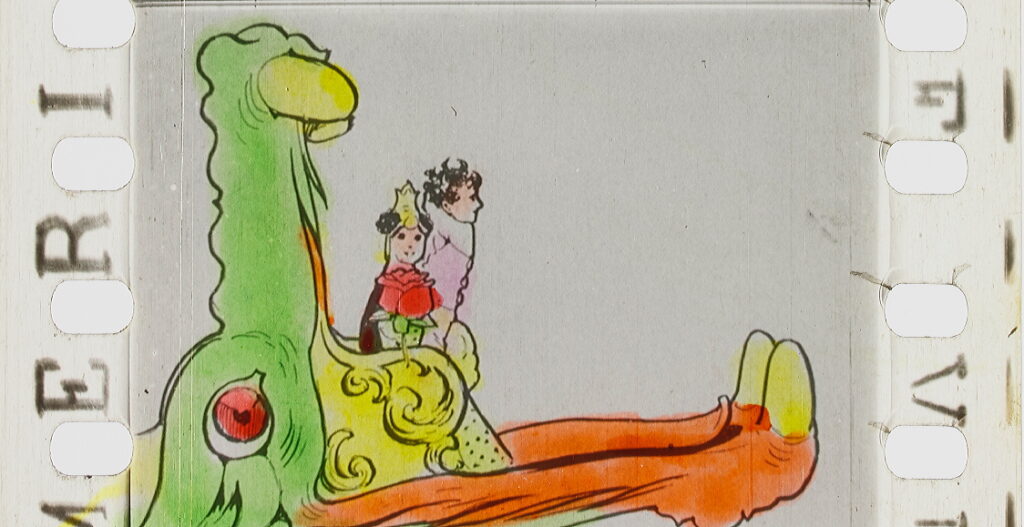
Even as the internet rots our collective brain with politically irresponsible conspiracy theories and confusion about whether or not hot dogs are sandwiches (they are), it also plays host to some pretty remarkable resources, such as Barbara Flueckiger’s database, Timeline Of Historical Film Colors. This site is a great place to dive in and learn about color in film – both still images and moving pictures. The science is interesting, and the exemplary images of different color processes are gorgeous to behold.
Here are a few examples. The first is a hand-colored frame from Winsor McKay’s 1911 film version of his Little Nemo In Slumberland strip. Each frame was painted by hand.
Here’s a frame from La peine du talion (FRA 1906, Gaston Velle; Albert Capellani)
The frame is colored but it is done by a stencil, giving it sharper lines.
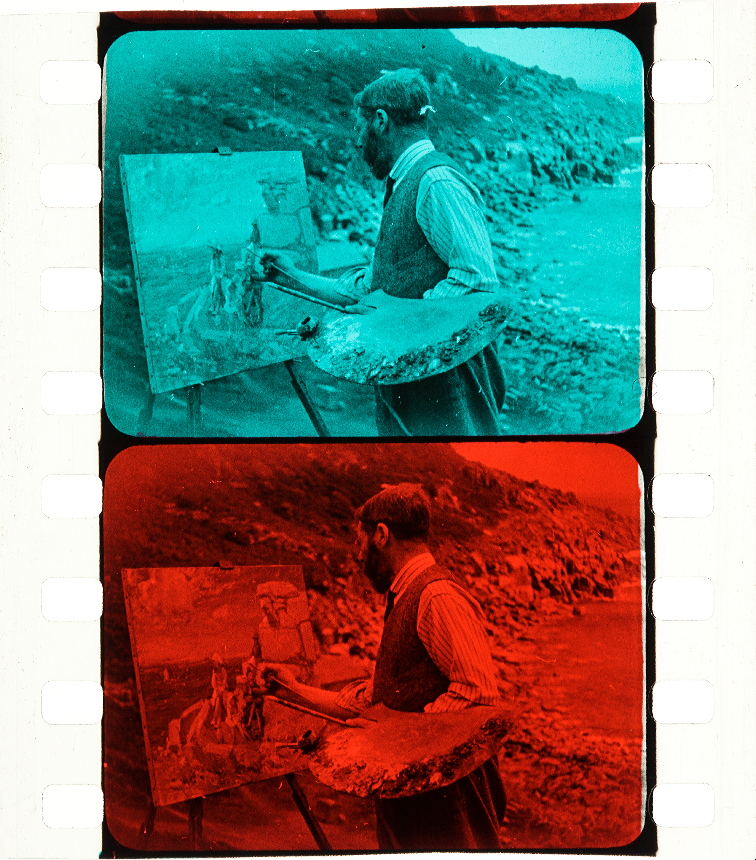
Here, two subsequent frames are stained with different colored dye, put it together and you sort of get an impression of vivid color:
The Open Road (GBR 1925, Claude Friese-Greene)
The two color Kodachrome process used a process of tanning and treating the film stock before applying dyes.
The Flute of Krishna (USA 1926, Eastman Kodak)
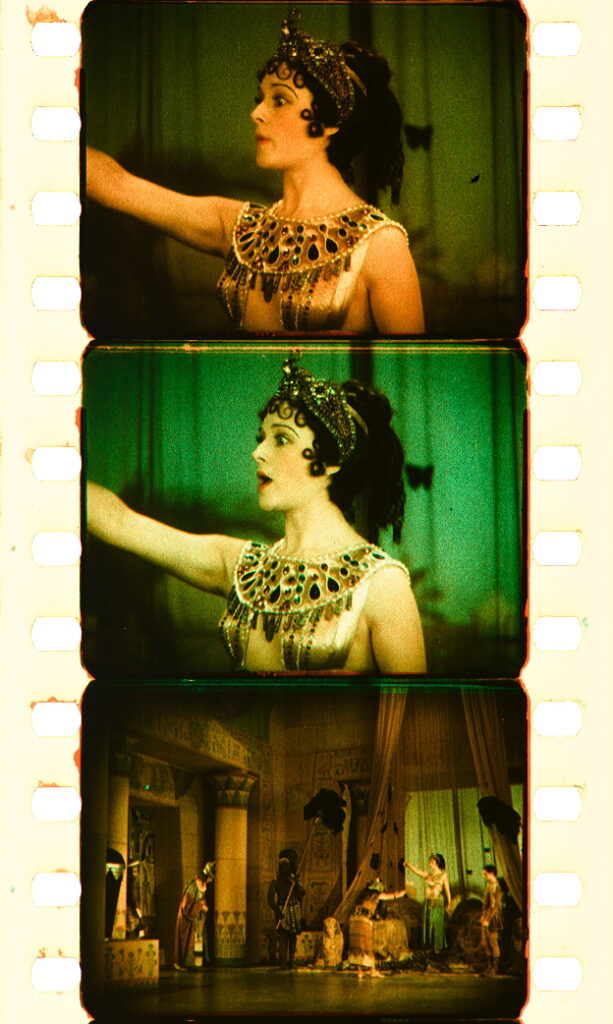
Next, we encounter subtractive two-strip Technicolor. in which dye imbibition is used to transfer red and green data to a black and white positive frame.
Cleopatra (USA 1928, Roy William Neill)
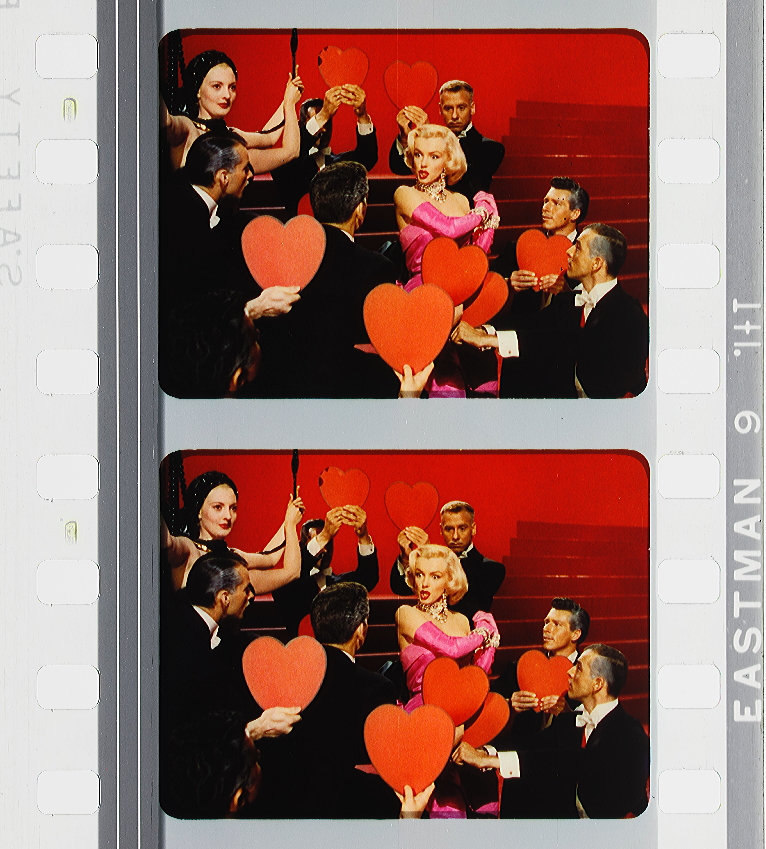
Three-strip Technicolor was the next advancement, and this one became the industry standard for decades. The artificiality here seems paradoxically “more real than real.”
Gentlemen Prefer Blondes (USA 1953, Howard Hawks)
A large number of other processes are detailed on the site, some experimental and abortive, others that sought to widen the market and make vivid color more affordable, like Agfacolor, which incorporated color-forming solutions in the film emulsion itself.
Maske in Blau (GER 1953, Georg Jacoby)
It’s a truly fascinating walk through film history. There’s a lot of technical info, but thankfully also quite a bit of explanation of the terms used. It’s a fun way to spend that stray 30 or 40 hours you might find yourself with during quarantine.
“Orgies?! Anyone will tell you they’re the LONELIEST PLACE IN THE WORLD!” – Susan Tyrrell in conversation with Skip E. Lowe
During the last five of so years of her life, the great actress Susan Tyrrell (1945-2012) called Austin her home. “Su-su” as she was known to her many friends, was an accomplished screen performer, an Academy Award nominee, and a tireless seeker of great parts. In the introductory portion of the video that follows, video-collector Badly Licked Bear compares her to Rip Torn, and the comparison is appropriate: incandescent talents, hopelessly weird, with an unquenchable appetite for variety in their chosen roles.
If you haven’t already seen FORBIDDEN ZONE (1980) starring Tyrrell as the Queen of the Sixth Dimension, you should do so right away. She is also remarkable in ANDY WARHOL’S BAD (1977), John Waters’ CRY BABY (1990) and John Huston’s FAT CITY (1972) for which she was nominated for an Oscar.
Possibly even more berserk than any of her films is this 1993 interview with Hollywood Public Access host Skip E. Lowe, on whom Martin Short reportedly based his Jiminy Glick character. This is Tyrrell at her best, on fire with candid self-assessments, indiscreet to the max, and every inch a movie star. Who else could say, “I have a very private, gorgeous life,” or “I’m not going to hide the fact that I’m bitter. I just want to make some bucks off of it.” She was a special person, and there will never be another one like her.
So soak it up, and enjoy this video. And while you are at it, check out the other programs that Bret Berg and his network of collectors are unearthing over at the invaluable Museum Of Home Video. But first, Susan Tyrrell.
As a further artifact of Tyrrell’s amazing life, here is a somewhat blurry photo of the Academy Award nomination plaque she received for FAT CITY. It was found roughly jammed into the back of a kitchen cupboard in a Venice, California apartment by a friend of author/producer Zack Carlson. The plaque was gifted to Tyrrell’s family after her death. The magic marker addendum is 100% Su-su, and a precious reminder of her indomitable spirit.
Back in 1934, when Hollywood’s self-censoring Production Code began to be enforced zealously, no one would have dreamed that nearly a century later the phrase “pre-code” would be a rallying cry that would drive audiences to repertory theaters en masse, or occasion reveries of nostalgia about hard drinking and adultery among otherwise mild mannered TCM aficionados. But here we are. The raunchiest pre-code movies are more well loved today than any number of formerly esteemed ‘prestige pictures’ with starchier collars.
It’s not hard to see why. The more daring pre-code film scenarios were more apt to depict class mobility and less restrictive gender roles. Mae West could really let loose with her own dialogue. Barbara Stanwyck and Joan Blondell could embody a brassier brand of woman. Allusions to drug use, sexual freedom and other taboo subjects were not only allowed but – presumably – encouraged by producers of more urban fare.
At AFS we have shown our share of Pre-Code films. Here, drawn from the last few years of AFS programming, and with a few other titles added in, is what we are calling the “Precode ’34’ in memory of that dark year when the curtains were drawn closed on these wondrous years.
If you click on the “Read notes” button you can see what series these screened in, and, if they happen to be streaming on an online service, where. We hope you enjoy the films.
Recently, film Twitter has been on fire with a supercut of interviews by Lincoln, Nebraska TV personality Leta Powell Drake. There are some big laughs in the edit, which of course compiles the most awkward moments from a number of interviews.
It’s true that Drake has a unique style, and a big personality, but she’s also good at her job, inasmuch as her job is to get something new and different from her guests, who tend to repeat the same answers during these local interview junkets. Drake makes the interviews must-see TV. Fortunately for all of us, there are hours and hours of her interviews on YouTube. We haven’t watched all of them, but here are some of our favorites.
Tim Curry is clearly having a hard time keeping a straight face as Drake interviews him in Rocky Horror regalia. He’s very funny here, and plays along winningly:
The not-terribly-shy Telly Savalas brings that 5 minutes before closing time at the singles bar energy to this interview:
Another actor well-known for playing a TV detective, Peter Falk. She asks him about his missing eye – great stories here – and playfully berates him for doodling during the interview:
Another huge personality is actress Carrie Nye – who also happened to be the wife of native Nebraskan Dick Cavett. Here she talks about Richard Burton’s drinking, the challenge of doing a daily soap opera, and her Mississippi accent:
2020 is the Centennial of the Italian Director Federico Fellini’s birth. For many years his name was synonymous with the outré in film, before his acolyte and great admirer David Lynch assumed that mantle in the public discourse. Fellini’s visual style, which brought together great beauty and grotesquerie in the same gorgeously composed frame, greatly influenced the whole culture during the ’60s – an era which still resounds with a particularly loud echo today.
It is perhaps not so surprising that Fellini would be drawn to that other great visual influence of the ’60s, LSD. In the following 1966 interview he talks, in his imperfect but evocative English, about his sole experience with the drug, how he feels that artists are already frequent travelers between the conscious and unconscious mind, and about his experience of color, which you can perhaps see as influential on his first color films JULIET OF THE SPIRITS (1965) and his SPIRITS OF THE DEAD segment TOBY DAMMIT (1968).
“I remember I had some exaltation about color. I see colors not like they are normally – we see colors in the object. In this case, I saw colors, just as they are, detached from the object. I had for the first time the feeling of the presence of the color in a detached way.
“Taking this drug, LSD-25, reality becomes objective… so reality is innocence, is pure, and is of divine beauty. In the same moment that the reality becomes to you this divine beauty, there is also the other side, reality is just of divine beauty because we don’t give any meaning to it, as is innocence. But in the same moment, to not give meaning to reality means that you don’t understand reality any longer. Reality becomes scenes without any meaning. So you can become a saint or you can become a crazy man.”
Normally by this time of the year we at AFS would have presented at least one installment of the Noir Canon series at the AFS Cinema. The Canon at this point includes twenty one titles, most of the heavy hitters in the field of post-WWII American crime and detective films: DOUBLE INDEMNITY, THE BIG SLEEP and company, naturally, as well as the low budget indie DETOUR, and the extraordinary British entry NIGHT AND THE CITY. Here are the films we have shown so far as part of the Noir Canon series. You can also find the whole list here on Letterboxd, as well as our list of lesser-known noir greats.
THIS GUN FOR HIRE (1942)
The first teaming of Alan Ladd and Veronica Lake made Ladd a star and whet the public’s appetite for more of the pair.
DOUBLE INDEMNITY (1944)
A perfect film. Billy Wilder directs Barbara Stanwyck, whose terrible blonde wig and anklet reflect her tawdriness alongside Fred MacMurray and Edward G. Robinson.
LAURA (1944)
In Otto Preminger’s society noir, Dana Andrews plays a police detective who, in the course of unraveling the truth about a shocking murder, falls in love with the victim.
DETOUR (1945)
Edgar G. Ulmer’s microbudget ‘B’ noir follows a man who falls into a swirling maelstrom of ill fate after being picked up hitchhiking.
SCARLET STREET (1945)
Fritz Lang’s version of the story that Jean Renoir had previously filmed as LA CHIENNE – literally “the bitch” features Edgar G. Robinson as an amateur painter and cashier who falls for a classic Femme Fatale (Joan Bennett.)
THE BLUE DAHLIA (1946)
In the years that followed THIS GUN FOR HIRE, Alan Ladd became a major star. This film, which has a somewhat bizarre original screenplay by Raymond Chandler, was made quickly before Ladd was scheduled to report for induction in the armed forces. It reunites Ladd and Lake just as her star was falling. It’s weird, but quite enjoyable.
THE BIG SLEEP (1946)
Howard Hawks’ tremendously entertaining adaptation of the Raymond Chandler novel, adapted by Leigh Brackett and William Faulkner, reteams Bogart and Bacall after their breakthrough pairing in Hawks’ TO HAVE AND HAVE NOT.
THE KILLERS (1946)
Robert Siodmak directs this noir tragedy that takes off from Ernest Hemingway’s short story of the same name. Burt Lancaster, in what is technically his film debut, is remarkable as the former boxer, hunted by killers, whose story is told in flashback. With Ava Gardner at her most elegant, and William Conrad, who delivers the immortal line “They all come here and eat the big dinner.”
NIGHTMARE ALLEY (1947)
The ultimate carnival noir, with Tyrone Power as a midway mentalist who gets in too deep. Stunningly odd and probably Power’s best performance. Guillermo del Toro is currently working on a remake.
OUT OF THE PAST (1947)
Jacques Tourneur’s classic is perhaps the noiriest of all noirs, with Robert Mitchum, never better, as a man who tries to carve out a new life but is hounded by his past.
THE LADY FROM SHANGHAI (1947)
Considered as an entertainment film, Orson Welles’ deliberate cash grab movie is incomprehensible. Taken as an opportunity to sneak an art film past Columbia Pictures, it makes more sense. Starring Welles – with a ludicrous Irish accent, and Rita Hayworth, with dyed platinum blonde hair. The finale in a hall of mirrors is justly renowned.
RAW DEAL (1948)
Anthony Mann’s very cheap ‘B’ noir is an exercise in style and tension that transcends its limitations thanks to the cinematography of the Hungarian camera genius John Alton, who has come to be known as the “painter of light” and whose work is characterized by unusual angles and chiaroscuro lighting. Top flight cast too, with Dennis O’Keefe, Claire Trevor, Marsha Hunt and Raymond Burr.
IN A LONELY PLACE (1950)
Nicholas Ray, who always directed with enormous – sometimes difficult to bear – sensitivity, brings out a different side of Humphrey Bogart, who plays a burned out screenwriter who might be a murder. With Gloria Grahame as the young actress who tries to put the pieces together.
THE ASPHALT JUNGLE (1950)
John Huston’s heist drama follows a group of criminals with very different motivations as they plan and execute a jewel robbery. With a solid cast led by Sterling Hayden and Marilyn Monroe in a small but memorable role.
NIGHT AND THE CITY (1950)
Richard Widmark stars as a small time hustling con man who bites off way more than he can chew when he enters the world of wrestling promotion in the unsavory London underworld. Director Jules Dassin ratchets up the intensity with virtuosity as Widmark’s fate darkens.
SUNSET BOULEVARD (1950)
Gloria Swanson is unforgettable as the faded Hollywood star Norma Desmond, who lives in a crumbling mansion – and equally crumbling reality – in Billy Wilder’s shockingly dark black comedy.
ANGEL FACE (1953)
Otto Preminger directs Jean Simmons as a manipulative young rich woman, who falls for ambulance driver Robert Mitchum and triggers a dark cycle of jealousy and death. Shockingly dark and acidic.
THE BIG HEAT (1953)
Fritz Lang’s masterful direction makes this story of a tough cop whose investigation of a powerful mob becomes a life-or-death obsession. With Glenn Ford as the detective, Gloria Grahame as a gang moll and Lee Marvin as a brutal enforcer.
KISS ME DEADLY (1955)
Hands down the weirdest film on this list. Robert Aldrich pushes the toughness quotient to the absolute level in his adaptation of Mickey Spillane’s novel. Not really very much like other movies. Hugely influential – you will see the film’s MacGuffin alluded to in a number of other films.
THE KILLING (1956)
Another ensemble heist movie starring Sterling Hayden, a la THE ASPHALT JUNGLE, but the then-unknown young director Stanley Kubrick has a few new tricks under his sleeve.
TOUCH OF EVIL (1958)
After years in European exile, Orson Welles was persuaded to come back to Hollywood and direct again thanks to the intercession of star Charlton Heston. This border-town story of police corruption and murder is sublime with great performances from Welles, Heston, Janet Leigh, Joseph Calleia and, in a magnificent cameo, Marlene Dietrich.
Additionally, because we’re a little restless this week, we have compiled a list of lower profile noir films that we like quite a lot. That list, Kiss Me Obscurely: Little Known Noir Classics, is here. There are a number of British ‘B’ films, generally coproductions with American studios, featuring an American lead and made within a highly constrained budget. You’ll also find some real oddball films on the list, like SHACK OUT ON 101, with Lee Marvin as a short order cook who thwarts communists. It’s a fun list and we hope you enjoy these films, a number of which are available on streaming services.
We often hear epic films characterized as “operatic.” Sometimes it’s a lazy adjective, but for Luchino Visconti (born on November 2nd, 1906) it is a correct comparison. In fact his productions of Grand Opera outnumber his feature films. By all contemporaneous accounts he grasped the dramatic and spectacular possibilities of opera as well as anyone of his era. This appreciation of dramatic gestures both massive and subtle also informed his screen work, which includes ROCCO AND HIS BROTHERS, SENSO, THE LEOPARD and THE DAMNED. Dramatic contradictions came easily to Visconti, a man born into nobility (his full title was Count Luchino Visconti di Madrone of Lonate Pozzolo) who later joined the Communist Party.
For some more insight on the fascinating biography of Visconti, former AFS Programming Director Chale Nafus sums it up pretty well here.
It was on the set of THE DAMNED that the following documentary was made. We hear from his stars Charlotte Rampling and Ingrid Thulin about his working methods as well as from the director himself who, unsurprisingly, is a perfectionist. His methods and philosophy might be described as old school in many ways. But this old school is a particularly good school and so his thoughts on the matter are well worth hearing and learning from.
It’s Halloween month, and for many of us that means our home viewing diet takes a deep dive into the world of horror cinema. At this point maybe you have seen all of the biggies and are exploring the fringes a bit. As it happens we have also done a bit of nocturnal fringe-exploration, so for those who might like a little advance scouting report in the field of vampire movies we have compiled a Letterboxd list called “Medium Rare Stakes: Lesser Known Vampire Classics”
If you are not a deep Universal Horror nut, you may not have realized that at the same time Tod Browning’s epochal Lugosi DRACULA (1931) was filming, a Spanish language version of the film was also being made. During that era, there was no post-synch dubbing, so an entirely different cast filmed the dialogue scenes on the same sets at night. It’s called DRÁCULA (1931) and a lot of people think it is better than the admittedly-pokey English-language version. Judge for yourself.
DRÁCULA (1931)
Another non-English language oddity is DRACULA IN ISTANBUL (1953), which hits all the usual beats, but has a distinct and unusual Turkish feel. 1967’s THE LIVING CORPSE is a Pakistani take on the novel with sex and musical numbers(!) added in. Such far-flung locales as the Philippines (1972’s wiggy, color-tinted THE BLOOD DRINKERS) and Argentina (Emilio Vieyra’s mod-ish 1967 BLOOD OF THE VIRGINS) also make the list.
THE BLOOD DRINKERS (1964)
Back in the States, the Universal Dracula films hit American TV screens in the ’50s and there was an increased demand for vampire movies to slake the thirst of teenage viewers. BLOOD OF DRACULA (1957) is about a female teenage misfit who is in fact a vampire – there’s a lot of interesting stuff here about parental neglect and the place of education in society. CURSE OF THE UNDEAD is a vampire western with a surprisingly goth tone and a very good performance by Michael Pate as the mysterious black-clad stranger.
BLOOD OF DRACULA (1957)
Europe got into the horror game in a big way after the Hammer Dracula films began making a lot of money at the box office in the late ’50s. Roger Vadim’s BLOOD & ROSES (1960) is a fake art film in the best Vadim tradition, and it kicked off the long cycle of lesbian vampire movies, many of them based on J. Sheridan LeFanu’s story “Carmilla.” The Italian SLAUGHTER OF THE VAMPIRES (1962) is cheap but atmospheric, filmed in high contrast black and white on astonishing old-country locations and featuring the kind of dubbing that sounds like a flat, undifferentiated internal monologue, if you’re into that sort of thing. Another Italian horror film, 1972’s THE NIGHT OF THE DEVILS is made with much more polish, and is one of the few genuinely frightening Italian gothics outside the oeuvre of Mario Bava.
BLOOD AND ROSES (1960)
Some interesting Euro-cult auteurs made vampire films as well. Jess Franco’s VAMPYROS LESBOS (1971) is too well known at this point to consider it a rarity, but his DAUGHTER OF DRACULA (1972) is little discussed but very interesting, if you have the Jess Franco gene. Others will surely tune out – or doze off. The Polish filmmaker Walerian Borowczyck often operates on the fringes between the art film and the horror movie. His IMMORAL TALES (1973) features, in an omnibus of erotic horror tales, what may be the best representation yet of the Countess Elizabeth Bathory story. She is the Hungarian noblewoman who allegedly bathed in the blood of virgin serfs to attain eternal beauty.
IMMORAL TALES (1973)
The low-budget American indie LEMORA: A CHILD’S TALE OF THE SUPERNATURAL (1973) deserves a special mention here as it is truly sui generis, a small-town Depression-era period piece about the teenage daughter of a gangster who becomes the target of a female vampire. It is really unusual and strangely effective. Highly recommended.
LEMORA: A CHILD’S TALE OF THE SUPERNATURAL (1973)
If you like to laugh along with your vampires, there are some funny ones on the list. A RETURN TO SALEM’S LOT (1987) is, in the best huckster tradition, not a sequel to Tobe Hooper’s 1979 TV movie SALEM’S LOT at all. But it is a Larry Cohen movie, so it has its share of laughs among the scares. Sam Fuller steals the show with a manic performance as a Nazi hunter turned Van Helsing. It’s really something. NOCTURNA (1979) is funny in spite of itself. It’s a mess if we’re being honest about it, but the sub-sub-genre of Disco Vampires is so shamefully underpopulated that we are forced to include it here. John Landis’ INNOCENT BLOOD (1992) is also very amusing, with a parade of top-flight character actors chiming in and giving their all.
A RETURN TO SALEM’S LOT (1987)
There are more on the list, and you probably have obscure favorites of your own. Keep exploring and let us know what some other favorites are in the Letterboxd comments.
Public Access Cable Television began in the early ’70s at the time that commercial cable television outlets began expanding their operations through the country. This system of allocating a certain number of channels for local programming was mandated by the FCC thanks to the advocacy of pioneers in the field of community media. The cable companies in their headlong rush for expansion agreed to not only dedicate channel space to the project but also to fund the creation and maintenance of production facilities.
This ushered in the golden age of Public Access Television with its mixture of City Council hearings, church services, shaky-cam gardening shows and, inevitably, late night anything-goes free-for-alls. Austin, naturally, had an active talent pool to draw from, and its CATV (Community Access Television) programs reflected the community well. Viewers had access to the usual municipal hearings and sermons, as well as the expected hours of guitarists cranking up sub-Eddie Van Halen eruptions of arpeggios and chaotic call-in shows offering psychic advice for the lovelorn or UFO abductees, or both.
In the midst of all of this, some community members were getting their hands on cameras or professional editing bays for the first time, beginning what for some would be an important part of their lives and careers. Here we should note that AFS administers Austin Public, which carries this long tradition of community media into the age of YouTube and podcasts. Austin Public offers classes, equipment access, and studios for live television, film, and podcast creation. There are still cable channels as well, one of them is the longest running CATV channel in the country in fact, which reach tens of thousands of Austinites.
One of Austin Public’s busiest producers is John Spottswood Moore. He has produced a six-part series called Our Town on TV about the history of Austin CATV. Here, in his words is a bit about the project:
“In this six-part series we have curated some of the weirdest and most touching moments from five decades of average Austinites making not so average TV. In “Famous Folks”, we see the likes of Allen Ginsberg, James Brown, and many other cultural legends who visited town. In “The City That Rocks”, we find out why Austin is a hub for live music. In “On The Street” we see the City’s many cultural shifts through 50 years of everyday people stopping to talk to the camera. So tune in, sit back, and enjoy five decades of guerilla television!”
We miss our Family Style screenings at the AFS Cinema with guest programmer/host Stacy Brick, so we asked her to share some of her best scary-but-not-too-scary movie recommendations so that we can stream them together. Here is Stacy:
Looking for some spooky or just plain fun Halloween movies to watch as a family? We’ve got you covered with some less obvious choices sure to produce laughs and maybe even start some interesting conversations.
ABBOTT AND COSTELLO MEET FRANKENSTEIN
It’s not only Frankenstein’s monster – Dracula, and the Wolf Man are invited to the party, too! By 1948 the character-driven horror films at Universal had petered out – along with the careers of Abbott and Costello. The genius idea to combine the comedy duo (playing for laughs) and the monsters (playing it straight) was a hit. Although it was a swan song for the monsters it was the first in a series of four comedic horror films for Abbott & Costello. You’ll laugh at the monsters and Abbott & Costello’s antics – no nightmares here!
Streaming on: Amazon, YouTube
5,000 FINGERS OF DR. T
This cult classic is the only film written and designed by Theodor S. Geisel – better known as Dr. Seuss. The film is a Technicolor avant-garde musical about an evil piano teacher who holds 500 boys captive and forces them to play a giant piano for eternity. Seuss said he wrote it as revenge on his piano teacher who would rap his knuckles with a pencil when he made a mistake. The film was a flop when it came out in 1953, presumably because it was too dark for most children of that time, making it hard to classify.
Streaming on: Criterion Channel
RETURN TO OZ
Fairuza Balk is Dorothy in this dark sequel to THE WIZARD OF OZ. This time around, Dorothy has some new friends from other L. Frank Baum stories, including Billina the chicken, Tik Tok the robot, and Jack Pumpkinhead. She must once again muster her courage to overcome evil in the Land of Oz and save her friends who have been turned to stone. In her review, Janet Maslin of The New York Times remarked, “Children are sure to be startled by its bleakness.” As a kid, I remember being terrified by the Wheelers, but as is the case with most 80’s movies, my kids (ages 10 and 12), weren’t disturbed in the least. Instead they thought it was “weird in a cool way.”
Streaming on: Disney+, Amazon
TEEN WOLF
This teen comedy with a twist opened in the summer of 1985, earning about 10 times less than that other, more well-known Michael J. Fox blockbuster released the same year. In the film, high-schooler Scott Howard (Fox) learns that he shares an interesting gene with his father. He goes to some keggers (relatively mild), plays some basketball, and is forced to decide if he should be his true self or play up his flashy alter ego to get with the in-crowd.
Streaming on: Amazon, YouTube
INVASION OF THE BODY SNATCHERS
This paranoid sci-fi film has been remade numerous times, but make sure you watch the original 1956 version. Dr. Miles Bennell is set on saving surrounding towns from the fate his small town has suffered. The pod people are taking over, using seed pods to replicate people and stealing their souls. The fast pace of the film is unique for the time and makes it that much better to enjoy with your kids. Keep this one to 10 and over.
We thought it might be fun, in the lead-up to Halloween, to take an approach to Italian giallo thrillers inspired by the late American film critic Andrew Sarris, whose highly influential 1968 book “The American Cinema: Directors and Directions 1929-1968” sorted American directors into ten different categories. Since we are working in a more limited field, we will limit the categories here. We hope that, like Sarris’ book, this will be a vector for discoveries and disputes galore.
Before we start, just what is a giallo film? In recent years, it has come to refer to practically any Italian horror film – many reviewers, for instance, have referred to Dario Argento’s 1977 supernatural horror film SUSPIRIA as a giallo for instance. It is not. Giallo (pronounced jee-AH-loh) movies are essentially murder mysteries, inspired by the sort of pulp novels that were sold cheaply throughout Europe in bright yellow paperback editions – giallo is Italian for yellow, you see.
Giallo films tend to be procedurals in which an innocent person – not a cop or detective – tracks the murderer through a labyrinth of clues and suspects. The killings are set-pieces, with ample POV shots, inserts of black-gloved hands holding gleaming straight-razors and the like. Sometimes there are bizarre, almost surrealistic, elements as well. These are typically pretty mechanical plots, and the formula – even when deviated from – is well understood by maker and viewer.
Here, with apologies to Andrew Sarris, are our categories of some of the most celebrated and/or interesting Giallo filmmakers. The placement of these directors into categories only takes into account their work in the genre. Many have done exceptional work in other areas that is not accounted for here.
As a corollary to this list, and to make it easier to add films to your personal watchlist, we have created a Letterboxd list of the titles mentioned here. You can find it here.
Pantheon Directors:
“These are the directors who have transcended their technical problems with a personal vision of the world. To speak any of their names is to evoke a self-contained world with its own laws and landscapes. They were also fortunate enough to find the proper conditions and collaborators for the full expression of their talent.” (Sarris)
Mario Bava:
THE EVIL EYE (aka THE GIRL WHO KNEW TOO MUCH), BLOOD & BLACK LACE, FIVE DOLLS FOR AN AUGUST MOON, HATCHET FOR THE HONEYMOON, TWITCH OF THE DEATH NERVE (aka BAY OF BLOOD)
Dario Argento:
THE BIRD WITH THE CRYSTAL PLUMAGE, THE CAT O’NINE TAILS, FOUR FLIES ON GREY VELVET, DEEP RED, TENEBRE, OPERA
The Far Side Of Paradise:
“These are the directors who fall short of the Pantheon either because of a fragmentation of their personal vision or because of disruptive career problems.” (Sarris)
Lucio Fulci:
ONE ON TOP OF THE OTHER, A LIZARD IN A WOMAN’S SKIN (aka SCHIZOID), DON’T TORTURE A DUCKLING, THE NEW YORK RIPPER, MURDER ROCK
Umberto Lenzi:
ORGASMO (aka PARANOIA), SO SWEET… SO PERVERSE, A QUIET PLACE TO KILL (also aka PARANOIA), OASIS OF FEAR (aka DIRTY PICTURES), SEVEN BLOOD STAINED ORCHIDS, KNIFE OF ICE, SPASMO, EYEBALL
https://www.youtube.com/watch?v=uY3AIPR-Mhs
Sergio Martino:
THE STRANGE VICE OF MRS. WARDH, THE CASE OF THE SCORPION’S TALE, YOUR VICE IS A LOCKED ROOM AND ONLY I HAVE THE KEY, ALL THE COLORS OF THE DARK (aka THEY’RE COMING TO GET YOU), TORSO
https://www.youtube.com/watch?v=W54YxxBU5wQ
Luciano Ercoli:
FORBIDDEN PHOTOS OF A LADY ABOVE SUSPICION, DEATH WALKS ON HIGH HEELS, DEATH WALKS AT MIDNIGHT
Massimo Dallamano:
WHAT HAVE YOU DONE TO SOLANGE?, WHAT HAVE THEY DONE TO YOUR DAUGHTERS?
Aldo Lado:
SHORT NIGHT OF GLASS DOLLS, WHO SAW HER DIE?
https://www.youtube.com/watch?v=DlMidH4tmvA
Expressive Esoterica:
“These are the unsung directors with difficult styles or unfashionable genres or both. Their deeper virtues are often obscured by irritating idiosyncrasies on the surface, but they are generally redeemed by their seriousness and grace.” (Sarris)
Emilio Miraglia:
THE NIGHT EVELYN CAME OUT OF THE GRAVE, THE RED QUEEN KILLS SEVEN TIMES
Silvio Amadio:
SMILE BEFORE DEATH, AMUCK!
https://www.youtube.com/watch?v=6TIKlWO0kaU
Lightly Likable:
“These are talented but uneven directors with the saving grace of unpretentiousness.” (Sarris)
Antonio Bido:
BLOODSTAINED SHADOW, WATCH ME WHEN I KILL
Alberto De Martino:
THE MAN WITH ICY EYES, THE KILLER IS ON THE PHONE
Romolo Guerreri:
THE SWEET BODY OF DEBORAH
https://www.youtube.com/watch?v=8UPEs3ASj44
Lamberto Bava:
A BLADE IN THE DARK, DELIRIUM
Just Passing Through:
This is a category of our own making. These are filmmakers who worked in a variety of genres and perhaps made an interesting giallo or two.
Enzo G. Castellari:
COLD EYES OF FEAR
Luigo Bazzoni:
THE FIFTH CORD
Pupi Avati:
THE HOUSE WITH LAUGHING WINDOWS
https://www.youtube.com/watch?v=V7kIXSz4bKk
Francesco Barilli:
PERFUME OF THE LADY IN BLACK
Duccio Tessari:
THE BLOODSTAINED BUTTERFLY, PUZZLE
Flavio Mogherini:
THE PYJAMA GIRL CASE
Elio Petri:
A QUIET PLACE IN THE COUNTRY
Fernando Di Leo:
SLAUGHTER HOTEL
Riccardo Freda:
THE IGUANA WITH THE TONGUE OF FIRE
Luigi Cozzi:
THE KILLER MUST KILL AGAIN (aka THE DARK IS DEATH’S FRIEND)