The great, now sadly departed and much missed, comic actor Gene Wilder referred to one of his comedy techniques as “trying to keep the lid on.” You can see him now, in your mind’s eye, absorbing all the world’s mania, and trying, in a mighty fit of exertion, to hold it all in. Very few things are as funny as watching Gene Wilder almost lose his cool. He was the master of this technique, and of many other things that we didn’t know we needed until he showed us.
Life is, of course, often trying and difficult, but when we watch Wilder pantomime the difficulties of dealing with other people (and ourselves), he helps us keep the lid on.
Take some time soon to enjoy Wilder the artist by watching YOUNG FRANKENSTEIN or WILLIE WONKA or BLAZING SADDLES or HAUNTED HONEYMOON soon, maybe with a younger person. But right now, put on your headphones and enjoy many delightful moments of Gene Wilder below.
A 2001 Bravo profile:
Wilder explains how his mother’s heart attack made him funny:
Here he elaborates on his mother, and covers psychoanalysis and Mel Brooks in this animated “Blank On Blank” short.
And finally here is a heartfelt 2 hour interview with Terry Gross on Fresh Air. Click here to listen.
Here’s AFS Head of Film & Creative Media Holly Herrick on the THREE COLORS.
“Krzysztof Kieslowski’s THREE COLORS are some of the most visually arresting films of contemporary cinema, and are packed with numerous camera set ups to achieve his signature precision in the cinematography. Yet the filmmaker never used a storyboard or indicated camera direction in his screenplays (which, in the latter years, were collaborations with the other brilliant Krzysztof, Piesiewicz). According to the filmmaker, the camera was placed where it forcibly had to be to capture the meaning of the scene. In Kieslowski’s mind, there was only one right camera approach for any given moment.
“We get a window into these choices, and into what connects the films in the THREE COLORS cycle, in the following videos. Criterion special features are often a master class in filmmaking, and such is the case with the Kieslowski interviews that they published on their beautiful 2011 release of THREE COLORS, portions of which are published below in the link from The Film Stage. In them, Kieslowski discusses manufacturing a sense of déja vu in RED, what close-ups mean in BLUE, and some of the hidden themes that tie the three films together as a single cycle.”
Barbara McLean, editor of ALL ABOUT EVE, VIVA ZAPATA! & dozens of other films
There’s a nice, though too-short, piece by Mark Cousins in the BFI’s Sight & Sound magazine this month about the important, but sometimes under-appreciated role that female editors have played in film history. The list of credits is dizzying, from THE WIZARD OF OZ to MAD MAX: FURY ROAD. The article serves as a reminder that women have edited some of the films we love the most. Also, oftentimes in classic Hollywood, the credited editor was just the department head – almost always male, and the others who did the work were… you guessed it.
There’s an allusion in the article to one of editor Dede Allen’s quotes about “intended and unintended possibilities.” I think it deserves to be reprinted in full here.
“When I start cutting a movie, I always cut with mixed feelings. I have a definite intention, a definite starting point: the dramatic function of the scene;. the psychology of the characters, etc. But when I become absorbed in the material, I suddenly see all the possibilities the material contains. The unexpected. Intended and unintended possibilities. I can’t help wandering into the material. I milk the material for all the small possibilities I see in it. A look, a smile – after the director has said “cut!”. Afterwards I form a general view again. But it is in the collision between the general strategy and the pleasant distractions along the way that constitutes editing as art; the true life of the film.”
Here are the 100 greatest films of the 21st century according to 177 respondents to the BBC’s poll of movie critics, reviewers, etc. The methodology, etc. is here.
We’re thrilled here at AFS that our Artistic Director Richard Linklater is represented twice on the list, and that we have shown so many of the films on this list – or are scheduled to. There will certainly be disputes and heated conversations, and that’s what such lists are for, but perhaps, to paraphrase Andrew Sarris, we are too close to our own times to adequately judge our own creative products.
Have fun:
100. Toni Erdmann (Maren Ade, 2016)
100. Requiem for a Dream (Darren Aronofsky, 2000)
100. Carlos (Olivier Assayas, 2010)
99. The Gleaners and I (Agnès Varda, 2000)
98. Ten (Abbas Kiarostami, 2002)
97. White Material (Claire Denis, 2009)
96. Finding Nemo (Andrew Stanton, 2003)
95. Moonrise Kingdom (Wes Anderson, 2012)
94. Let the Right One In (Tomas Alfredson, 2008)
93. Ratatouille (Brad Bird, 2007)
92. The Assassination of Jesse James by the Coward Robert Ford (Andrew Dominik, 2007)
91. The Secret in Their Eyes (Juan José Campanella, 2009)
90. The Pianist (Roman Polanski, 2002)
89. The Headless Woman (Lucrecia Martel, 2008)
88. Spotlight (Tom McCarthy, 2015)
87. Amélie (Jean-Pierre Jeunet, 2001)
86. Far From Heaven (Todd Haynes, 2002)
85. A Prophet (Jacques Audiard, 2009)
84. Her (Spike Jonze, 2013)
83. A.I. Artificial Intelligence (Steven Spielberg, 2001)
82. A Serious Man (Joel and Ethan Coen, 2009)
81. Shame (Steve McQueen, 2011)
80. The Return (Andrey Zvyagintsev, 2003)
79. Almost Famous (Cameron Crowe, 2000)
78. The Wolf of Wall Street (Martin Scorsese, 2013)
77. The Diving Bell and the Butterfly (Julian Schnabel, 2007)
76. Dogville (Lars von Trier, 2003)
75. Inherent Vice (Paul Thomas Anderson, 2014)
74. Spring Breakers (Harmony Korine, 2012)
73. Before Sunset (Richard Linklater, 2004)
72. Only Lovers Left Alive (Jim Jarmusch, 2013)
71. Tabu (Miguel Gomes, 2012)
70. Stories We Tell (Sarah Polley, 2012)
69. Carol (Todd Haynes, 2015)
68. The Royal Tenenbaums (Wes Anderson, 2001)
67. The Hurt Locker (Kathryn Bigelow, 2008)
66. Spring, Summer, Fall, Winter…and Spring (Kim Ki-duk, 2003)
65. Fish Tank (Andrea Arnold, 2009)
64. The Great Beauty (Paolo Sorrentino, 2013)
63. The Turin Horse (Béla Tarr and Ágnes Hranitzky, 2011)
62. Inglourious Basterds (Quentin Tarantino, 2009)
61. Under the Skin (Jonathan Glazer, 2013)
60. Syndromes and a Century (Apichatpong Weerasethakul, 2006)
59. A History of Violence (David Cronenberg, 2005)
58. Moolaadé (Ousmane Sembène, 2004)
57. Zero Dark Thirty (Kathryn Bigelow, 2012)
56. Werckmeister Harmonies (Béla Tarr, director; Ágnes Hranitzky, co-director, 2000)
55. Ida (Paweł Pawlikowski, 2013)
54. Once Upon a Time in Anatolia (Nuri Bilge Ceylan, 2011)
53. Moulin Rouge! (Baz Luhrmann, 2001)
52. Tropical Malady (Apichatpong Weerasethakul, 2004)
51. Inception (Christopher Nolan, 2010)
50. The Assassin (Hou Hsiao-hsien, 2015)
49. Goodbye to Language (Jean-Luc Godard, 2014)
48. Brooklyn (John Crowley, 2015)
47. Leviathan (Andrey Zvyagintsev, 2014)
46. Certified Copy (Abbas Kiarostami, 2010)
45. Blue Is the Warmest Color (Abdellatif Kechiche, 2013)
44. 12 Years a Slave (Steve McQueen, 2013)
43. Melancholia (Lars von Trier, 2011)
42. Amour (Michael Haneke, 2012)
41. Inside Out (Pete Docter, 2015)
40. Brokeback Mountain (Ang Lee, 2005)
39. The New World (Terrence Malick, 2005)
38. City of God (Fernando Meirelles and Kátia Lund, 2002)
37. Uncle Boonmee Who Can Recall His Past Lives (Apichatpong Weerasethakul, 2010)
36. Timbuktu (Abderrahmane Sissako, 2014)
35. Crouching Tiger, Hidden Dragon (Ang Lee, 2000)
34. Son of Saul (László Nemes, 2015)
33. The Dark Knight (Christopher Nolan, 2008)
32. The Lives of Others (Florian Henckel von Donnersmarck, 2006)
31. Margaret (Kenneth Lonergan, 2011)
30. Oldboy (Park Chan-wook, 2003)
29. WALL-E (Andrew Stanton, 2008)
28. Talk to Her (Pedro Almodóvar, 2002)
27. The Social Network (David Fincher, 2010)
26. 25th Hour (Spike Lee, 2002)
25. Memento (Christopher Nolan, 2000)
24. The Master (Paul Thomas Anderson, 2012)
23. Caché (Michael Haneke, 2005)
22. Lost in Translation (Sofia Coppola, 2003)
21. The Grand Budapest Hotel (Wes Anderson, 2014)
20. Synecdoche, New York (Charlie Kaufman, 2008)
19. Mad Max: Fury Road (George Miller, 2015)
18. The White Ribbon (Michael Haneke, 2009)
17. Pan’s Labyrinth (Guillermo Del Toro, 2006)
16. Holy Motors (Leos Carax, 2012)
15. 4 Months, 3 Weeks and 2 Days (Cristian Mungiu, 2007)
14. The Act of Killing (Joshua Oppenheimer, 2012)
13. Children of Men (Alfonso Cuarón, 2006)
12. Zodiac (David Fincher, 2007)
11. Inside Llewyn Davis (Joel and Ethan Coen, 2013)
10. No Country for Old Men (Joel and Ethan Coen, 2007)
9. A Separation (Asghar Farhadi, 2011)
8. Yi Yi: A One and a Two (Edward Yang, 2000)
7. The Tree of Life (Terrence Malick, 2011)
6. Eternal Sunshine of the Spotless Mind (Michel Gondry, 2004)
5. Boyhood (Richard Linklater, 2014)
4. Spirited Away (Hayao Miyazaki, 2001)
3. There Will Be Blood (Paul Thomas Anderson, 2007)
2. In the Mood for Love (Wong Kar-wai, 2000)
1. Mulholland Drive (David Lynch, 2001)
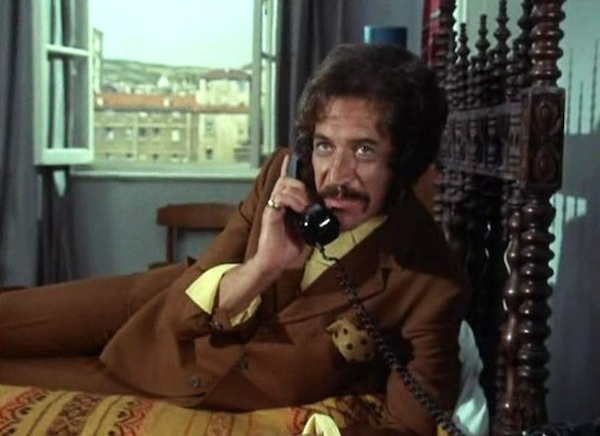
Peter Wyngarde (born Cyril Louis Goldbert on this day in 1933, though the year is disputed) is certainly an unusual figure in the British theater. Rail-thin, baroquely outfitted, and equipped with a mellifluous voice, he makes an unforgettable first impression, glanced through a window, in THE INNOCENTS (1961). He was a flamboyant figure who, ironically, cultivated an impression as a ladies man, and, if he had been a good actor in his youth, he was more of a character man in middle age, where our story begins.
Here’s an interview in which you get a sense of the man’s public persona and acting talents:
But he was a big, entertaining performer, and perfect for the small screen, where he starred as the pulp novelist and bon vivant Jason King in the British ITC show DEPARTMENT S (1969-70) and JASON KING (1971-72).
With Jason King, Wyngarde found a character who he could ride to the top of the ratings. He was named “The Man With The Sexiest Voice In Television” by the Sun newspaper, and was considered a national sex-symbol. At the same time, his handlers allegedly had their hands full extricating him from vice-squad trouble in London.
At the height of his fame, Wyngarde was persuaded to record an album. The result, a spoken word-over-music effort, is one of the strangest things ever, and oddly compelling. The presumptuous, politically incorrect Wyngarde does not come across very sympathetically, but that’s part of the historical appeal of the record. It’s not something you’ll want to hear more than once, other than to play it for friends and baffle them too.
Here’s one of the less offensive tracks. If you care to explore further, don’t say we didn’t warn you.
The Austin Chronicle today turns their screens spotlight on a group that has been bringing avant-garde and experimental cinema to Austin for four years now, and who will be presenting a showcase of local Austin Filmmakers at the AFS Cinema on Tuesday, August 23 at AFS Cinema. If you are interested in learning more about everything Experimental Response Cinema does, visit their site here, and by all means come to the event.
“This is the reason I didn’t join a fraternity.” – Dick Cavett
During the filming of John Cassavetes’ HUSBANDS (1970) the director/star and his other cast members Peter Falk and Ben Gazzara really got into character as a trio of middle aged ne’er-do-wells. When it came time to promote the film they took that same drunken abandon with them onto the Dick Cavett show. This is, along with Norman Mailer and Gore Vidal’s conflict on Cavett’s show, and the Oliver Reed/Shelley Winters war on Carson, one of the best examples of talk-show appearances gone wrong. Among other mayhem, Cassavetes gives Falk a horsey-ride and Gazzara kisses Cavett. Later, they become sincere. Gazzara discusses the work of Orson Welles at length, and compares Cassavetes to him. The three then bring up excellent points about filmmaking and life, though in slurred voices.
At one point the crowd turns on the guests and chants, “WE WANT DICK!”
Filmed 40 years ago, in August 1976, in one take, with director Claude Lelouch at the wheel, zipping through Paris, this is a high-concept, but high-reward film.
It was a bit of a goof. The director, having just acquired a high-tech camera mount for use in his new feature, decided to try it out in a short film. The whole thing was done very quickly, as you’ll see. Rumors persist that he was later arrested. It is not known if these are true. It certainly was dangerous and irresponsible. But also pretty cool.
OK, maybe don’t actually skip film school, at least if you’ve already enrolled. But you should be able to test out of at least 4 semesters with the knowledge and insight that can be had in this documentary about the great writer/director Samuel Fuller (born on this day in 1912).
Fuller was an all-American iconoclast, a no-bullshit believer in the power of free institutions with a tough-minded, skeptical, but always humanist viewpoint. This film, featuring large doses of Fuller’s wisdom, as well as insights from Jim Jarmusch, Quentin Tarantino, Martin Scorsese and others, can tell you 80% of what you really need to know about the art form of which Fuller was such a great master. Fuller is one of the great raconteurs, and a real character. The wisdom pours from him as unfettered as smoke from his cigars.
Lane, whose last film, OUR NIXON, was a 100% archival portrait of the disgraced President using only home movies shot by his worshipful aides, tells a very different story this time, about another charlatan, in another era. It’s one of the most bizarre, but true, stories you will ever hear.
In her words:
NUTS! is a feature length documentary [directed by Penny Lane] about Dr. John Romulus Brinkley, an eccentric genius who built an empire in Depression-era America with a goat testicle impotence cure and a million watt radio station.
Using animated reenactments, interviews, archival footage, and a hilariously unreliable narrator, NUTS! traces Brinkley’s rise from poverty and obscurity to the heights of celebrity, wealth and influence in Depression-era America.
Along the way, he transplants tens of thousands of goat testicles; amasses an enormous fortune; is (sort of) elected Governor of Kansas; builds the world’s most powerful radio station; invents junk mail, the infomercial, the sound-truck and Border Radio; hosts some epic parties; and annoys the heck out of the establishment, until finally his audacious actions force the federal government to create regulations to stop him.
How he does it, and what happens when it all comes crashing down, is the story of NUTS!
And here is Lane discussing the film and showing some clips:
Here, from Fandor Keyframe, is a video essay on Lynch’s films using words and concepts from Lim’s book “David Lynch: The Man From Another Place” to attempt to pinpoint exactly what set of traits make a film or sequence “Lynchian.”
Robert Aldrich (born on this date in 1918) had a lot of success in his career, made a lot of movies, did very well at the box office by and large, and left a legacy of films that will continually be rediscovered by new generations. But despite all this he has not become a ‘brand name’ among many cinephiles in the way that some of others of his generation have.
Born into great privilege; the son of a wealthy newspaper publisher, grandson of a United Senator, cousin to Nelson Rockefeller, and heir to the Chase Bank fortune; Aldrich need never have worked a day in his life but he chose to drop out of college and follow his dream of working in films. His parents were so upset at Aldrich’s decision to take an entry-level position as a production clerk at RKO that they cut him off entirely from his family fortune. Still, he had drive and talent, and rose through the ranks to become a production manager, associate producer and assistant director. In the latter capacity he worked with such greats as Jean Renoir and Charlie Chaplin.
Striking out on his own, Aldrich directed a number of television episodes and, eventually, some low-budget B-films that proved his competence. His first A-picture was APACHE (1954) a western starring Burt Lancaster. This paved the way for Aldrich’s first big hit, and first great artistic triumph, VERA CRUZ (1954). Here, in the context of a florid, colorful western, we begin to see some of Aldrich’s trademark ambivalence toward heroism. In his next film, KISS ME DEADLY (1955), Aldrich hits us with a brass-knuckled punch of deep distrust of authorities, and deep disdain for his detective-novel source material. The film is a masterpiece, and a touchstone of film rebels ever since.
Aldrich’s next few films proved his versatility, he made a melodrama, women’s pictures, war movies and a Biblical epic in succession. Following these he went back to the vein of black humor he had mined so successfully in KISS ME DEADLY, this time casting two famously difficult screen goddesses in WHATEVER HAPPENED TO BABY JANE? (1962), an unforgettably baroque and camp tale that nonetheless delivers riveting suspense.
After this huge hit, and international sensation, Aldrich was back on the job again, making a silly rat-pack western, FOUR FOR TEXAS (1963), a tonal sequel to BABY JANE, HUSH… HUSH SWEET CHARLOTTE (1964), and the small-cast war/survival movie THE FLIGHT OF THE PHOENIX (1965).
In 1967 Aldrich changed the very landscape of action filmmaking with his mega-hit THE DIRTY DOZEN. By this time Aldrich’s cynicism had become a mainstream commodity, so when his ‘heroes’ acted just as brutally as his Mike Hammer had in KISS ME DEADLY, no one took any unusual notice, except to cheer more loudly. The era of the big, multi-star international action epic had begun, but also, and this was less apparent at the time, the age of the anti-hero who provides subversive commentary about society’s values.
At this point Aldrich was a made man, with the freedom to choose personal projects. He did so, with the Hollywood satire THE LEGEND OF LYLA CLARE (1968), featuring an unfortunately miscast (or is she?) Kim Novak and an adaptation of the controversial lesbian-themed play THE KILLING OF SISTER GEORGE (1968). Next he made a very downbeat war drama, TOO LATE THE HERO (1970) and the sweaty (literally) gangster epic THE GRISSOM GANG (1971). In ULZANA’S RAID (1972) he made his definitive statement about war, and couched it in another Burt Lancaster western.
This was a period of terrifically interesting films that bombed at the box office. The next one was no different. EMPEROR OF THE NORTH (1973), about rail-riding hoboes during the Depression, is one of the smartest, most tensely directed, best acted films of the 1970s but it was again ahead of its time. After all these flops, Aldrich needed a touchdown, and he got it with his next film, THE LONGEST YARD (1974) about football shenanigans behind prison walls. The monetary success of THE LONGEST YARD gave Aldrich the chance to make more personal movies, and he did so.
In HUSTLE (1975), he reteamed with Burt Reynolds and added Catherine Deneuve to the mix in a modestly successful detective film. His last few efforts were an odd mix, from military paranoia in TWILIGHT’S LAST GLEAMING (1977), to a brutal black comedy about bad cops, THE CHOIRBOYS (1977) and then a weird comedy starring Gene Wilder and Harrison Ford (1979’s THE FRISCO KID).
His last film seemed, at the time, to be a desperate gambit to draw in audiences with a highly titillating commercial angle. … ALL THE MARBLES (1981) stars Peter Falk as a wrestling manager whose only clients are a tag team act, both gorgeous women, played by Vicki Frederick and Laurene Landon. The advertisements for the film made the most of their many charms and their tight spandex costumes. In reality, the movie is a sincere and moving sign-off by Aldrich. As Falk, Frederick and Landon make their way from one dingy rust-belt town to another, angling to get paid at the end of every match by dodgy promoters, Aldrich’s attitude toward the sometimes tawdry world of show business comes through. It’s an elegiac, ultimately triumphant film, much like John Ford’s similarly misunderstood DONOVAN’S REEF, and is the most fitting end to this most American of filmmakers’ career.
Aldrich died in 1983, at age 65.
Here’s the trailer for Aldrich’s final film, and final masterpiece, … ALL THE MARBLES: