John Huston (born on this day in 1906) was a great filmmaking talent, with remarkable intelligence and an unusual ability to communicate. He made many good, and some bad, movies, and was pretty much the definition of a larger than life character. It is impossible, hearing it now, not to be charmed by his mellifluous voice, and, even if we know that he could be a difficult person, all that is left for us now is his magnetic appeal, and his films.
Here, from 1966, are a pair of clips from the CBC in which we are taken behind the castle walls (literally) and shown some glimpses of Huston, his family and friends (Burl Ives!) at home in Ireland. In the second video, Huston, an avid horseman, and former cavalryman, shows his son a thing or two about how to keep a good seat in the saddle.
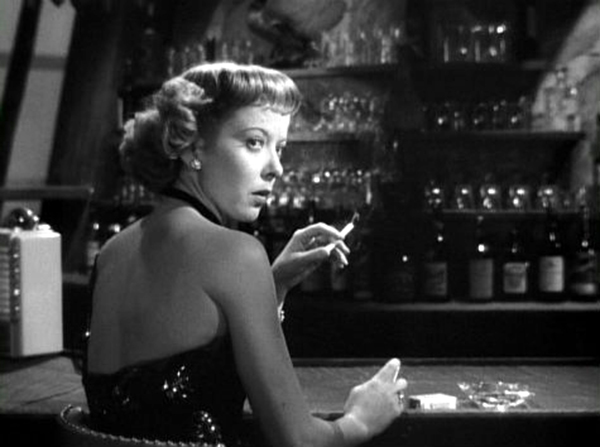
We hope you can join us this August for our special all-35mm tribute series to one of the screens finest performers, and a pioneering director, Ida Lupino. Program notes follow.
The Lupino name has been synonymous with the theater for many centuries, from Renaissance Italy, where the Neapolitan Lupinos began the family tradition as strolling players, jugglers and dancers; continuing into the 17th century, when the already-well known clan was exiled to England for political reasons, and where they became popular as actors, acrobats and clowns; and, eventually, to both the legitimate stage and music halls of London.
Ida Lupino, born in 1918 during an air raid blackout in London, was brought up in a home that was part boarding house and part theatrical agency. Traveling artistes stayed there, rehearsals took place in front of the family hearth, and Ida received a complete education in acting, stagecraft and music before she even set off for school. The young prodigy even wrote, produced, and starred in a play at age seven.
Through her family connections – her father Stanley was a director, and her uncle, who went by the name Lupino Lane, was a popular comic – she made her screen debut in 1931 in one of her father’s films, THE LOVE RACE. The experience on the film set made her think more seriously of acting as a career so she applied to and was accepted by the prestigious Royal Academy of Dramatic Art (RADA). She acted in many plays there and honed her natural talent to a fine edge. Itinerant American director Allan Dwan was then making a film in London. He saw much in the lovely, poised young actress, whom he cast – over her mother, who was in fact auditioning for the part – in an important role in HER FIRST AFFAIRE (1932).
Word got out about the talented newcomer and Paramount Pictures sent a ticket and a contract for her, with the idea that she would be perfect at playing Alice In Wonderland. But when she screen-tested for Alice it became apparent that she was too mature-looking for the role. Stuck in Hollywood, and under contract, she was restyled with processed blonde hair and pencil eyebrows as “the new Jean Harlow” and given roles that were, to say the least, beneath her abilities. It was at this time that she told a friend, “If I don’t get a part that I can get my teeth into, I’m going back home.” This was the beginning of several years of discontent, during which she alternately refused roles, served suspensions, and was loaned out for, sometimes punitive, assignments for other studios. By 1937, she convinced Paramount to release her.
A free agent at age 19, Lupino stopped bleaching her hair, and allowed her eyebrows to grow in naturally. She composed music during this time, a longtime avocation, and had her symphonic piece “Aladdin’s Lamp” performed by the Los Angeles Philharmonic. She made few films and got married. At this time she easily could have decided that the cinema was not in her future but when she heard that William Wellman was making an adaptation of one of her favorite stories, THE LIGHT THAT FAILED (1939), she knew that the part (a vulgar cockney bar girl who models for a great painter’s last work as he loses his sight) was one she could play better than anyone else. She stormed into Wellman’s office and gave a thunderous impromptu audition that convinced him to cast her. It was a breakthrough performance.
Soon the 21 year old was known as an acting powerhouse, and one who could hold her own against a powerful male co-lead. Warner Brothers signed her to a contract where she made some of the best films of her career, including THEY DRIVE BY NIGHT (1940) with George Raft and Humphrey Bogart, HIGH SIERRA (1940) again with Bogart, and THE SEA WOLF (1941) with John Garfield and Edward G. Robinson. Here she again occasionally found herself on suspension, as when she refused a role in KING’S ROW alongside Ronald Reagan. During her suspensions she learned a great deal about the technical aspects of filmmaking, as she used the idle time to shadow directors, editors and cameramen.
When not on suspension, she was often on loan to other studios, which is how she ended up at Fox making MOONTIDE in 1942.
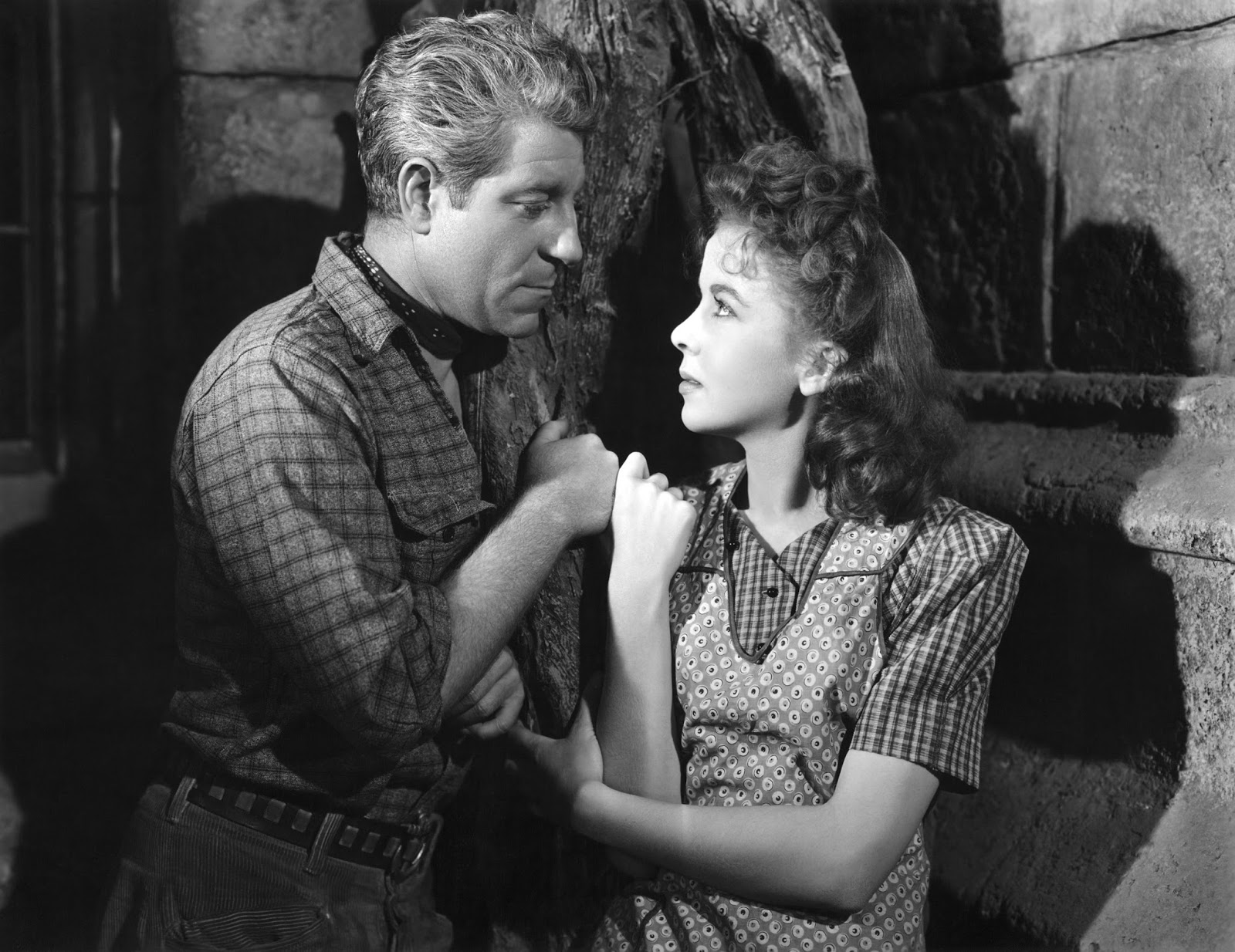
MOONTIDE D. Archie Mayo & Fritz Lang (uncredited), 1941 Written by John O’Hara and Nunnally Johnson (uncredited) from the novel by Willard Robertson; With Ida Lupino, Jean Gabin, Thomas Mitchell, Claude Rains; Cinematography by Charles Clarke; Music by David Buttolph and Cyril Mockridge
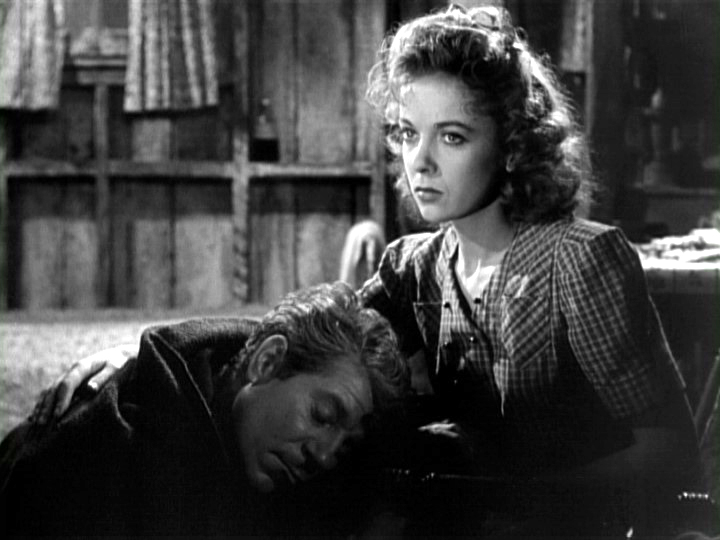
Hitler’s rise to power brought many talented Europeans to Hollywood, including, improbably, the great French leading man Jean Gabin. Perhaps it was thought that Gabin, whose magnetic but rough-hewn charm made him a favorite in France, would be the next Charles Boyer, but the two Frenchmen were very different and Gabin would be considered a washout in Hollywood, which was just as well for the art of cinema as he went on to do much of his best work back home in France. Here Gabin is a pillar of strength as a longshoreman who thinks he may have committed a murder and therefore retreats from the world to a small dockside shack. There he rescues a young woman (Lupino) who tries to drown herself but they find an obstacle to their domestic bliss when his friend (Thomas Mitchell) develops designs on Lupino (or perhaps Gabin himself). It’s a beautiful, semi-noir art film. Original director Fritz Lang, nursing a candle for Marlene Dietrich, hated Gabin, who was Dietrich’s longtime beau, and contrived a successful plan to get fired from the film after three weeks. It still bears his stamp, as well as that of novelist/short story writer John O’Hara, whose ear for dialogue was almost peerless. Lupino is heartbreaking as the woman who finds a reason to live again thanks to unexpected love.
By the end of the ‘40s, Lupino was becoming more independent than ever. After leaving Warner Brothers at age 29, she again struck out on her own and made such films as the extraordinary, tough ROAD HOUSE (1948).
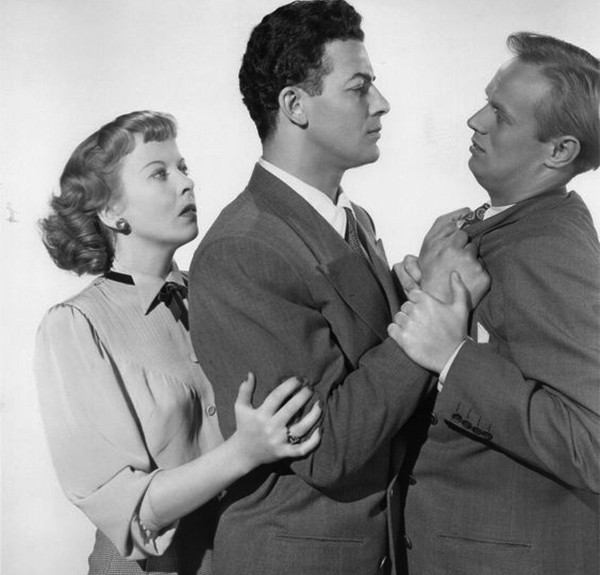
ROAD HOUSE D. Jean Neguelsco, 1948 Written by Edward Chodorov; With Ida Lupino, Cornel Wilde, Richard Widmark, Celeste Holm; Cinematography by Joseph LaShelle; Music by Cyril Mockridge
By 1948, Ida Lupino was, by any standard, a master actor, with 15 years in Hollywood on top of her prodigious formal education. In a role like this one, as a woman of easy virtue who drives all the men wild at a sleazy rural nightclub, that technical polish and experience might seem extraneous – after all, couldn’t any actress with sex appeal play this part? Well, no. Not like this. Lupino takes this fastball for a long ride as she nails the tough dialogue with the precision of an Olivier. It’s the story of a rivalry between two old friends, Cornel Wilde, as the manager of the roadhouse, and Richard Widmark, as the nasty, spoiled rich kid who inherited the business. Lupino, as she was so often in real life, is independent, but she can’t keep her heart entirely out of it. She performs several songs, using her own smoky singing voice, and creates from this rough material a character you’ll never forget.
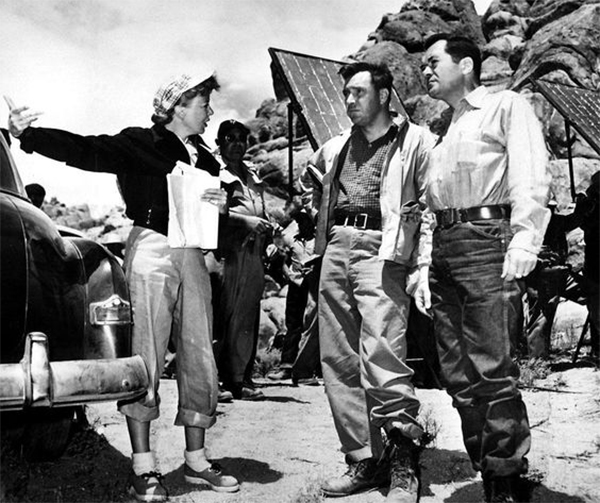
In 1949 Lupino, along with husband Collier Young, formed her own production company, The Filmmakers, to make quality, low budget, message films. Initially she was to be only a writer and producer, but when director Elmer Clifton had a mild heart attack during the filming of NOT WANTED (1949), Lupino finished the shoot. Through all this she continued her acting work, and in 1951 she gave one of her finest performances in Nicholas Ray’s ON DANGEROUS GROUND.
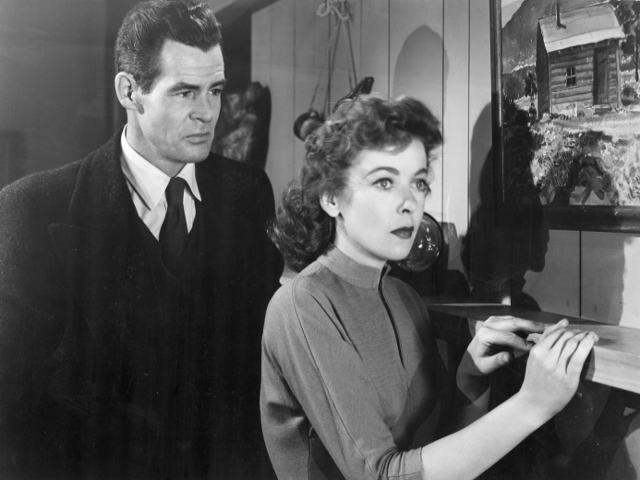
ON DANGEROUS GROUND Nicholas Ray, USA, 1951, 35mm, 82 min Written by A.I. Bezzerides from the novel by Gerard Butler; With Ida Lupino, Robert Ryan, Ward Bond; Cinematography by George E. Diskant; Music by Bernard Herrmann
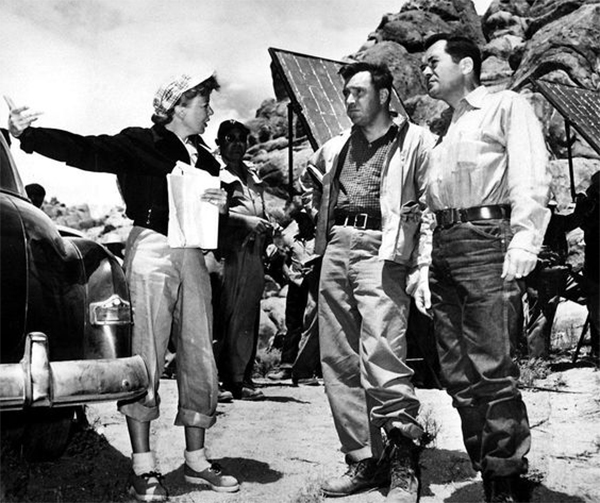
Many viewers consider Nicholas Ray’s ON DANGEROUS GROUND to be a “schizophrenic” film, with two distinct sections – the first focusing on out-of-control tough cop Robert Ryan’s experiences on the streets among the amoral scum of the big city, and the second depicting a more pastoral-looking, but no less secure, rural setting. This was intentional. In fact, Ray wanted to film the first chapter in black and white, and the rest in color a la WIZARD OF OZ. In this film, which Lupino directed a few days of, uncredited, she plays the blind sister of a fugitive boy who Ryan, with the victim’s unhinged father in tow, is assigned to catch. Through the woman’s example, Ryan, whose moral compass had been spinning wildly out of control, finds his north star, but not before fate can play its hand. It was common practice for actors, when playing blind characters, to wear special contacts, but Lupino insisted on “acting” blind, that is, without special assistance, and it’s certainly effective. Like all of Ray’s idiosyncratic films, the external settings mirror inner conflicts to an almost baroque degree. This film was neither a critical or commercial success upon release but has come to be highly regarded by modern audiences.
Lupino used acting to fund her productions, and continued to make her own films, including the first film noir ever directed by a woman, THE HITCHHIKER.
THE HITCHHIKER Ida Lupino, USA, 1953, 35mm, 71 min Written by Ida Lupino and Collier Young; With Edmond O’Brien, Frank Lovejoy, William Talman; Cinematography by Nicolas Musuraca; Music by Leith Stevens
Many auteurists despair of Lupino’s directorial work. All the lessons and connections they would seemingly like to find in her work are tantalizingly absent or brief. She was, as she liked to point out, “the poor man’s Don Siegel”, in other words, a pro’s pro, who could get a picture in the can on schedule, and still find time for little things like performances and story. THE HITCHHIKER is very much a Siegel-style vehicle, as two family men on a fishing trip are kidnapped by a psychotic escaped convict and must keep their heads to make their eventual escape. It’s edge-of-your-seat stuff from the director who ran a tight set, but was also referred to as mother by all the cast and crew who loved her.
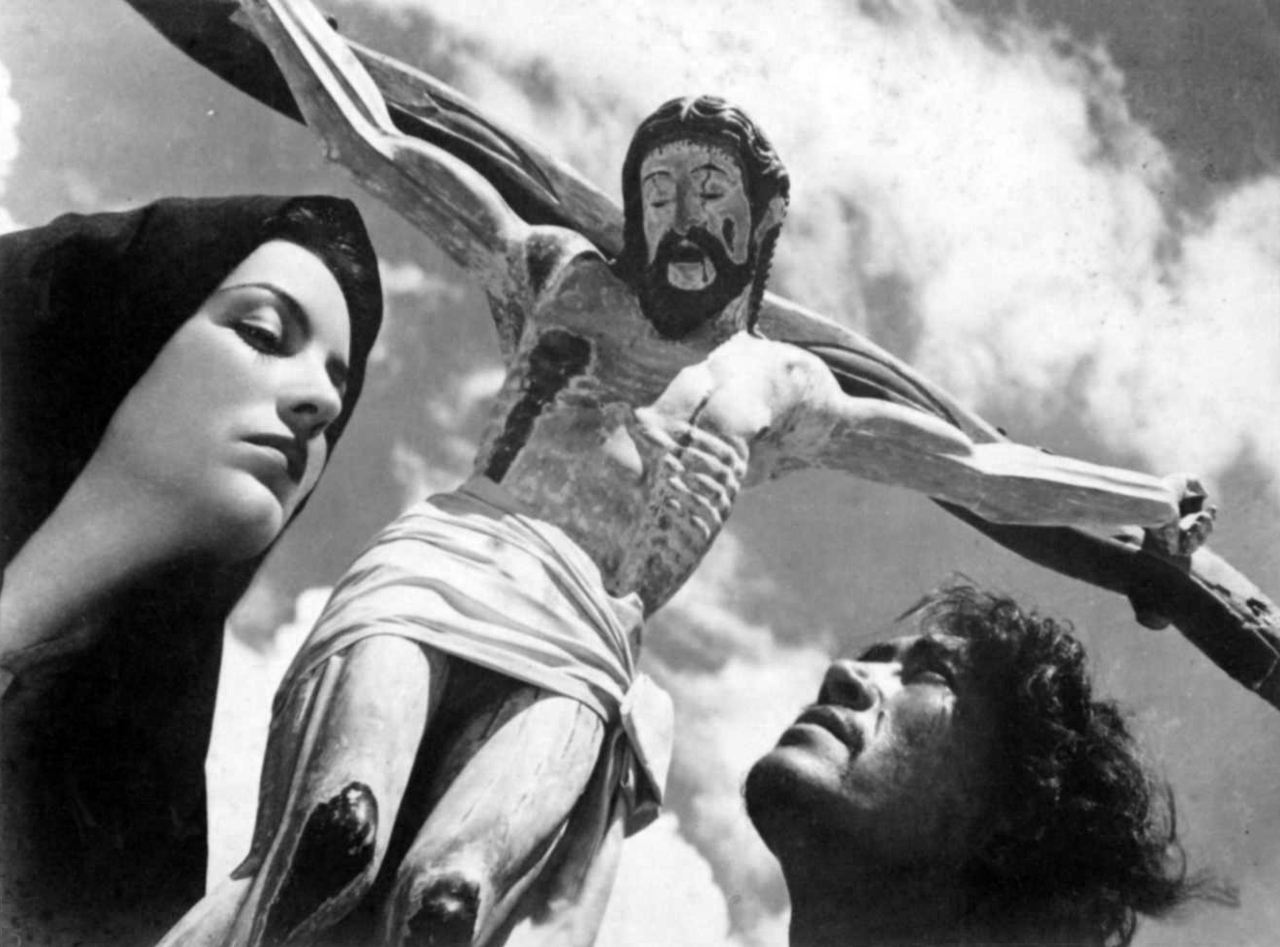
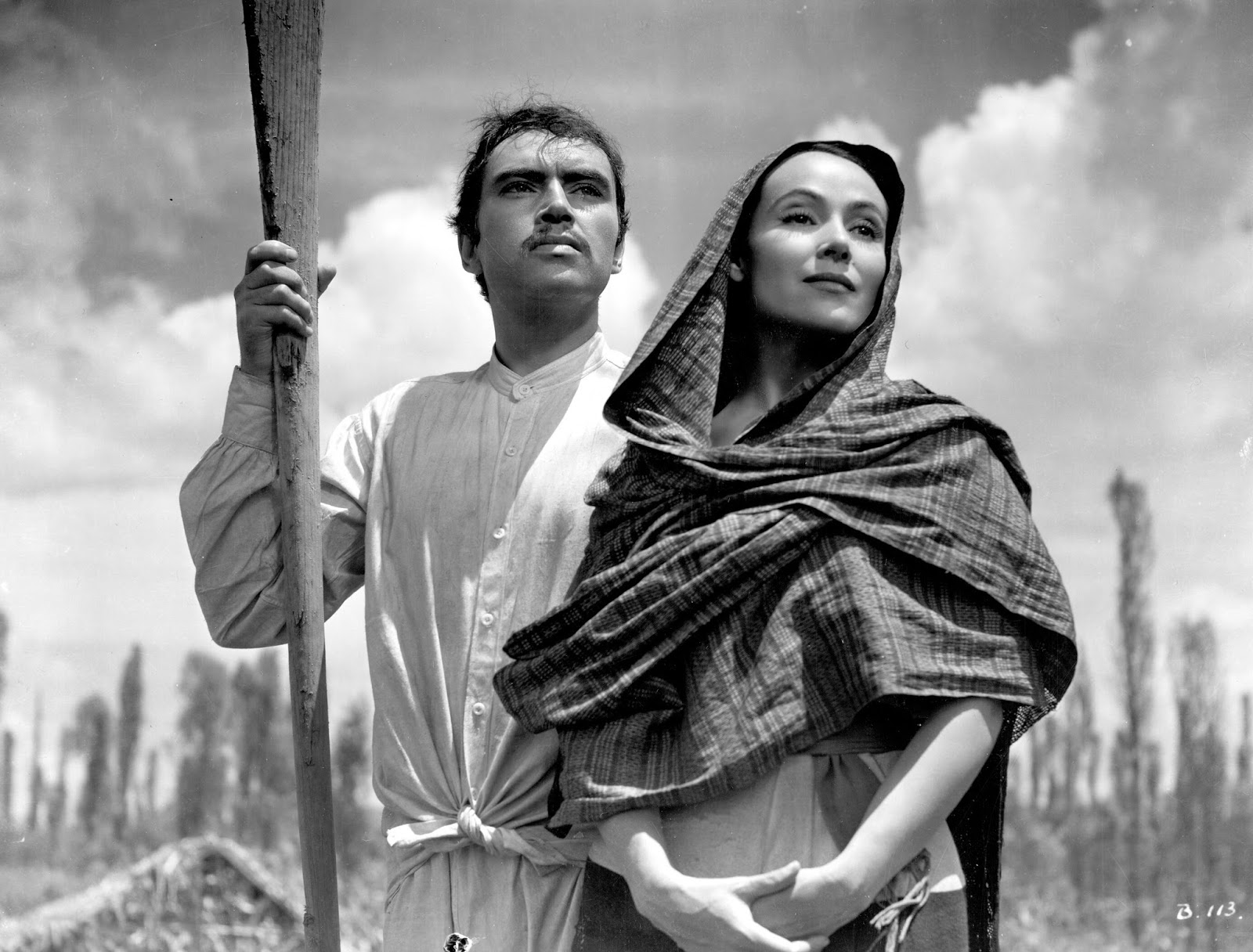
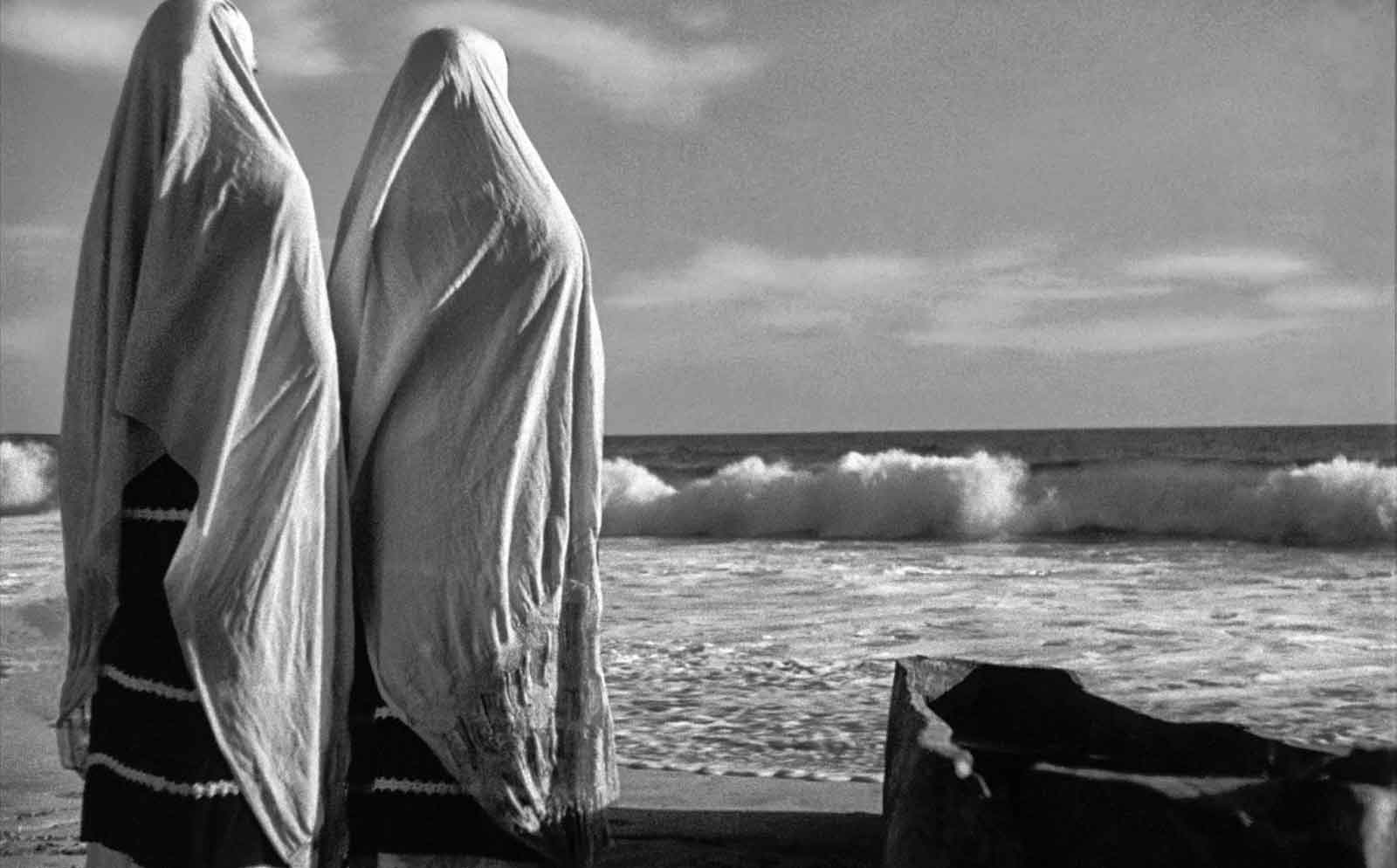
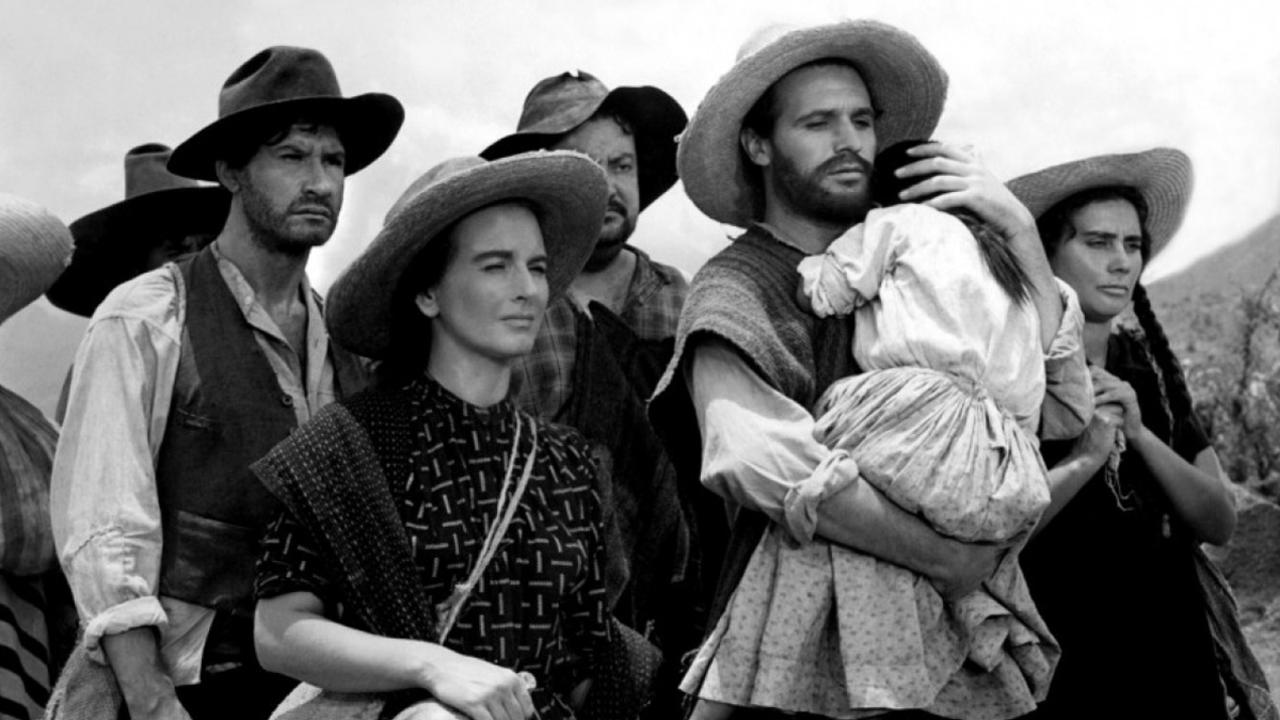
There are cinematographers who do their job adequately, making sure the subject is lit and focused according to the director’s wishes, and then there are the artists, who create perfect frames and perfect shots. These are rare people, and when they are empowered, can produce magical cinema. Gabriel Figueroa (1907-1997) was one of the latter. From the extraordinary vistas of Eisenstein’s QUE VIVA MEXICO (1932), through many Emilio Fernández titles, John Huston’s NIGHT OF THE IGUANA (1964), and Buñuel masterpieces such as THE EXTERMINATING ANGEL (1962) and LOS OLVIDADOS (1950), he contributed his expertise, his astonishing technical proficiency, and his unique eye for contrast and shadow.
Born into a family whose theatrical pedigree extended as far back as Renaissance Italy, British actress Ida Lupino was a vaudevillian from birth, a Royal Academy Of Dramatic Arts trained actress by 13 and an imported contract player at Paramount by age 15.
Hollywood had no idea what to do with the willowy, big-eyed beauty so she mostly spent the first ten years of her film career bouncing around, changing hair colors and reading bad scripts. In 1939 she forced her way into director William Wellman’s office and demanded to read for him. The rest was history. No longer just a decorative love interest, she proved in the films of the ‘40s that she was just as tough and talented as her co-stars, and, considering those co-stars were people like Humphrey Bogart and John Garfield, that’s a major statement.
Her early acquaintance with subpar screen material made her highly selective, and when she did not feel a script was up to her standards she refused the part, even when under contract. As a result, she was often suspended by her studio. She used the time to become proficient at the technical arts, and soon started her own production company with her husband Collier Young. Their output was low budget, quality B-movie fare, produced; and often written and directed; by Lupino.
This series presents a selection of three of Lupino’s best starring performances and, significantly, a rare 35mm print from the Library Of Congress of THE HITCHHIKER (1953), which she produced, co-wrote, and directed, and which is considered the first film noir directed by a woman.
ON DANGEROUS GROUND (1951, 35mm) Thu, Aug 4, 2016, 7:30 PM
Nicholas Ray’s parable of love and forgiveness is one of the best and most unusual noir films. Robert Ryan plays a city cop, driven to a state of constant rage and depression by the murder of a fellow police officer, who is reassigned to a murder investigation in a rural county. There the pursuit of the murderer leads him and the victim’s vengeful father, played by Ward Bond, to an isolated farmhouse, buried in snow, where the only inhabitant seems to be the suspect’s blind sister (Ida Lupino.) As the manhunt zeroes in on the nearby terrain, Ryan’s heart is softened by Lupino’s tenderness and love. The scenes between Ryan and Lupino contain some of the finest screen acting of the era and the film is justly considered a classic. Music by Bernard Herrman – he called it his favorite score.
Ida Lupino plays one of the great noir women in this story of a love triangle in a highway nightclub. Richard Widmark plays the owner. His longtime best friend Cornel Wilde manages the place for him. When new singer Ida Lupino shows up, Wilde knows she will cause trouble with the sociopathic ladies’ man Widmark so he gives her a return train ticket before she even auditions. She refuses and sings anyway. She’s an instant hit, especially with the male patrons. One of them says, “she reminds me of the first woman who ever slapped my face.” Soon Widmark and Wilde are at odds, and it goes way, way too far. The dialogue sparkles here and Lupino is at her no-nonsense best. Rare 35mm print.
Hardboiled novelist John O’Hara wrote the script for this story of the downtrodden denizens of the waterfront. The great French actor Jean Gabin, in exile from his war torn homeland, plays a longshoreman who may have committed murder while on a drunken bender. While hiding out on a barge he rescues a young woman (Ida Lupino) when she tries to drown herself. They become a couple, with plans to marry, but one of Gabin’s friends (Thomas Mitchell) becomes jealous, and fate’s wheels begin to turn. Co-directed (uncredited) by Fritz Lang. Featuring Claude Rains as a character named Nutsy (!!). Rare 35mm print.
Years ago, the only way a female director could work in Hollywood was on a “woman’s picture,” often a romance or a domestic drama. With THE HITCHHIKER, Lupino showed that she could hang with the Hollywood tough guys. Not only is it a dark film noir full of grinding suspense, it has an all-male cast. This is Lupino’s fifth film as a director and she has an assured, masterful touch with this kind of material. The story involves a pair of friends on a relaxing fishing getaway who pick up the wrong hitchhiker. He is a killer on the run who makes the men drive him to the Mexican border, so he can make his getaway. Knowing that the desperate fugitive won’t let them live, they plot their escape. A low budget wonder with Edmond O’Brien, Frank Lovejoy and William Talman. Rare 35mm print from the Library Of Congress.
Back in 1999, a novel called “Sarah” appeared on the scene. It was a work of raw force, telling the coming-of-age story of its then-20 year old (purported) author JT (Jeremiah “Terminator”) LeRoy. The author was presented as the son of a truck stop prostitute, who turned came up the HARD way in West Virginia, and later, on the streets of San Francisco, where he turned tricks and shot needle drugs. His work thrilled reviewers like the New York Times’ Catherine Texier, who wrote:
For a first novelist, J. T. LeRoy is astonishingly confident. His language turns the tawdriness of hustling into a world of lyrical and grotesque beauty, without losing any of its authenticity. One can clearly hear an Appalachian twang in his prose and, along with his gallows humor, the baroque religiosity of the South. In spite of Sarah’s lack of sexual innocence, his language is always fresh, his soul never corrupt. His sweet and pure vision makes even the nastiest scenes bearable.
Soon, LeRoy’s “Sarah” and subsequent novels, became underground touchstones, and were beloved by everyone from teenagers to rock stars. LeRoy wrote the original screenplay for Gus Van Sant’s 2003 film ELEPHANT and was associate producer on Asia Argento’s film adaptation of his THE HEART IS DECEITFUL ABOVE ALL THINGS.
LeRoy could not have been a hotter property than he was in 2005, when it all came tumbling down. On October 10 of that year, Stephen Beachy published an article in New York Magazine called “Who Is The Real JT LeRoy.” It was subtitled, “A search for the true identity of a great literary hustler.” Beachy provided years of evidence that added up to one conclusion, that there was no JT LeRoy.
From Beachy’s article:
There are writers I love who create intricate layers of stories that only imply an unstated psychological reality grounding the dizzying production of narrative; others self-consciously play with the boundary between fiction and non. LeRoy has written about the way prostitutes fulfill other people’s fantasies and about the way the literary world can seem like simply a different form of prostitution. In an early version of one of JT’s stories, he wrote that he sometimes felt like the emperor with no clothes. Maybe it’s more accurate to say that it’s the clothes that don’t have an emperor; it’s just a wig and sunglasses floating around a dizzying production of narrative.
It was the beginning of the end for the persona JT Leroy, and for the next few years the books fell into disrepute, littering clearance tables at book stores, but as the real author Laura Albert has come forward to reclaim her work, the books have again found favor with critics and readers, whether or not their author is “real” the books have value as works of fiction.
In 2010, Albert took the stage in San Francisco as part of the Moth Storytelling show and she shared a little of the complicated history of her life with JT Leroy:
And all of this is just the beginning. Feuerzeig’s excellent documentary raises and answers scores more questions, and, like a modern F FOR FAKE, makes us examine what we value in the “real.”
Here’s Feuerzeig telling what attracted him to the story:
Please note, NORMAN LEAR: JUST ANOTHER VERSION OF YOU, the new documentary about the fascinating life of the legendary television producer (and social change vector) screens at the AFS Cinema on August 24 and 28.
In celebration of Norman Lear’s 94th birthday we present this interview from the Archive Of American Television. Their emmytvlegends.org page is one of the most informative websites out there, with many hours of interviews with the people who made (and make) television happen. Lear is a brilliant and fascinating figure in the history of television.
He tells his whole story over the course of this (over 4 hour!!!) interview. This is pretty deep stuff, and most people won’t be interested in every bit of it, but the site helpfully provides a linked index of topics.
William Smith, Matt Dillon and Mickey Rourke in RUMBLE FISH (1983)
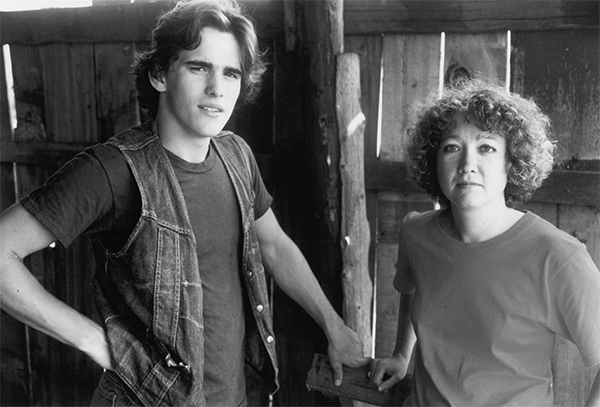
Author S.E. Hinton (born on this date in 1948) has written only one screenplay, and her literary output has been sparse – her best known work was written before she turned 30 – but her cultural impact has been significant. Legions of socially disaffected young people have gravitated to her novels of young Oklahomans over the years, and the characters she created in books like “The Outsiders” (1967), “That Was Then, This Is Now” (1971), “Rumble Fish” (1975), and “Tex” (1979), provided examples of cool kids – very cool kids – who could still feel pain and need others.
As the Young Adult Library Services Association stated when they gave Hinton the inaugural Margaret A. Edwards Award in 1988: in Hinton’s novels “a young adult may explore the need for independence and simultaneously the need for loyalty and belonging, the need to care for others, and the need to be cared for by them.”
Hinton with Matt Dillon, her favorite actor, and star of THE OUTSIDERS, RUMBLE FISH, and TEX
Francis Ford Coppola became a major admirer of Hinton and her works. His first Hinton adaptation was THE OUTSIDERS (1983). Much like the book, it was a medium-sized hit that continued to exert its influence over several decades. For many, it is one of the definitive movies and perceptive movies about the teenage years.
During the shoot of THE OUTSIDERS, Coppola and Hinton, who was on set as the film’s technical adviser, began writing a script for an adaptation of “Rumble Fish.” The idea was to make it as a low budget art film on many of the same locations with some of the same actors. Coppola stated that it was his “reward” for completing the difficult OUTSIDERS shoot. The resulting film is quite different from anything Hollywood could have expected. It is shockingly avant-garde in its black and white cinematography, sparse scene-blocking, and use of symbolic and elliptical storytelling techniques.
Today RUMBLE FISH is not an especially well known film, but it is highly prized and loved by those who have seen it. In 2014, Richard Linklater programmed the film for an AFS series and many of those who saw it for the first time hailed it as a masterpiece. Linklater’s remarks about the film are here.
Take a second to watch the trailer and wonder with us why RUMBLE FISH has not become a canonized classic (also – LOOK AT THAT CAST!):
Some people seem to carry their own cosmos around with them. That is definitely the case with writer/director Abel Ferrara (born on this day in 1951), who, even as he has created a body of work that is very impressive, has terrorized interviewers and others with his – shall we say – unpredictable approach to the art of conversation.
Here, in a 1996 interview with Conan O’Brien, the clash in their energies is notable. You can practically hear Conan saying “never again” to his booker. In hindsight, Ferrara wins the exchange, just by being so interesting. He seems to carry a little bit of Tompkins Square park around with him – maybe in his pocket.
Sample Exchange:
Conan: Why did Madonna want you to beat up Harvey Keitel?
Writer/director Maurice Pialat was a brilliant director but a notoriously difficult person. He was famous for his tense film sets, angry actors and his firing of multiple cinematographers and editors in a row on a single film. In general, it seemed he had a talent for making others despise him.
The fact that this feeling was not universal among his collaborators was largely overlooked by the industry; people preferred to play up the horror stories. Evelyne Ker, the actress who played Suzanne’s mother in Pialat’s celebrated À NOS AMOURS, described her experience, which gives a more complete picture of the ups and downs of working with Pialat:
“During the shooting we often had a good time. There was a tremendous bond between us, and lots of jokes. Pialat, its true, also needs psychodrama, tension, in order to create. So there were conflicts. Depending on his anxieties, depending on the day, he has his scapegoats. Something had to come from us that got him started, if not, he was bored, he got nothing done. But when we got started, it was endless like life itself, he just ate us up!”
In spite of early critical and commercial success, Pialat’s name was never mentioned among the great auteurs of his period. His of popularity made him easy to ignore, as did his decidedly unique and untrendy aesthetic.
But when UNDER THE SON OF SATAN won the Palme D’Or at Cannes in 1987, suddenly, the outsider that the industry loved to ignore was in the spotlight, for a film that the French public had already declared a bomb. In this video from the awards ceremony, Catherine Deneuve has to fight to silence the audience boos to let Pialat speak. Once he does, he gives it right back to them. Take a look at this incredible moment of Cannes history, now with subtitles.
Ben Steinbauer is a filmmaker we’ve been watching closely ever since his 2009 movie WINNEBAGO MAN signaled the approach of a major new documentary voice. Since then, Ben has stayed very busy producing and directing, mainly shorts and commercials, and also carving out a place as an award winning instructor.
Ida Lupino, who is the subject of our July History Of Television presentation and our August Essential Cinema series, had quite a career. First of all, members of her family had been in the theatrical business in one way or another for about 350 years. In other words, all the way back to Renaissance times. She was discovered in her native England as a young teenager by Hollywood director Allan Dwan, who encouraged her to come to Hollywood. She did, and mostly treaded water for years as an ingenue. Eventually she persuaded director William Wellman to give her a substantial dramatic role, and, at the advanced age of 21, she finally found her calling on the screen, as a soulful performer of depth and range. Later, she became an independent producer and director who changed film history.
We learn a bit about all of this in the following segment of the long running television show YOU BET YOUR LIFE, as the apparently very nervous Lupino receives visits from relatives, friends and professional colleagues.
Jeff Nichols, Austin-based writer/director (SHOTGUN STORIES, TAKE SHELTER, MUD, MIDNIGHT SPECIAL) has a new movie coming this November called LOVING. It is based on the true story of Richard and Mildred Loving, an interracial couple who were sentenced to prison in Virginia for marrying across the color line and who fought the verdict all the way to the Supreme Court. It’s a powerful story and Nichols would seem to have the perfect touch for it. Ruth Negga and Joel Edgerton play the Lovings, and we expect to hear their names a lot during award season.