Arnaud Desplechin is one of the major figures of world cinema. His filmography includes such acclaimed works as KINGS & QUEEN (2004), A CHRISTMAS TALE (2008), JIMMY PICARD (2013) and the new MY GOLDEN DAYS. Below he talks about his films, performers and the importance of classic films to him and to his work. Enjoy.
There is, as of yet, no official holiday commemorating those character actors who turn up in large numbers of organized-crime movies or television shows, but if there were such a holiday, today would be a great day for it.
Take a look at who was born on this date:
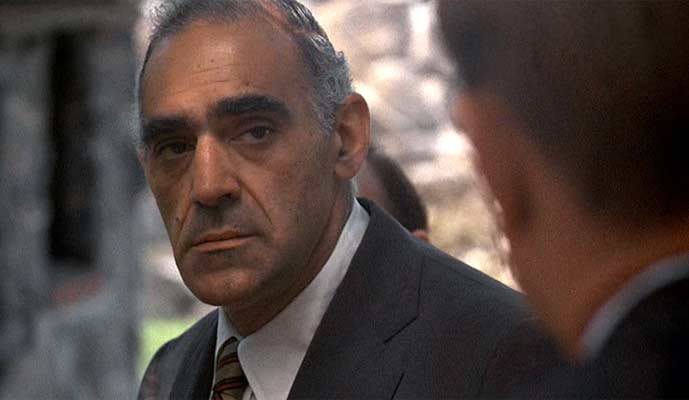
Abe Vigoda (1921-2016): He had a million credits but is probably best known as Tessio from the Godfather movies.
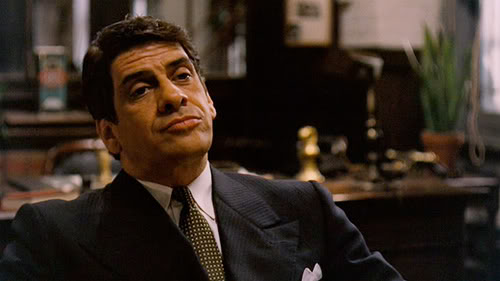
Al Lettieri (1928–1975): He died young, but his portrayal of The Turk in THE GODFATHER is unforgettable. Also appeared memorably as a criminal in THE GETAWAY (1972) and MR. MAJESTYK )1975).
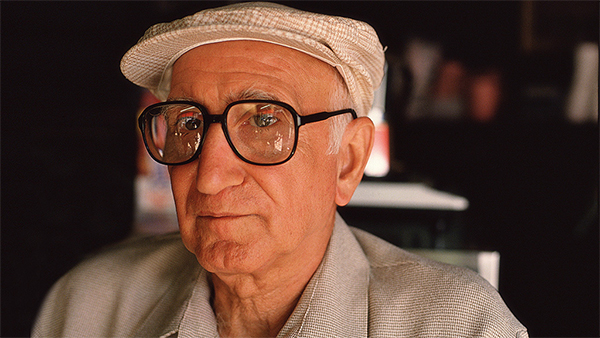
Dominic Chianese (1931-): Multitalented singer/actor. Appeared in THE GODFATHER PART II and many other films before achieving mafia immortality as the SOPRANOS’ Uncle Junior.
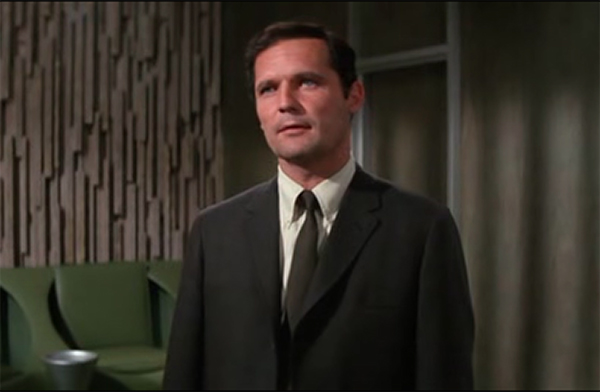
John Vernon (1932-2005): Deep-voiced Canadian character actor who played all sorts of roles, including gangsters in POINT BLANK (1967) and CHARLEY VARRICK (1973).
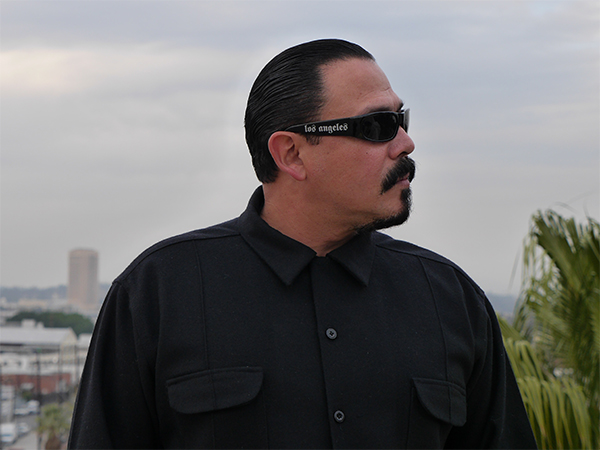
Emilio Rivera (1961-): Busy character actor, a regular on SONS OF ANARCHY, and a specialist in playing Mexican and other Latin-American criminals.
Write or call your Congressional Representative today.
Remember how Terrence Malick used to keep us waiting for years or decades between films? He’s quickened his pace a little but it still seems like we’ve been waiting a long time for his new one KNIGHT OF CUPS.
Now there are two new clips from the film online here.
Sal Mineo, who was murdered under still-mysterious circumstances 40 years ago today, will of course always be best remembered for his deeply affecting performance as Plato in REBEL WITHOUT A CAUSE. It’s one of those rare perfectly cast movies and Mineo achieves his own immortality in the film alongside James Dean and Natalie Wood.
He appeared in many other films too, of course, but starring roles were few and far between for him. Perhaps his second finest moment was in a disturbing psychological thriller from 1965 called WHO KILLED TEDDY BEAR? It’s not often seen or discussed, and to be frank, it has real flaws. It is directed by stage and TV journeyman Joseph Cates and written by Arnold Drake, probably otherwise best known as a comic-book writer – he created the Guardians Of The Galaxy.
Mineo, who is excellent, stars as a young man employed as a nightclub waiter, tormented by his own sexual hangups, who falls for the club’s new DJ, glamorous Juliet Prowse, and is ripped apart by his inner conflicts, which boil over into their lives. As you can probably guess, it does not end well for anyone.
The film is made with a raw edge, enhanced by its cheapness and the sleaziness of its real locations.
The emotional high point of the film is the following scene, when the (dangerously) emotionally reserved Mineo dances with Prowse for the first time and it’s sexy and dangerous all at the same time. They are both dancing in character and it’s a hundred times more effective than an hour of dialogue could ever be. This is a special scene, enhanced by an amazing song by Bob Gaudio and Al Kasha, which somehow was never released as a single.
The remarkable, dreamlike black-and-white look of WINGS OF DESIRE (which screens twice this weekend) seems to exist outside of time. There’s a reason for this. Because his regular cinematographer Robby Muller was otherwise occupied shooting BARFLY, Wenders called again on the old hand Henri Alekan, with whom he had worked on THE STATE OF THINGS in 1982.
At the time of making WINGS OF DESIRE, Alekan (born on this date in 1909) was 78 years old and one of the known masters of light in the world. Chosen by Eugen Schüfftan (who counted Gance’s NAPOLEON and Lang’s METROPOLIS among his piddling credits) as his camera operator, Alekan assisted the master on Marcel Carné’s PORT OF SHADOWS and continued work in this vein until the war, when he joined the French Resistance and fought bravely against Hitler and his Vichy minions, even escaping from a Nazi P.O.W. camp to continue the fight.
in 1946 Alekan shot the remarkable BATTLE OF THE RAILS, which showed the world for the first time what life under the Nazi occupation had been like. Many of the cast and crew members of the film had been Alekan’s comrades in the Resistance.
His next feature was Jean Cocteau’s BEAUTY AND THE BEAST (1946) which I believe we are safe in calling one of the most magical achievements in cinematography. His subsequent – very busy – career includes many high points – Wyler’s ROMAN HOLIDAY (1953), Jules Dassin’s fine heist movie TOPKAPI (1964), the bizarre, but beautifully-shot, samurai western RED SUN (1971), Raul Ruiz’ surreal 1982 film ON TOP OF THE WHALE, and Alain Robbe-Grillet’s still-underrated 1983 erotic drama LA BELLE CAPTIVE, among many, many others. But it is Wenders’ 1987 WINGS OF DESIRE that best calls upon Alekan’s special genius for computing the equation of light and shadow (and mirrors, as it turns out) that results in visual magic.
Interviewer: I know that you prefer to create effects in the camera rather than turning over to the laboratory the production of effects. I imagine that there are several factors in play in this preference – such as the challenge for you, and the viewer experiencing a greater authenticity in an effect produced in the camera.
Alekan: I think perhaps the word authentic isn’t fully appropriate. Maybe it’s the fact that the tricks done in the camera are tricks carried out by a person. While tricks done in the laboratory – though obviously also carried out by a person – involve a good bit of science. And there is a difference between scientific, rational thought and artistic, emotional thought. I just don’t believe that electronic effects can make the public experience the same communication you can achieve with a trick that is manually executed. The proof is that in the theater, the tricks are almost always done manually. And I think we fully accept the little risks, even the imperfections, that can suddenly turn up in a theatrical trick effect.
Cinematic effects are much more advanced, it’s true. The public shouldn’t realize that we are using an effect. But they have to feel the same emotion as the person who has created the effect. Then you are dealing with people, with grips, gaffers, cameramen, who play with the effect like musicians in an orchestra. A recorded concert doesn’t move me in the same way as a concert experienced in a theater and in the presence of the musicians. And I think that trick effects in the cinema work the same way.
James Dean, born in 1931 in Indiana, found his calling as an actor early, while appearing in stage productions during his one semester at UCLA. He began making the Hollywood rounds in 1951, playing bit parts in television shows and movies (including Samuel Fuller’s FIXED BAYONETS and Douglas Sirk’s HAS ANYBODY SEEN MY GAL?).
By 1955, Dean was due to become a star and his handsome, brooding charm was ideal for the new kind of juvenile lead that was needed for the fictional and stage properties being optioned for the screen at the time. Marlon Brando had set the pace, with his great, wound-up style of method acting, but at 30 he was too old, and, after his performance in A STREETCAR NAMED DESIRE, too sexually threatening, to play most of these roles. It was simply Dean’s time and place and he was destined to become identified with the era like no other male performer.
Here, in a screen test for EAST OF EDEN we can see both Dean’s “baby Brando” style and his star power, much of which comes from his tangled, confused self-awareness and his undeniable suitability as a first class camera subject.
In a way Dean was America during the post war boom, grown up fast in a home with two cars and plenty of cold milk in the refrigerator, wanting nothing but empty and striving in the way of young people – and young societies. He gave us all this not with words but with hunching posture and tortured upturned glances that, thanks to the fine directors he worked with, and his own instincts, did not became a caricature.
Knowing him as we know him now, as a symbol of lost promise, how can we imagine him past his 25th birthday? What parts could he have played? Would he have floundered, as did Brando, in teahouses of August moons? And would he have recovered with a Brando-like second act, and had his own last tangos? Would he have gone the way of Paul Newman, and become a dependable but rarely scintillating lead? It’s not hard imagining Dean as COOL HAND LUKE or Fast Eddie Felsen. Would he have dropped out altogether or become a director? We can never know.
Here’s the great Harry Dean Stanton in an interview filmed a couple of years ago talking about the backstory of his appearance in Wim Wenders’ 1984 classic PARIS, TEXAS. Wenders, David Lynch and Kris Kristofferson also chime in.
After WWII the United States faced off against a new adversary, its former ally the Soviet Union. No shots were fired, but the two superpowers existed in a constant state of alert. In America, the fear of Soviet takeover amounted to a kind of national pathology. Demagogues like Senator Joseph McCarthy had their day, exploiting the fear of communism for political gain.
In Hollywood, the requirement of a loyalty oath was supported by some, and names were named in Congressional testimony. As one critic said of the Hollywood informers, “they lied, not to save their lives, but to save their swimming pools.”
It was during this period that over 300 members Screen Directors Guild (subsequently known as the Directors Guild of America) met on October 22, 1950 to discuss a new proposal which would require all directors to take an oath of loyalty to the United States and file detailed reports about the loyalty of all their co-workers. The Hollywood establishment was worried that accusations of communist leanings would bring sanctions from Washington and a vocal segment of the industry vowed to clean house. I’ll let the DGA’s official historian take it from here.
It’s a thrilling procedural, with Cecil B. DeMille as the instigator of the loyalty proposal and cast of characters including Frank Capra, John Huston, Nicholas Ray, Robert Wise, Vincente Minnelli, Fritz Lang, Joseph L. Mankiewicz, George Stevens, and, maybe most iconically, John Ford, who delivered the coup de grâce to DeMille’s witch hunt:
“Finally, after midnight, Ford raised his hand with a director’s sense of drama and timing.
“My name is John Ford. I am a director of Westerns…. I have been sick and tired and ashamed of this whole goddamn thing—I don’t care which side it is,” Ford told the crowd. “If they intend to break up the Guild, they’ve pretty well done it tonight…. I don’t think we should [be] putting out derogatory information about a director, whether he is a Communist, beats his mother-in-law, or beats dogs. That is not our purpose.”
Playing the conciliator, he added, “I don’t agree with C.B. DeMille. I admire him. I don’t like him, but I admire him….You know when you get the two blackest Republicans I know, Joseph Mankiewicz and C.B. DeMille, and they start a fight over communism, it is getting laughable to me.”
The Guild, Ford said, was in crisis and needed to clean house. Then he dropped his bombshell: “There is only one alternative, and that is for the board of directors to resign and elect a new board.” His words were greeted with a roar of applause and cheers.
Ford’s proposal offered a way out, and the bleary-eyed members, some of whom were due on their sets in only a few hours, voted on the motion by ballot. The announcement by Mankiewicz of its passage earned the night’s final ovation, whereupon each of the board members rose to offer his resignation. The image of a battered, humiliated DeMille descending from the podium and withdrawing defiantly to the back of the hall was a memory few would forget.”
The documentary RICHARD LINKLATER: DREAM IS DESTINY screened at Sundance yesterday and the first reviews are in. The doc, directed by Louis Black and Karen Bernstein, gives audiences the most complete portrait yet of Richard Linklater, writer, director and, yes, founder and Artistic Director of the Austin Film Society.
John DeFore at The Hollywood Reporter calls the film “One of the most enriching and enjoyable docs about a filmmaker in recent memory,” and gives us the following appetizing teaser:
“The film offers plentiful pre-moviemaking biographical material and spends enjoyable time thumbing through the spiral notebooks where Linklater kept journals full of big ideas. Offering wisdom any wannabe auteur should heed, Linklater describes his approach to the one-man production of his pre-Slacker feature It’s Impossible to Learn to Plow by Reading Books (“It’s a long time before your technical skills catch up to your ideas.”) and shows the meticulous, Walden-inspired accounts he kept of how he spent his money and time in those days.”
“The years which led up to him making Slacker are joyously depicted. In high school, Linklater loved baseball and at one point attempted to write a biography of Dostoyevsky. Then he decided to switch from being an aspiring novelist and playwright to making films. He made his own one-man productions, recording the sound on a Walkman. He moved to Austin and found like-minded friends who started a film club and would eventually become the crew and production unit behind Slacker.”
Abe Vigoda, who died today at the age of 94, seemed like a great guy. He was blessed with an unforgettable face and he was a fine actor whom everyone who worked with him seemed to love. Today most of us know him best from his role in THE GODFATHER as Sal Tessio. He was also one of the stars of the very successful comedy series BARNEY MILLER. Significantly, in MTV’s obituary they refer to him as the star of 1997’s GOOD BURGER. He lived so long that even his longevity became a fond joke.
Here is Vigoda in the place we would least expect to find him, on Dr. Ruth Westheimer’s sex advice talk show. He’s very sharp, funny and deeply lovable as he talks with Westheimer. Don’t expect much sex advice, he’s strictly business.
In 1923, 25-year old Sergei Eisenstein, destined to change the art of film forever as director of BATTLESHIP POTEMKIN and other seminal works, was working as a stage director. On one production he had the idea to add a multimedia element, a filmed fantasia that would serve as an act break and a cover for changing sets. The resulting short film, which we call GLUMOV’S DIARY, is the master’s first cinema credit. It is considerably different from Eisenstein’s other work, and it’s weird. It also shows us his great flair for the medium, especially notable for one so lacking in film experience.
In tribute to Eisenstein on the 117th Anniversary of his birth we present it here: