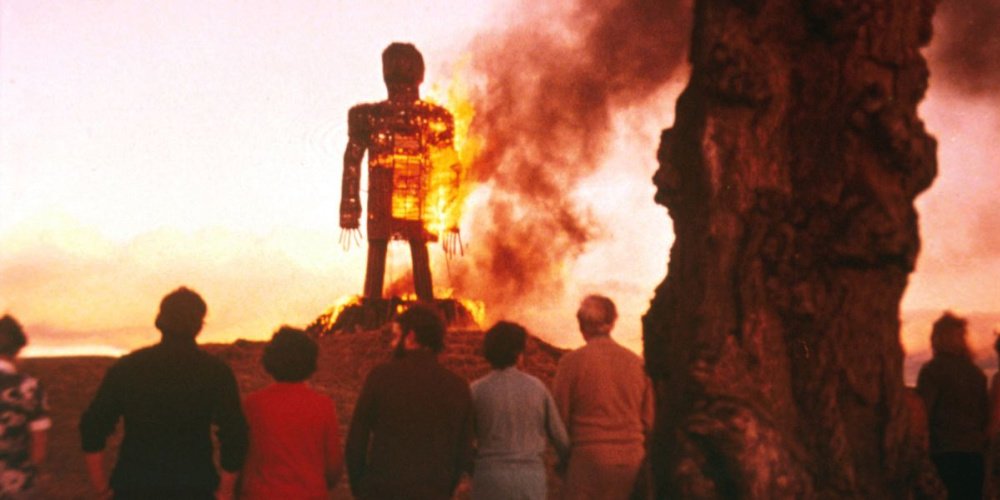
The 93rd Academy Awards ceremony takes place this weekend and while the event this year will certainly be different from previous, non-pandemic-plagued years, there is always a certain amount of magic in the air. This magic has been well-earned over the years. Starting in 1929 as a rather insular industry banquet, it has blossomed into the spectacle it is now. An Oscar is worth a good deal more now than it was then. It is a virtual guarantor of profitability for the film that wins Best Picture and an acting award can more or less ensure a lifetime of work for the lucky recipient.
With so many years of history, there are bound to be some moments that stand out above others. Here are a few favorites. It would be impossible to present any kind of comprehensive list, and many others have taken stabs at it, but we hope you enjoy our selection.
Here is Jane Fonda accepting the award in 1979 for her work in Hal Ashby’s COMING HOME. She developed a much greater awareness for disabled people while preparing for the film and it certainly comes across powerfully in her speech.
Next, a couple of groundbreaking moments. Hattie McDaniel accepts the Best Supporting Actress award for GONE WITH THE WIND. McDaniel was the first Black actor nominated for an Academy Award and the first winner. You may notice that the close-up of the speech was done after the fact in a retake, as the camera placement at the time would not permit close angle shots.
Sixty-two years later, Halle Berry was the first Black performer to win the award for Best Actress, for MONSTER’S BALL. You can see how very aware she is of the historic nature of the moment and it adds to her own deeply emotional response.
Here’s another special one. Charles Chaplin’s role in the refinement and perfection of the art of Cinema is well known. What may be less well known today is that he was effectively exiled from the his adopted home in the U.S. for decades thanks to an anti-communist witch hunt spearheaded by FBI Director J. Edgar Hoover, and aided in the sensationalist press by charges of loose sexual morals. Hollywood did not forget, and you can see some of the response here – in fact the video is considerably shortened. The actual ovation that Chaplin received by the industry’s best and brightest was twelve minutes long, a record that seems destined to stand.
Here are two old friends who captured the hearts of the public like few others before them, having fun on stage together for the last time as Cary Grant presents the honorary Oscar to James Stewart in 1985. There’s a lot of love in this room.
This is a two-parter. First, as William Holden and Barbara Stanwyck presented an award at the 1978 Oscars, Holden was seized by a moment of gratitude for his longtime friend and former co-star Stanwyck. Back in 1939, Holden’s film career nearly ended before it began, but Stanwyck, his GOLDEN BOY co-star, took him under her wing. Holden can tell the rest of the story better than we can. It’s hard to see it in the blurry video, but Stanwyck has tears streaming down her face.
Late in 1981, William Holden died unexpectedly. At the next year’s Oscar ceremony, Stanwyck received an honorary lifetime Oscar, her first. In the speech, she remembered her old friend.
Finally, this may be the most iconic Oscar speech. It is certainly the most parodied. But, there’s something so primal and real about Sally Field’s refrain of “You like me” that transcends the glitz and the polish of the show. This is what it is all about for most of us, most certainly for actors, and she comes right out and says it.
You have probably seen the news by now that Pacific Theatres, the cinema chain that operates the famous Arclight Theaters, is closing up shop due to the financial strains caused by the pandemic. For now, that means that its most famous and most visible outlet, the historic Cinerama Dome, is shuttering. The shock and outrage caused by this announcement, and the close proximity of some singularly deep pockets belonging to film lovers, may help to save the dome. We hope so, but it seems like a good time to look back at the theater that was originally intended to serve as a pilot program that would change film exhibition for good.
Cinerama Dome Under Construction 1963
To understand the impetus for the project in the first place, let’s look at its time period. In 1963 movie theaters were locked in an existential struggle with television. How could the big screen set itself apart from the small screen? 3D was one way, another way was to make the big screen a huge screen. That gave rise to the Cinemascope boom of the ’50s and, by 1952, to Cinerama, a process that used an enormous, curved screen that actually enveloped an audience in its picture, provided by three synchronized projectors. You could definitely never experience that at home.
The curved Cinerama screen
Speaking of which, the very idea of home was changing too. People were moving farther away from city centers into suburbs, which were being built as fast as the lumber could be unloaded from trucks and the concrete for the streets poured. This is where the radical idea for the geodesic dome came in. The dome, first conceived by the visionary architect and futurist R. Buckminster Fuller, was cheap to produce and quick to assemble. The idea was that the Cinerama company could build dozens of these around the country with a reasonably low investment and put them where the people were, whether in the city centers or the suburbs. The unusual, futuristic design was also sure to be an attention grabber, always a commercial asset.
The IT’S A MAD, MAD, MAD, MAD WORLD Premiere
By the time the pilot Cinerama Dome was built in Hollywood, there were only eleven Cinerama films commercially available to show. This may give the reader an idea as to why the project was in hot water already even as it hosted the premiere of the twelfth, Stanley Kramer’s knockabout comedy IT’S A MAD, MAD, MAD, MAD WORLD. Cinerama was extremely expensive to film, to print, to produce and even to ship to venues. Furthermore the unusual physical dimensions of the features made them difficult to convert for exhibition in non-Cinerama theaters and, you guessed it, for television, at a time when TV licensing was just becoming a major building block in film budgeting.
Cinerama did not peter out immediately, it had its run, peaking in 1965 with seven Cinerama productions being released. Only three of these were truly prestige productions however, and the rate of return was not sufficiently remunerative to continue at this pace. And so the great dream of a Dome in every city did not come true, though an unused aluminum prototype was built in Las Vegas where it stood until 1985.
In 1987, showing THE UNTOUCHABLES in 70mm
In many ways that made the first Cinerama Dome in Hollywood a great monument to a future that never came to pass. As of now, the Dome will no longer offer film exhibition, but the future is as hard to predict today as it was in 1963, and there very well may be plans to keep the Dome extant in one form or another. We hope so.
The facade of the Cinerama Dome restored to its period glory for ONCE UPON A TIME IN HOLLYWOOD (2019)
This is a reprint of an AFS Viewfinders post from 2015.
Nearly 20 years after her death, film critic Pauline Kael still inspires controversy. During her lifetime she was loved by many, hated by some and feared by studios and publicists (much of Hollywood felt, with some justification, that she could make or break a movie with her New Yorker reviews).
One matter that nearly everyone agrees on is that she was an exceptionally good and forceful writer. Her collections fall in and out of print, but just as every generation of theater people discovers Shakespeare anew, so does every new cycle of film people find its way to Kael. And if those copies of “I Lost It At The Movies” or “Kiss Kiss Bang Bang” are a little dog-eared and foxed, then so be it, the contents are immortal.
Kael began writing about film professionally when she managed and programmed a small two-screen theater for the Berkeley Cinema Guild from 1955 to 1960. She wrote beautiful, insightful and persuasive capsule notes for the films she chose. At around the same time she became the on-air film critic for Berkeley’s community radio station KPFA. A number of the reviews Kael read on-air are collected in her first books and her capsule reviews can be found in the invaluable collection “1001 Nights At The Movies,” revised as “5001 Nights At The Movies.”
She had an 8-year run as unpaid film reviewer for KPFA before quitting in 1963. Some of the frustrations that led to her resigning the post are apparent in this broadcast, recorded just before she quit. Kael’s legendary wit, incisiveness and truculence are here, in a giant-sized portion. All of us who replay an argument in our heads afterwards, thinking, “I should have said that!” will appreciate the precision and sickness of the burn she administers here.
This recording is incomplete, though you certainly get the flavor of it. Her full broadcast script (including the portion not available on tape) is reprinted here:
Replying to Listeners
by PAULINE KAEL
I am resolved to start the New Year right; I don’t want to carry over any unnecessary rancor from 1962. So let me discharge a few debts. I want to say a few words about a communication from a woman listener. She begins with, “Miss Kael, I assume you aren’t married — one loses that nasty, sharp bite in one’s voice when one learns to care about others.”
Isn’t it remarkable that women, who used to pride themselves on their chastity, are now just as complacently proud of their married status? They’ve read Freud and they’ve not only got the illusion that being married is healthier, more “mature,” they’ve also got the illusion that it improves their character. This lady is so concerned that I won’t appreciate her full acceptance of femininity that she signs herself with her husband’s name preceded by a Mrs. Why, if this Mrs. John Doe just signed herself Jane Doe, I might confuse her with one of those nasty virgins, I might not understand the warmth and depth of connubial experience out of which she writes.
I wonder, Mrs. John Doe, in your reassuring, protected marital state, if you have considered that perhaps caring about others may bring a bite to the voice? And I wonder if you have considered how difficult it is for a woman in this Freudianized age, which turns out to be a new Victorian age in its attitude to women who do anything, to show any intelligence without being accused of unnatural aggressivity, hateful vindictiveness, or lesbianism. The latter accusation is generally made by men who have had a rough time in an argument; they like to console themselves with the notions that the woman is semi-masculine. The new Freudianism goes beyond Victorianism in its placid assumption that a woman who uses her mind is trying to compete with men. It was bad enough for women who had brains to be considered freaks like talking dogs; now it’s leeringly assumed that they’re trying to grow a penis — which any man will tell you is an accomplishment that puts canine conversation in the shadows.
Mrs. John Doe and her sisters who write to me seem to interpret Freud to mean that intelligence, like a penis, is a male attribute. The true woman is supposed to be sweet and passive — she shouldn’t argue or emphasize and opinion or get excited about a judgment. Sex — or at least regulated marital sex — is supposed to act as a tranquilizer. In other words, the Freudianized female accepts that whole complex of passivity that the feminists battled against.
Mrs. Doe, you know something, I don’t mind sounding sharp — and I’ll take my stand with those pre-Freudian feminists; and you know something else, I think you’re probably so worried about competing with male egos and those brilliant masculine intellects that you probably bore men to death.
This lady who attacks me for being nasty and sharp goes on to write, “I was extremely disappointed to hear your costic speech on and about the radio station, KPFA. It is unfortunate you were unable to get a liberal education, because that would have enabled you to know that a great many people have many fields of interest, and would have saved you from displaying your ignorance on the matter.” She, incidentally, displays her liberal education by spelling caustic c-o-s-t-i-c, and it is with some expense of spirit that I read this kind of communication. Should I try to counter my education — liberal and sexual—against hers, should I explain that Pauline Kael is the name I was given at birth, and that it does not reflect my marital vicissitudes which might over-complicate nomenclature?
It is not really that I prefer to call myself by my own name and hence Miss that bothers her or the other Mrs. Does, it is that I express ideas she doesn’t like. If I called myself by three names like those poetesses in the Saturday Review of Literature, Mrs. Doe would still hate my guts. But significantly she attacks me for being a Miss. Having become a Mrs., she has gained moral superiority: for the modern woman, officially losing her virginity is a victory comparable to the Victorian woman’s officially keeping hers. I’m happy for Mrs. Doe that she’s got a husband, but in her defense of KPFA she writes like a virgin mind. And is that really something to be happy about?
Mrs. Doe, the happily, emotionally-secure-mature-liberally-educated-womanly-woman has her opposite number in the mailbag. Here is a letter from a manly man. This is the letter in its entirety:
Dear Miss Kael,
Since you know so much about the art of the film, why don’t you spend your time making it? But first, you will need a pair of balls.
Mr. Dodo (I use the repetition in honor of your two attributes), movies are made and criticism is written by the use of intelligence, talent, taste, emotion, education, imagination, and discrimination. I suggest it is time you and your cohorts stop thinking with your genital jewels. There is a standard answer to this old idiocy of if-you-know-so-much-about-the-art-of-the-film-why-don’t-you-make-movies. You don’t have to lay an egg to know if it tastes good. If it makes you feel better, I have worked making movies, and I wasn’t hampered by any biological deficiencies.
Others may wonder why I take the time to answer letters of this sort: the reason is that these two examples, although cruder than most of the mail, simply carry to extremes the kind of thing so many of you write. There are, of course, some letter writers who take a more “constructive” approach. I’d you to read you part of a long letter I received yesterday:
I haven’t been listening to your programs for very long and haven’t heard all of them since I began listening … But I must say that while I have been listening, I have not heard one favorable statement made of any “name” movie made in the last several years…. I have heard no movie which received any kind of favorable mention which was not hard to find playing, either because of its lack of popularity or because of its age. In your remarks the other evening about De Sica’s earlier movies you praised them all without reservation until you mentioned his “most famous film — The Bicycle Thief, a great work, no doubt, though I personally find it too carefully and classically structured.” You make me think that the charge that the favorability of your comments on any given movie varies inversely with its popularity, is indeed true even down to the last nuance.
But even as I write this, I can almost feel you begin to tighten up, to start thinking of something to say to show that I am wrong. I really wish you wouldn’t feel that way. I would much rather you leaned back in your chair, looked up at the ceiling and asked yourself, “Well, how about it? Is it true or not? Am I really biased against movies other people like, because they liked them? When I see a popular movie, do I see it as it is or do I really just try to pick it apart?” You see, I’m not like those other people that have been haranguing you. I may be presumptuous, but I am trying sincerely to be of help to you. I think you have a great deal of potential as a reviewer…. But I am convinced that great a potential as you have, you will never realize any more of that potential than you have now until you face those questions mentioned before, honestly, seriously, and courageously, no matter how painful it may be. I want you to think of these questions, I don’t want you to think of how to convince me of their answers. I don’t want you to look around to find some popular movie to which you can give a good review and thus “prove me wrong.” That would be evading the issue of whether the questions were really true or not. Furthermore, I am not “attacking” you and you have no need to defend yourself to me.
May I interrupt? Please, attack me instead — it’s this kind of “constructive criticism” that misses the point of everything I’m trying to say that drives me mad. It’s enough to make one howl with despair, this concern for my potential — as if I were a cow giving thin milk. But back to the letter—
In fact, I would prefer that you make no reply to me at all about the answers to these questions, since I have no need of the answers and because almost any answer given now, without long and thoughtful consideration, would almost surely be an attempt to justify yourself, and that’s just what you don’t have to do, and shouldn’t do. No one needs to know the answers to these questions except you, and you are the only person who must answer. In short, I would not for the world have you silence any voices in you … and most certainly not a concerned little voice saying, “Am I really being fair? Do I see the whole movie or just the part I like—or just the part I don’t like?”
And so on he goes for another few paragraphs. Halfway through, I thought this man was pulling my leg; as I got further and read “how you missed the child-like charm and innocence of The Parent Trap … is quite beyond me,” I decided it’s mass culture that’s pulling both legs out from under us all. Dear man, the only real question you letter made me ask myself is, “What’s the use?” and I didn’t lean back in my chair and look up at the ceiling, I went to the liquor cabinet and poured myself a good stiff drink
How completely has mass culture subverted even the role of the critic when listeners suggest that because the movies a critic reviews favorably are unpopular and hard to find, that the critic must be playing some snobbish game with himself and the public? Why are you listening to a minority radio station like KPFA? Isn’t it because you want something you don’t get on commercial radio? I try to direct you to films that, if you search them out, will give you something you won’t get from The Parent Trap.
You consider it rather “suspect” that I don’t raise more “name” movies. Well, what makes a “name” movie is simply a saturation advertising campaign, the same kind of campaign that puts samples of liquid detergents at your door. The “name” pictures of Hollywood are made the same way they are sold: by pretesting the various ingredients, removing all possible elements that might affront the mass audience, adding all possible elements that will titillate the largest number of people. As the CBS television advertising slogan put it—“Titillate—and dominate.” South Pacific is seventh in Variety’s list of all-time top grossers. Do you know anybody who thought it was a good movie? Was it popular in any meaningful sense or do we just call it popular because it was sold? The tie-in campaign for Doris Day in Lover Come Back included a Doris Day album to be sold for a dollar with a purchase of Imperial margarine. With a schedule of 23 million direct mail pieces, newspaper, radio, TV and store ads, Lover Come Back became a “name” picture.
I try not to waste air time discussing obviously bad movies — popular though they may be; and I don’t discuss unpopular bad movies because you’re not going to see them anyway; and there wouldn’t be much point or sport in hitting people who are already down. I do think it’s important to take time on movies which are inflated by critical acclaim and which some of you might assume to be the films to see.
There were some extraordinarily unpleasant anonymous letters after the last broadcast on The New American Cinema. Some were obscene; the wittiest called me a snail eating the tender leaves off young artists. I recognize your assumptions: the critic is supposed to be rational, clever, heartless and empty, envious of the creative fire of the artists, and if the critic is a woman, she is supposed to be cold and castrating. The artist is supposed to be delicate and sensitive and in need of tender care and nourishment. Well, this nineteenth-century romanticism is pretty silly in twentieth-century Bohemia.
I regard criticism as an art, and if in this country and in this age it is practiced with honesty, it is no more remunerative than the work of an avant-garde film artist. My dear anonymous letter writers, if you think it is so easy to be a critic, so difficult to be a poet or a painter or film experimenter, may I suggest you try both? You may discover why there are so few critics, so many poets.
Some of you write me flattering letters and I’m grateful, but one last request: if you write me, please don’t say, “This is the first time I’ve ever written a fan letter.” Don’t say it, even if it’s true. You make me feel as if I were taking your virginity — and it’s just too sordid.
The course of Cinema’s history has been a long and arduous one. Today’s master is tomorrow’s forgotten auteur. As the tastes of the multitudes and the critical fashions of the day converge in the manner of a mighty river… are you still reading?
Good, because this is an April Fools joke. We’re not really doing a reappraisal of Rob Schneider’s art, though, if we’re being honest, there are some pretty funny Rob Schneider movies, particularly the underrated Deuce Bigalow cycle. Hey, funny is funny.
While we’ve got you laughing – we hope – we want to share a list that AFS Lead Programmer Lars Nilsen has created of some very funny oddball comedies that you can stream today on the most popular services.
You can see the list here and if you click on the “Read Notes” button it will show you the streaming services that the films can be viewed on.
Some of the films are recent: Onur Tukel’s bizarre go-for-broke gonzo revenge comedy CATFIGHT (2016) and Jocelyn DeBoer and Dawn Luebbe’s 2019 GREENER GRASS which takes a completely surreal look at suburban conformity.
A few of the films are reasonably well known – like the hysterically funny 1994 CLIFFORD which stars Martin Short (sans any special effects) as a 10 year old boy making life hell for his uncle, played by the great Charles Grodin. The 1966 film LORD LOVE A DUCK has also gained some notoriety as a critical favorite in recent years, largely due to the wonderful lead performances by Tuesday Weld and Roddy McDowell. And COTTON COMES TO HARLEM, an energetic, fast paced adaptation of the Chester Himes novel has also been spotlighted more recently, but is still woefully underappreciated.
Naturally there are some total unknowns, like THE MANCHU EAGLE MURDER CASE which uses a parade of stars to tear the roof off the depraved poultry industry of central California. And the Chicago-made TOWING which seems to be a bilious reaction to a bad experience with a tow truck driver. Both are very funny.
Lastly, there are a pair of wild cards on this list. Michael Reeves’ THE SHE BEAST is rarely discussed as a comedy, maybe because it is also a very effective horror film, but the humor is weird and pervasive in the story of a pair of tourists (Ian Oglivy and Barbara Steele) who get tangled up with a witch’s ghost on a road trip in Eastern Europe. And Sacha Guitry’s THE STORY OF A CHEAT uses the old “unreliable narrator” gambit to create comic tension in its memoir of a fictional ne’er do well.
Last week was a whirlwind of screenings, Q&As, and roundtables, as it always is during SXSW, but unlike most years the whole thing was virtual, conveyed through an app. It still feels a little odd to participate in film festivals virtually though it must be said that many fests now have it down pretty well. There is no substitute for the person-to-person interaction, the line conversations, the impromptu meetings, etc, but the ability to watch six or more movies a day is pretty unique to the at-home experience. We saw a bunch of unique films this year and, as usual, we wanted to highlight a few of them for you so that you can keep an eye out for them as they make their way into theaters and/or home viewing setups.
Here are some of the best and most interesting films that AFS Lead Programmer Lars Nilsen saw at SXSW ’21.
“Not surprisingly all but one of my picks are docs. It was an especially good class of non-fiction films this year. There were many fine Austin-made films as well, some of which AFS had the honor of providing funding or other assistance for. I am not including these here, not because they were not excellent, but because they have received a fair amount of attention elsewhere.” – Lars Nilsen
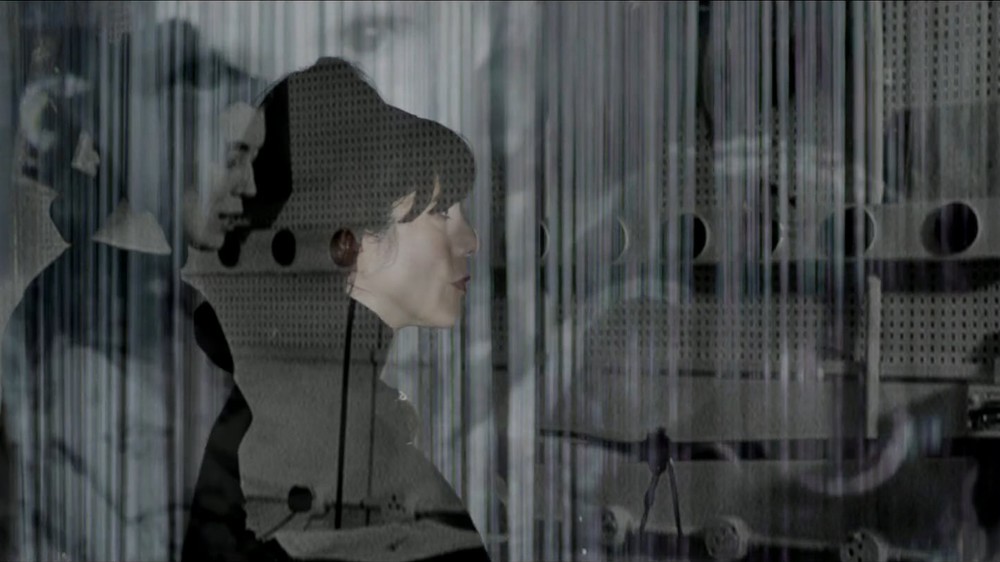
DELIA DERBYSHIRE: THE MYTHS & THE LEGENDARY TAPES (Dir. Caroline Catz)
The life and times of the electronic music pioneer who was a key contributor to the music and other sounds created by the BBC Radiophonic Workshop. Only a small amount of footage exists of Derbyshire but director Caroline Catz has added dramatic reconstructions of recording sessions and other key moments to help give us a portrait of an artistic pioneer who climbed some pretty steep walls to help change the landscape of modern sound. Catz has also enlisted the aid of composer Cosey Fanni Tutti to remix and reimagine some newly rediscovered tapes of Derbyshire’s memoirs.
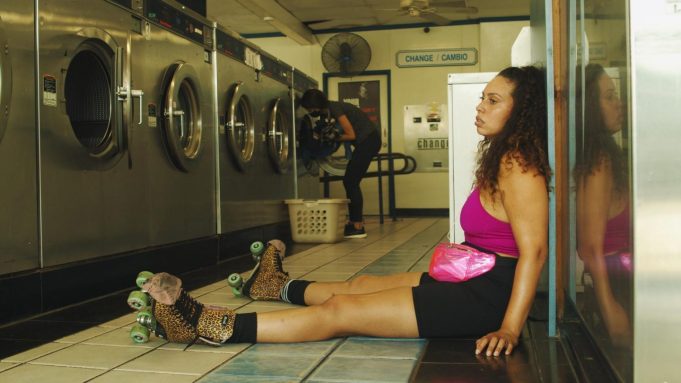
I’M FINE (THANKS FOR ASKING) (Dir. Kelley Kali, Angelique Molina)
The subject matter of this film sounds a little grim – a young mother who lives with her daughter in a tent because they can’t afford a home has to hustle up a few hundred dollars and gets sidetracked continually. In fact, there’s a lot of joy and humor in this sharply observed narrative film. While the struggles are shown in a realistic manner, there is a haze of optimism that hangs over the picture and keeps things from getting too depressing. We have faith in the woman and in the power of her will to succeed.
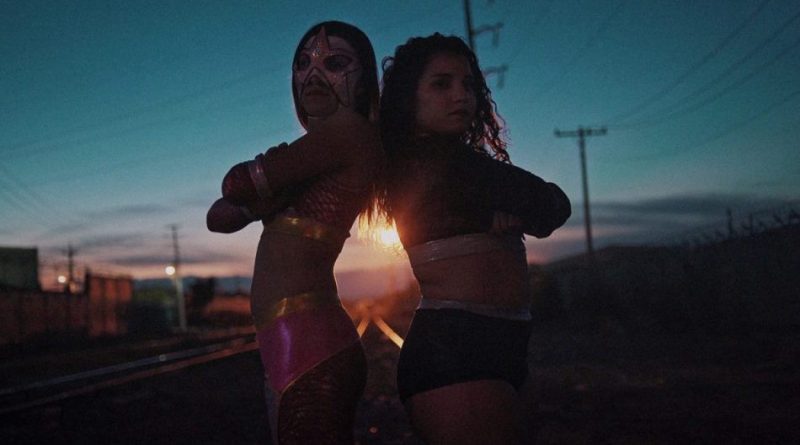
LUCHADORAS (Dir. Paola Calvo, Patrick Jasim)
This is something of a real-life superhero film. In the community of Ciudad Juarez, just across the border with El Paso, the violent crime rate is astronomical, and women are especially vulnerable. Against this backdrop, we meet several female wrestlers from different backgrounds, of different ages and even of different heights – one of them is a little person. As we come to see how they cope in this environment—putting on shows, trying to get to America, and teaching self-defense classes for women—we gain respect for their struggle and the character that allows them to fight through it.
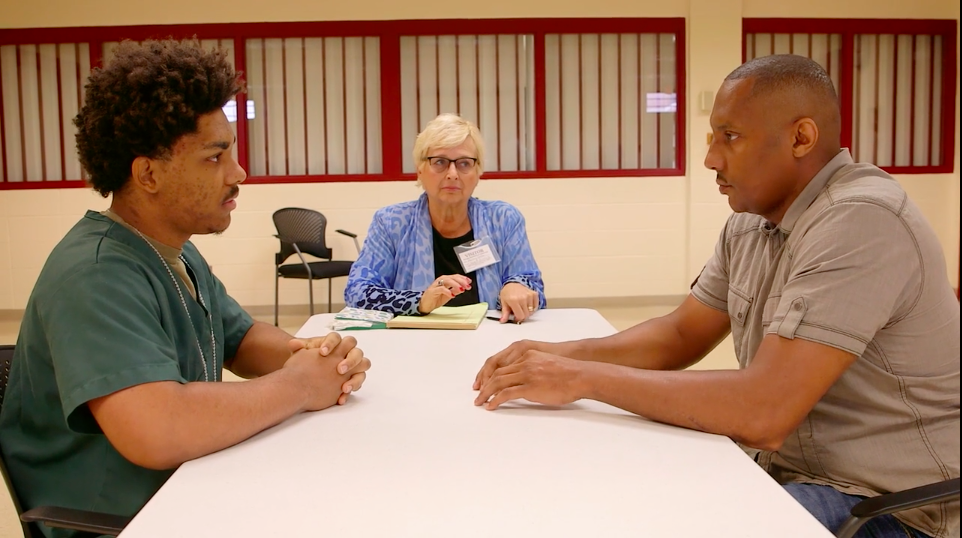
WHEN CLAUDE GOT SHOT (Dir. Brad Lichtenstein)
In this documentary, we see the many facets of a single, seemingly senseless crime. A Milwaukee man is approached by a would-be carjacker with a gun. The driver speeds off but is hit by a bullet fired by the pursuing thief. The victim undergoes a painful surgery to reconstruct his jaw but recovers. The young thief however continues his spree and is shot in the spine. The rest of the film shows us their parallel stories. The victim, a successful businessman and middle-aged law student had some similar run-ins with the law as a young man and he tries to forgive and help. The now-disabled teenage perpetrator does not seem willing to meet in the middle. This is their surprising and moving story.
WOODLANDS DARK AND DAYS BEWITCHED: A HISTORY OF FOLK HORROR (Dir. Kier-La Janisse)
Kier-La Janisse is a legend in the field of film programming and as a film critic – her book House of Psychotic Women is a key influence on modern horror criticism and its intersection with trauma in the lives of fans and makers. Alongside her other work, she has made a large number of what she calls “bibliodocs” which use collectors’ footage, newly created video, and her own narration to tell stories of subjects she personally cares about deeply – subjects have included Bubblegum music and the creative life of Lee Hazlewood. This is a bibliodoc with relatively supercharged means. It is about folk horror and not just the folk horror of the British Isles. This is a comprehensive and long (over three hours) film that will make the viewer consider the themes of folk horror films in new ways.
SXSW is back! After last year’s cancellation, the 2021 festival returns as an all-digital experience, taking place March 16-20. We are excited to be a part and share that six AFS-supported filmmakers are making their world premieres at SXSW: Haley Anderson’s SUMMER ANIMALS, Keith Maitland’s DEAR MR. BRODY, Mei Makino’s INBETWEEN GIRL, Channing Godfrey Peoples’ DORETHA’S BLUES, Tamara Saviano’s WITHOUT GETTING KILLED OR CAUGHT, and Renee Zhan’s O BLACK HOLE!
Ahead of the festival, AFS talked with filmmakers Keith Maitland, Mei Makino, and Tamara Saviano about their new projects (all of which were supported by the AFS Grant). We will also be hosting online Q&As with AFS-supported filmmakers during SXSW on our website. As well, join us for a special AFS@SXSW ‘21 Virtual Mixer on March 18, 8–10pm. The event is free and you can register here.
For more info on this year’s online festival, visit SXSW 2021.
Keith Maitland, DEAR MR. BRODY Narrative Documentary
Tell us a little about your film. DEAR MR. BRODY is a psychedelic look into the heart and the bank account of the hippie millionaire who promised the world peace for the price of a postage stamp. It’s about our wants, desires and needs, and ultimately finding what matters most.
What was it about this particular story that made you want to feature it as the subject of a documentary? Michael Brody invited people to write him letters outlining their needs and he’d send them money—that was his plan, anyway. The Brody story had never been told. Behind that story were hundreds of thousands of letters that had never been opened. There was just too much opportunity for discovery, for uncovering an untold past and exploring the humanity of then and now, to pass this one up.
The past year has been full of challenges and delays—how does it feel to finally be premiering DEAR MR. BRODY at SXSW 2021? When Tribeca was cancelled, and the summer festivals, and then even Telluride, we were unsure if anyone would ever see our film… we were in limbo, like so much of the world—on pause. To get to share the film here in Austin with SXSW is a full-circle kind of moment.
As the recipient of an AFS Grant, how has that been helpful in your production of the film? I can’t say enough about how much I appreciate AFS, the literal spine of our filmmaking community. The support that AFS has provided throughout the years has helped take the edge off of a dangerous and unpredictable business. I’ve met collaborators, mentors and proteges through AFS programming.
How can we keep up with your film? You can keep up with us on Twitter & Instagram: @dearmrbrody@keithmaitland
Mei Makino, INBETWEEN GIRL Narrative Feature
Tell us a little about your film. On its surface INBETWEEN GIRLis about a teenage girl crushing on the hot guy on her soccer team, but beneath that it’s about a young woman figuring out her identity and place in the world.
What was the inspiration behind INBETWEEN GIRL? I’ve always been a fan of coming-of-age films, and I wanted to write one that was a little messier and closer to real life. I was also interested in exploring the psyche of a mixed-race teen dealing with unrelenting hormones.
Can you share anything about your experience of making the film? I learned so much! This really was a second film school for me. It was a blast getting to chat with and learn from all of the different departments. There was so much talent and knowledge on set, and it was a joy to witness.
As the recipient of an AFS Grant, how has that been helpful in your production of INBETWEEN GIRL? It was incredibly helpful in getting us started in post-production! We received the grant right after we finished production, and it gave us a huge feeling of ease and relief. It also gave us some street cred—when you’re backed by AFS, people start to pay attention.
Tamara Saviano, WITHOUT GETTING KILLED OR CAUGHT Narrative Documentary
Tell us a little about your film. WITHOUT GETTING KILLED OR CAUGHT is the true story of Guy Clark, the dean of Texas songwriters, who struggles to write poetic, yet indelible songs while balancing a complicated marriage with wife Susanna, and a deep friendship with singer-songwriter Townes Van Zandt, on whom Susanna forged a passionate dependence.
You first wrote a book about Guy Clark with the same title, WITHOUT GETTING KILLED OR CAUGHT: THE LIFE AND MUSIC OF GUY CLARK—did you set out to also make a documentary and what was the process like turning the book into a film? NO! I did not set out to make a film at all. While I was working on the book, another filmmaker approached Guy and wanted to make a documentary. Guy told me the only way he would cooperate on a film is if I made it, because we had already spent years together on the book. So, he put the idea in my head and also made me feel like I should rise to the challenge.
What is it about Guy Clark and his music that makes him so enduring? I think Guy is one of the greatest American songwriters who ever lived. His songs are like literature. They could have been short stories. And the Texas connection makes those stories especially rich.
As the recipient of an AFS Grant, how has that been helpful in your production of the film? The AFS Grant really helped us out of a jam after SXSW 2020 was cancelled. We had many expenses that were not recoupable leading up to our cancelled world premiere. The AFS Grant helped enormously.
How can we keep up with your film? Withoutgettingkilledorcaught.com is the best way. That is the platform where people can buy tickets for the virtual screenings in March and April. At the end of May, the film will be available On Demand at our website. Also, if people sign up for our newsletter, we will send them a rare, mid-1960s recording of Guy singing “Step Inside My House,” which is the first song he wrote and he never recorded it for an album.
March 8 is International Women’s Day. This is a day – hopefully only one of many days throughout the year – when, in the words of the UN: “women are recognized for their achievements without regard to divisions, whether national, ethnic, linguistic, cultural, economic or political.”
In the spirit of that day, we hope you will take some time to watch a film by one of the scores of woman filmmakers who have been supported by AFS Grants. These monetary endowments, funded by AFS’s donors, help to shape the cinematic landscape as we move forward, and the Texan filmmakers who are helped by these grants are given a springboard for making career leaps.
Allow us to suggest a few streaming films from AFS Grant-supported women filmmakers.
MISS JUNETEENTH
(2020, Directed by Channing Godfrey Peoples, 2016 & 2019 AFS Grant recipient)
This story of a connection between a mother and daughter in the lead-up to a Miss Juneteenth pageant. has captivated audiences and netted first-time director a raft of acclaim including awards from the National Board Of Review and four Independent Spirit Award nominations.
(2019 Directed by Annie Silverstein, 2019 AFS Grant recipient)
This film about a connection made across generations and social bounds between a rebellious teenage girl and an aging bull-rider screened at Cannes in the Un Certain Regard section, has been nominated for three Independent Spirit Awards, and garnered ecstatic reviews from critics worldwide.
(2019, D. Ivete Lucas & Patrick Bresnan, 2017 & 2018 AFS Grant recipient)
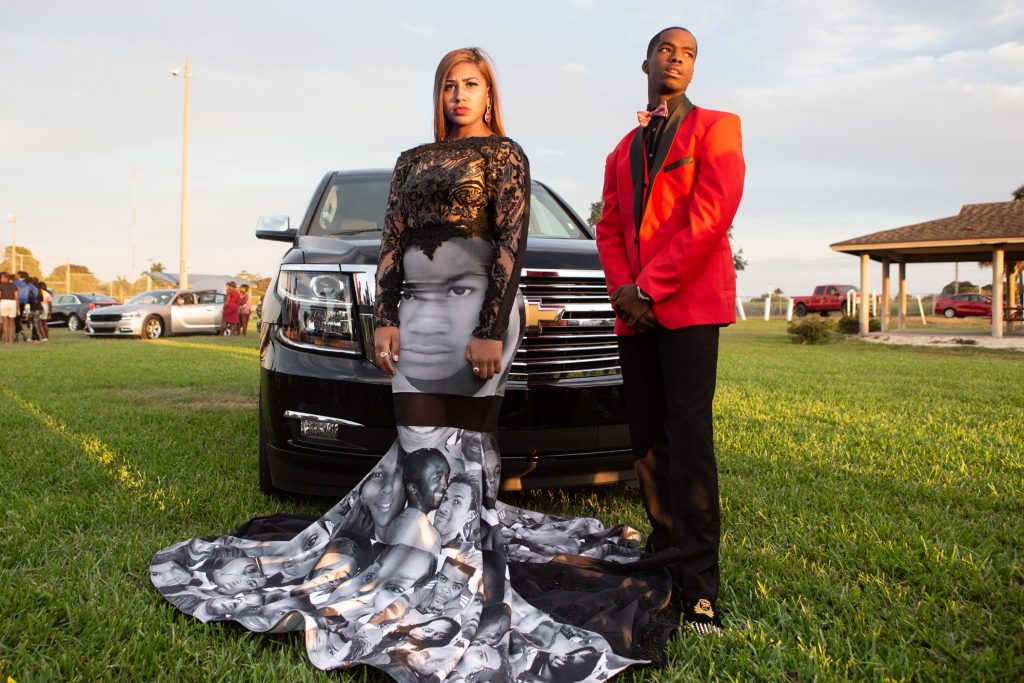
This documentary, made by the wife and husband team of Ivete Lucas and Patrick Bresnan, takes the viewer into the life of Pahokee, Florida as a group of teenagers experience their final year of high school. As the teenagers look to their future, the town also contemplates what the future might hold for it.
(television show, multiple directors, 2016-, former producer and executive producer is a four time AFS Grant recipient)
This one’s a little different. This is episodic TV with a high binge-quotient. The series, created by Ava DuVernay, is about three very different siblings who reunite in Louisiana when they inherit a sugar plantation. The show was directed, produced and executive produced during the 2017 and 2018 seasons by Kat Candler, who received the first of her four AFS Grants way back in 2000 and has credited AFS with helping her make the leap into television, where she has become one of the hottest talents in the business.
Almost as long as there have been films there have been documentaries about what happens behind the scenes. Some are amateurish, some are basically just commercials for the feature film, and a rare few are excellent works of art themselves. We have featured St. Claire Bourne’s work on these pages before. Well before Spike Lee asked him to document the making of 1989’s DO THE RIGHT THING, Bourne was a well known documentary filmmaker, and he has a clear idea about what he wants to say here. He wants to place the richness of the culture front and center and show the exertions and the beliefs of the people who are working to bring that culture to a place of prominence.
It is fascinating to watch the community come together around the production. We see Spike Lee as he guides large forces of people power and then, just as quickly, goes into intimate consultation with his actors about the tiniest aspects of their performances. We can see what a massive responsibility the director has on a film set, while also simultaneously considering the added weight of Lee’s task as he makes a film about social currents that are of such enormous import to the people of a neighborhood.
It’s a remarkable documentary and an inspiration to creative and cultural workers everywhere. We hope you enjoy it too.
You don’t need us to tell you that when it comes to independent film, the annual Sundance Film Festival is the big Kahuna. This is the time when much of the blueprint for the year in indie film is determined. The films that make a big impression here are likely to be the ones that everyone is talking about in a few months – the arthouse hits. But those three or four titles are not the only movies that play at Sundance. For professional film programmers, like our own, the fest is also a first look at a wide variety of projects from around the world. Every year our AFS Cinema screen features dozens of films that we first laid eyes on in Park City, Utah.
This year was a little different. There was no snow on the ground, and we could watch the films from the comfort of our own homes without having to eat popcorn and milk duds for dinner. But the Sundance programmers delivered another excellent slate of films. Here are some of AFS Lead Film Programmer Lars Nilsen‘s favorites from the fest. Keep an eye on them on our virtual screens and – fingers crossed – real screens this year.
WRITING WITH FIRE (Dir. Sushmit Ghosh, Rintu Thomas)
This doc introduces us to the female journalists who work for the online news outlet Khabar Lahariya in Northern India. These women are not only outcasts due to their gender in a culture that values men much more highly, they are also members of the “lowest” caste, the Dalits. As we observe them covering their beats, mainly using their mobile phones to film and record their reportage, we get a sense of the dangers that people in their socioeconomic class face. This background makes us admire them all the more because these women, led by their editor Meera, are stone cold bulldogs. Their fearless pursuit of the story is contrasted with members of the legitimate media, living soft lives and asking even softer questions. These are remarkable women and this doc honors their courage and tenacity.
WE’RE ALL GOING TO THE WORLD’S FAIR (Dir. Jane Schoenbrun)
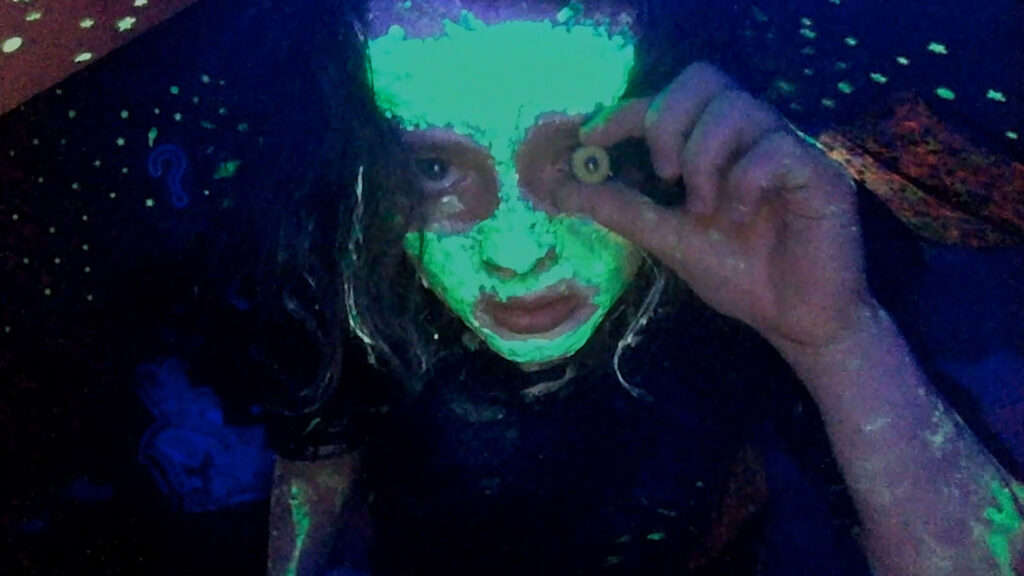
Fans of Jane Schoenbrun’s traveling Eyeslicer programs, which you may have seen at the AFS Cinema, will be eager to see Schoenbrun’s narrative debut film. Here, a teenage girl participates in a mysterious online roleplaying game called the World’s Fair Challenge. The film’s perspective for much of its runtime is the video updates she makes as she records the effects of the unseen stimuli on her mind and body. Schoenbrun is a keen student of online subcultures and this film forces us to keep our antennae on high alert as we digest the context clues about the game and its players. In such a heightened state, the horror elements of the narrative catch us off guard in new and provocative ways.
MY NAME IS PAULI MURRAY (Dir. Betsy West, Julie Cohen)
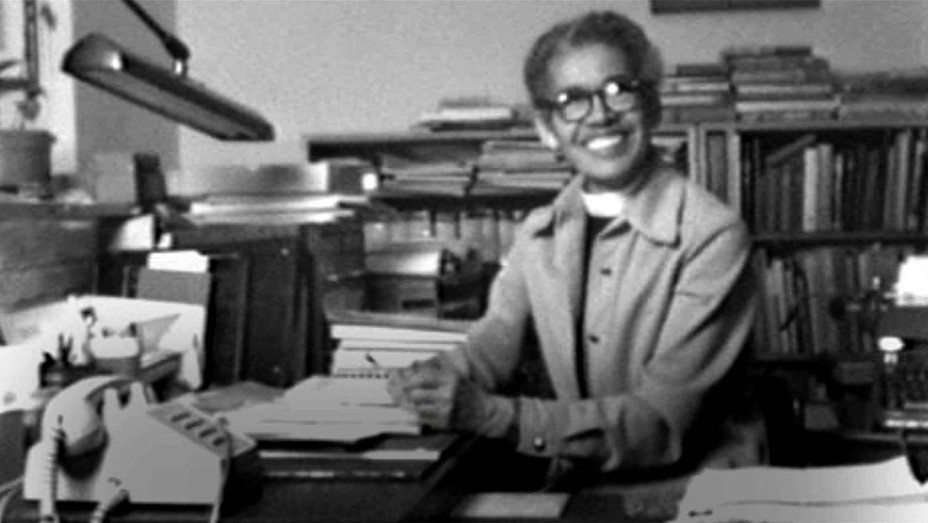
The makers of RBG are back with a new doc that is both a major step forward for their filmmaking as well as a much-needed portrait of a brilliant and complex person whose life is the stuff of legend. Pauli Murray’s public and intellectual life is almost too eventful to be believed. Murray, disguised as a boy, rode freight trains during the Depression, was arrested in some of the earliest anti-segregation protests, became a lawyer, gestated some of the key points that were later used in Civil Rights legislation, and more. I won’t spoil the surprises. Throughout it all, she was wrapped up in a personal quest to determine her gender identity. Now, we might consider her non-binary, but in the years before society’s vocabulary could encompass this, she faced a major struggle to come to terms with it. This is a truly remarkable story, and it will not be surprising if a narrative biopic is made about Murray in a few years.
REBEL HEARTS (Dir. Pedro Kos)
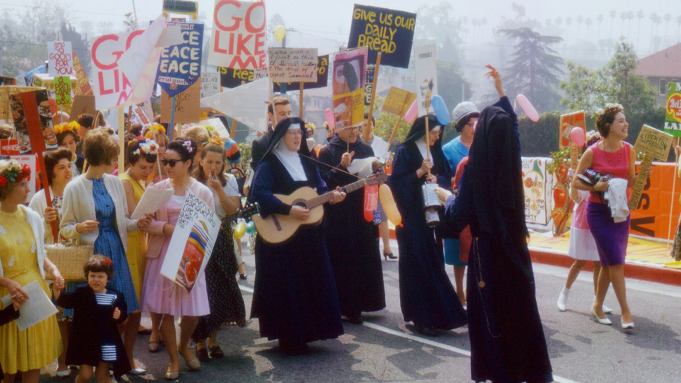
The inner workings of convents and religious schools are mysterious things to the (literal) layperson. This documentary shows us the inner workings of Los Angeles’ Immaculate Heart College and the nuns who ran it, the Sisters Of The Immaculate Heart. That is interesting enough in itself, but the time period in which we are given this access is the era of dissent and change that began in the ’60s. As the nuns begin to question their role in the Church and the Church’s role in society, the ecclesiastical higher-ups appoint a very conservative Bishop to oversee their work and the dissent multiplies. A very interesting film even for people who are not involved in religious life. Special alert for lovers of printmaking and serigraphy, as one of the nuns was a very famous artist who worked in this medium, Corita Kent.
CRYPTOZOO (Dir. Dash Shaw)
Like Dash Shaw’s earlier animated feature MY ENTIRE HIGH SCHOOL SINKING INTO THE SEA, this highly imaginative new film is so full of ideas that the new effect can be somewhat exhausting. I will chalk a lot of that up to the fact that I was watching five or six movies every day, but you may find that this one is best taken in smaller doses. The aesthetic is post-psychedelic – I would place the visual and musical reference points at approximately 1980. That’s not a bad thing. There’s also a lot of anti-establishment paranoia, something that never seems to go out of style. The allegorical story of cryptids and their allies trying to survive and thrive in a world of capitalist and militaristic exploitation is stretched to the absolute breaking point but the visual phantasmagoria is endlessly surprising and rich.
These five films only scratch the surface of course. You’ll surely be seeing a number of our other favorites in theaters or on streaming services in the months to come. Keep an eye out for these: AMY TAN: UNINTENDED MEMOIR, FLEE, HOMEROOM, JOCKEY, RITA MORENO: A GIRL WHO DECIDED TO GO FOR IT, THE SPARKS BROTHERS, STREET GANG: HOW WE GOT TO SESAME STREET, SUMMER OF SOUL (…OR: WHEN THE REVOLUTION COULD NOT BE TELEVISED), and others.
In commemoration of the one year anniversary of the COVID lockdown in Wuhan, China, our friends at MTV Films are making the doc 76 DAYS available absolutely free to watch on Saturday 1/23. Even better, for every stream of the film you watch, AFS will receive a donation.
This is one of the best films of 2020, perhaps you saw it on one of the many year-end lists or heard the NPR story about it. It’s a remarkable film, full of heroic medical workers pushing themselves past the point of human endurance as they battle the first wave of the COVID 19 outbreak. It’s a beautiful document of humanity and there are even a few laughs – really!
“We are likely to be watching films on this subject for years to come, but for it’s sheer in-the-moment rawness, 76 DAYS is one that will stick in your consciousness for some time.”
It has been twenty-five years since Robert Rodriguez’s FROM DUSK TILL DAWN hit American movie screens. We’re guessing you’ve seen it by now. It’s the one that made George Clooney and Salma Hayek movie stars and it was among the most exciting moviegoing experiences of the decade. You can imagine how thrilling it must have been to see on opening night as a rabid crowd jammed the Paramount Theater for the Austin Film Society world premiere of the film.
Here from the vaults is a shaky-cam document of the opening night remarks by Louis Black, Richard Linklater and Quentin Tarantino. Robert Rodriguez was in California working on promotion for the film. Fortunately, Tarantino, never known as a low-energy speaker, kicks it off right. Forgive the low video quality but we think you’ll agree that this moment of Austin film history is worth seeing.
If you are a fan of conspiracy theories, you are living in the right era. Pizzagate, Epstein, personality cults, furniture retailers selling children in armoires… It’s all so weird and dumb, and belief in this stuff is terrifyingly widespread.
But we didn’t start the fire. Cinema du Conspiracy has been thriving since the ’60s, amply fueled by the confusion and uncertainty that followed in the wake of the Warren Commissions report on JFK’s assassination. Again and again, the JFK story reappears in films and other fictional thrillers about conspiracies and paranoia. But even though the JFK conspiracy is the Big Daddy of them all, there are also movies about other conspiracies and the general paranoia stew that was the late 20th century.
Here are some deep cuts from Conspiracy and Paranoia land, chosen by AFS Lead Programmer Lars Nilsen. We assume you are familiar with some of the heavy hitters in the genre, THE CONVERSATION, JFK, THE PARALLAX VIEW, BLOW OUT, etc. Here are some others that you may not be familiar with and can help provide you with a few therapeutic hours of controlled mania before you turn on the news and are again confronted with the deep weirdness of real life.
For the Letterboxers among you, here is a link so you can add these films to your own watchlist.
BLUE SUNSHINE (1977, Dir, Jeff Lieberman)
In this true classic of seventies paranoia, a bunch of people start flipping out and committing murders for seemingly no reason, until someone pieces together the fact that they had all taken a mysterious strain of LSD back in the ’60s. Dark secrets, harrowing bad trips, it’s all here. A spectacular piece of low-budget horror filmmaking.
CAPRICORN ONE (1977, Dir. Peter Hyams)
This picks up where the “moon landing was faked” theory lets off. Here, it’s a Mars landing, staged in a TV studio. The astronauts whose lives are in danger are played by James Brolin, Sam Waterston and OJ Simpson and the reporter who flips over desks in his crusade to discover the truth and protect the hapless astronauts is played by Elliott Gould! A fast-paced, mildly silly ride, but it’s fun.
Streaming on HBO Max & Shout Factory TV
CUTTER’S WAY (1981, Dir. Ivan Passer)
When Jeff Bridges’ character Richard Bone sees a crime perpetrated by a wealthy man go unpunished, he is thirsty for justice. But when he brings his physically and mentally scarred Vietnam vet friend Alex Cutter (John Heard) into the picture, he unleashes a hurricane of righteous fury. A fascinating character study that assumes you agree with the premise that America is hopelessly corrupt and evil and goes from there.
EXECUTIVE ACTION (1973, Dir. David Miller)
A lot of these films allude in various ways to the JFK assassination. This one meets it head-on, postulating a theory, put forward by assassination historian Mark Lane, about how and why the President was killed. Starring Burt Lancaster and scripted by Donald Trumbo, it’s a very dramatic Hollywood take on the events, in a good way. This one was pretty controversial and was pulled from theaters. A few short years later, in the aftermath of Watergate, it fit right in with the national tone of skepticism and mistrust in institutions.
THE HIDDEN (1987, Dir. Jack Sholder)
In this one, the shape-shifting evil that is making people commit mass murders comes from a galaxy far, far away, and so does its adversary, a space cop temporarily occupying the very symmetrical body of Kyle MacLachlan. Hyperviolent, humorous and genuinely surprising in its plot convolutions.
LAST EMBRACE (1979, Dir. Jonathan Demme)
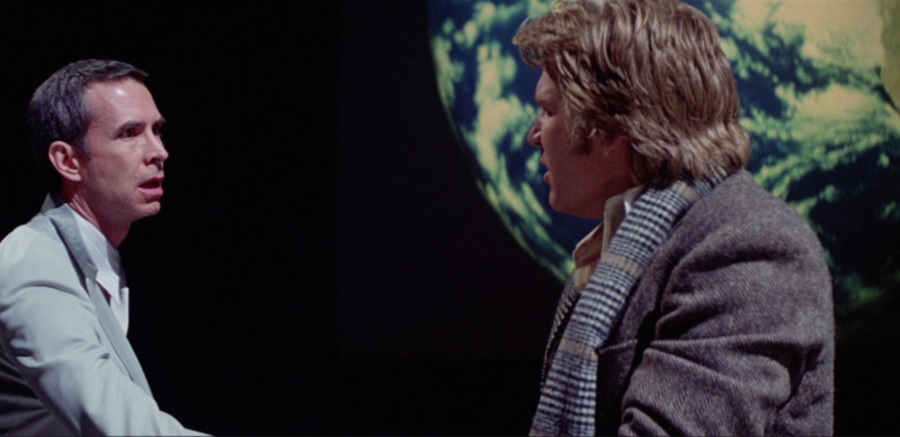
A real left turn by Demme, whose previous film had been the Altmanesque ensemble dramedy CITIZENS BAND. Here Roy Scheider plays a tough CIA agent on the mend from a nervous breakdown who finds that his employers are not thrilled to have him back. A great cast (the underrated Janet Margolin, Charles Napier and weird young Christopher Walken) adds a lot to this, as does the incredible orchestral score by the legendary old-Hollywood composer Miklos Rosza.
SECONDS (1966, Dir. John Frankenheimer)
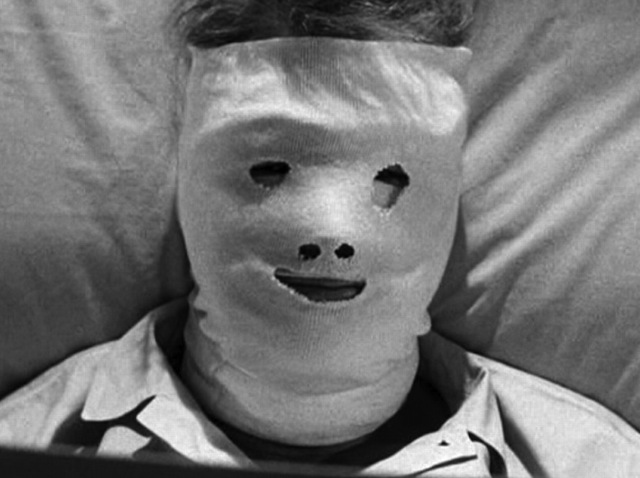
The unsung star of this speculative fiction movie is cinematographer James Wong Howe whose career stretches back to 1923. Always an innovator, here he was allowed to produce some wild effects in the service of the story of a drab, middle-aged man who fakes his death and undergoes a complete identity change including plastic surgery, only to find that all is not what it seems.
Streaming on Kanopy
SHIVERS (1975, Dir. David Cronenberg)
Cronenberg’s first feature shows us a tightly controlled utopian condo of the future faced with a parasitic venereal infection that turns its residents into zombie sex freaks. Like NIGHT OF THE LIVING DEAD meets J.G. Ballard’s “High Rise.” The touchy-feely self-help vibe of the condo overlords creates a truly creepy counterpoint to the gory body-horror proceedings within. We’re all scared of the CIA, but this movie makes us fear our horny neighbors too. Sheesh.
Streaming on the Criterion Channel
SPARE PARTS (1979, Dir. Rainer Erler)
This one is pretty obscure. Made by Germans in the US for German TV. You can find it on YouTube and on at least one of those 50 movie DVD sets. It’s surprisingly suspenseful and good. A young German couple on their honeymoon in New Mexico (OK, we’ll let that one pass) are pursued by freelance organ harvesters in a supercharged ambulance. There are many plot convolutions involving the military and hospitals and it all ends with a big action-filled bang in New York City.
THE SPOOK WHO SAT BY THE DOOR (1973, Dir. Ivan Dixon)
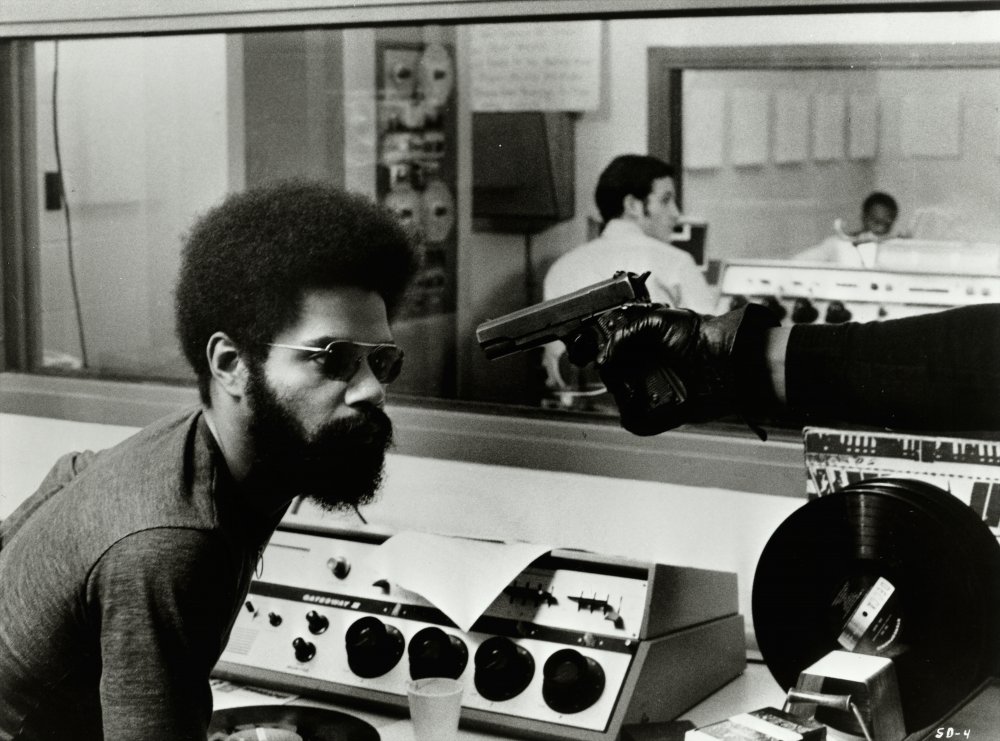
This one is something different entirely. An adaptation of a novel written by former US Information Agency official Sam Greenlee about a black man who, recruited by the CIA as a token, becomes disillusioned with the philosophy and utility of the agency and goes rogue, deploying the training and tactics of the racist US government against it. This is a truly groundbreaking film, and there was some offscreen espionage surrounding its release. It was removed from circulation and the negative was (intentionally?) mislabeled and misfiled in the vault. The actor/producer Tim Reid, an admirer of the film, found the negative thirty years later and gave the film its first truly widespread release in 2004. Current Austin Studios Director Martin Jones was an Executive Producer of the rerelease, by the way.
THE STUFF (1975, Dir. Larry Cohen)
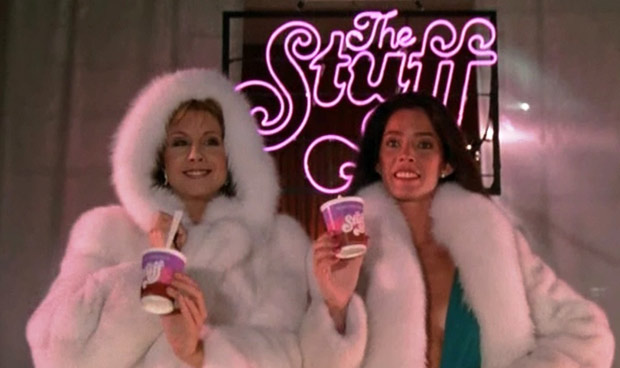
Larry Cohen’s curmudgeonly companion piece to John Carpenter’s THEY LIVE is about a decadently delicious dessert called THE STUFF. Nobody knows what’s in it, or where it comes from, but Cohen’s favorite over-the-top actor Michael Moriarty is a former spy hired by Big Ice Cream to find out. It’s silly, of course, but as usual with the acerbic Cohen, there’s an underlying distrust of authority figures running through the narrative.
Streaming on Amazon Prime and Hoopla
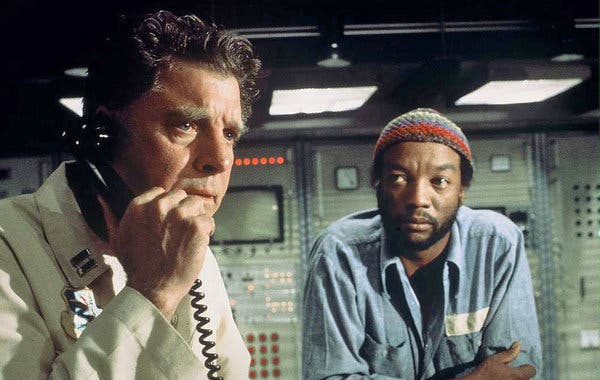
TWILIGHT’S LAST GLEAMING (1977, Dir. Robert Aldrich)
The tagline says it all: “WE HAVE INVADED SILO 3. WE ARE PREPARED TO LAUNCH NINE NUCLEAR MISSILES. WE DEMAND TEN MILLION DOLLARS, AIR FORCE ONE… AND YOU, MR PRESIDENT.” That’s the crux of the drama, but it has some of that good old anti-establishment juice as well. The leader of the insurrection is a disgraced former general (Burt Lancaster again) who wants the public to hear the real truth about why America was in Vietnam. Gritty, grimy and kind of dimly photographed, it benefits from Robert Aldrich’s dependable mastery of film direction and ratchets up that tension big time.
WINTER KILLS (1979, William Richert)
Maybe the platonic ideal of a conspiracy movie, it has just about anything you would ever want. Jeff Bridges plays the half-brother of the assassinated President “Keegan,” whose father, played by John Huston, is a string-pulling zillionaire. When Bridges gets a hot tip about who killed his brother, he finds that seemingly everyone is out to stop him. While it works as an exhilarating thriller, it also works as a pitch black comedy and social satire. It was not a hit at the time, to put it mildly, but the passage of time has been kind to the film, and audiences seem to finally be ready for it.