Glenda Jackson, born 80 years ago today, had an enviable acting career both on stage and screen. As a member of the prestigious Royal Shakespeare Company, where she and her cohorts helped to bring about a widespread, modern reappraisal of the Bard’s work and later as a film actress, where she brought a new kind of screen presence to the fore. Her breakthrough screen role was in Ken Russell’s adaptation of D.H. Lawrence’s WOMEN IN LOVE (1969) and she won nearly every award in the book: Academy Award, National Board of Review, National Society of Film Critics, New York Film Critics Circle, etc.
She followed this triumph with other major performances in films like SUNDAY, BLOODY SUNDAY (1970), MARY, QUEEN OF SCOTS (1971), A TOUCH OF CLASS (1973), for which she won her second Academy Award, and many more, through the ’80s and into the ’90s.
Her acting legacy could be called, with some understatement, secure. Which is why it is so admirable that she retired altogether from acting in pursuit of a new career, that of a Labour MP. In Parliament, she used her magnificent voice and bearing to advocate for progressive causes, often excoriating her opponents for cutting education and other services, and maintaining a staunch antiwar stance. She retired in 2015 after 23 years of service in Parliament.
Here she is in 2013, during Parliaments remarks about the departed Baroness Margaret Thatcher. On a day when the room was filled with sober tribute and remembrance, Jackson made sure that the spirit of anti-Thatcherism was heard loud and clear. By the time her argument reaches its climax, the dissents in the chamber are loud and raucous. It’s really something, especially when Jackson refutes the argument of one who has come to pay tribute to her political enemy Thatcher for being the first woman prime minister. Jackson’s response is personal, brilliantly phrased and acidic.
Orson Welles produces Rita Hayworth from a steamer trunk, 1943
In 1943 world famous actor and filmmaker Orson Welles (who was born on this date in 1915) was eager to do something special for the war effort. Though he was a poor physical candidate for service – he rated a 4F – he could do quite a lot in terms of raising money and troop morale. So Welles wrote up a proposal for a circus-like revue that could travel around the country raising funds for the war effort and providing first class entertainment for returning or furloughed service members, who could attend at no cost. For civilians, tickets started at $1.65.
Welles himself was the master of ceremonies and, as The Magnificent Orson, its magician headliner. Welles’ wife, the glamorous Rita Hayworth, also performed a variety of headline acts. Comic relief was provided by Jo-Jo The Great (whom we now know as Joseph Cotten). Other collaborators were the great French star Jean Gabin, who put his great shoulders to work moving scenery, and actor Keye Luke, who was tasked with the creation of culturally respectful Asian scenery and props. Later, after her boss at Columbia forced Hayworth to drop out of the show, Welles was forced to fall back on Hayworth’s understudy, Marlene Dietrich (!).
Here’s the entire advertised bill of fare for a performance of The Mercury Wonder Show:
The Mercury Wonder Show
For Service Men
Program
ORSON THE MAGNIFICENT
Defies the laws of science in feats of legerdemain never before presented in America. The occult secrets of antiquity and the present day reproduced for your delight and fascination in: Born In Flames, A Rabbit From a Headpiece, Le Chapeau en Pair, The Devil’s Orchard, Horticulture From Hell, The Strange Aquarium, Birds From The Blue, The Fourth Dimension, Audubon’s Dream, The Hindu Mango Mystery (as advertised), Fruit Under a Spell, and THE HAUNTED AVIARY with Invisible Pigeons and Transparent Doves.
THE MIRACULOUS CHICKEN FARM
Twenty-five (25) Living Hens Manufactured as You Watch , Without The Aid of a Single Egg. DE- and RE-CAPITATION: A Strange Feat of the Barnyard as Never Before Presented in the Western Hemisphere: Ballet of the Roosters: Chanticleer Takes It on the Lam: The Hens’ Delight.
Dr. Welles presents his
Original Experiments in Animal Magnetism
(All Nature Freezes at His Glance)
Psychic Readings
The Magic Crystal
Due to the unbelievable strain on the practitioner of this incredible feat the management must reserve the right to change this portion of the program without notice.
Secrets of the Sphinx
THE ANCIENT LORE OF THE DARK CONTINENT ASSEMBLED FOR THE FIRST TIME UNDER CANVAS
CHAINED IN SPACE
WITCHES FARMYARD
An Incredible Assortment of Sortilege Not To Be Duplicated in the Most Famous Repertoires in the History of Thaumaturgy, presenting: Bovine Obedience; At the Shooting Gallery (including “Marksmanship’s Reward); Evaporation in the Mystic Diary; The Dalai’s Milk Pail (Direct From Tibetan Lamaseries); The Flight of the Hare; Fowl Elusive; La Rapiere du Diable; A Voice From the Dead; Faster Than Light; THE WORLD FAMOUS “BALSAMO’S SECRET,” and the CASKET OF COUNT CAGLIOSTRO.
PEKIN NIGHTS
An Interlude from Old Cathay
The Manchu Marvel; The cages of Han Lun; Enchanted Porcelain; Rain-making “Orientale”; Drought by Witchcraft (including Feats of Dexterity – a Dazzling Display); Hungkwel’s Downfall; The Fan of Fu Ling.
THE CHEF’S SURPRISE
A Fantasy in Smoke; Shampoo Sorcery; The Indestructible Playing Card (Culled from the Secret Archives of Jared Higgenbottom); Humpty Dumpty Restored; Battledore.
$ TEN THOUSAND DOLLARS CHALLENGED! $
(Performed Under Rigid Test Conditions)
IMPROVISATIONS
THE GOOSE, THE GUINEA PIG AND THE LADY
THE GIRL WITH X-RAY EYES
An Extraordinary Demonstration by Miss Rita Hayworth of Strange Powers Recognized, but Unexplained by Science. Featuring Thought Transmission and Projection, Extra-Sensory Perception, Lightning Calculation, and Second Sight.
THE GREAT JOSEPH
The Wizard of the South Presents Split Second Escapology. The redoubtable J. Cotten Risks His Life at Every Performance.
THE DEATH OF THE SILKEN GORDS
FIRST TIME IN THE WEST
MILLION $ MYSTERY
Miss Hayworth and Mr. Cotten Make You Doubt Your Senses is a Bewildering Display.
INTERMISSION AND CONCERT
SCENES FROM A HINDOO MARKETPLACE
THE FAKIRS OF INDIA OUTDONE
THE WORLD’S FASTEST CANARY
(Three Surprises and a Miracle)
DEATH CASKET
THE FLIGHT OF TIME
PAINLESS SURGERY
Doctor-Sorcerer and His Apprentices Defy Laws of Dissection
THE HUMAN SEWING MACHINE
MUST BE SEEN TO BE BELIEVED
PRINCESS NEPHROTITE
The Queen of Egypt Brought Back From the Dead. Her Materialization, Levitation, Evanishment and Lightning Reappearances.
GRAND FINALE
VOODOO!
A re-enactment of Mr. Cotten’s Interesting Experiences Among the Witchdoctors in Dark Africa
As the screwed-and-chopped narration intones at the beginning of the first episode of the new Vice show OUTSIDER, “Welcome to the show that reveals the beautifully complex and unique minds behind the world’s most inadvertently insane movies.”
This new show, produced by sometime-AFS staffer Zack Carlson and Vice-lord Evan Husney, promises to take us into the lives and stranger-than-fiction stories of the filmmakers behind some of the wildest movies we’ve ever (or never) seen.
Many have seen THE MIAMI CONNECTION, thanks to the tireless efforts of Carlson and Husney to rerelease it through Drafthouse Films. Now, the true story of master Y.K. Kim, and his central Florida followers, can be revealed.
There are tons of small film festivals around the world, good ones, bad ones, specialized ones, generalized ones. The very best of these are the well-curated festivals of discovery – the ones whose lineups reflect a scholarly approach by expert programmers. We’re lucky enough to have a number of these in Austin, none better than Cine Las Americas, in its 19th year of presenting films from Latin America and the Iberian peninsula.
“Cine” (as it is most frequently abbreviated by Austinites, in the same manner as “South-By”), presents films that are far off the radar, like MAGALLANES, the opening night presentation, which screens on Wednesday May 4 at the Marchesa.
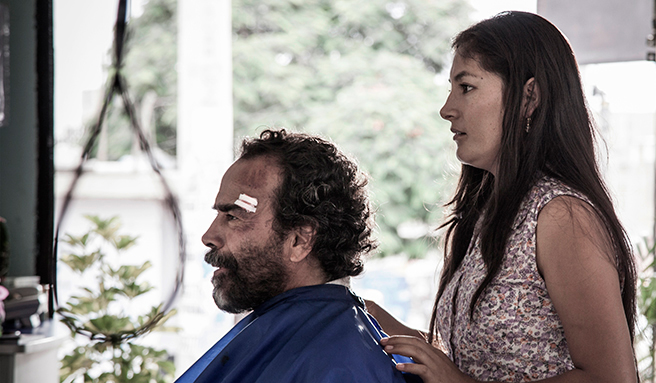
Made in Peru by actor-turned-director Salvador del Solar, MAGALLANES is, as you might expect for a film made by an actor, a showcase for its exceptionally fine performers, who enact a story full of historical resonance for Peruvians and Americans alike. The theme of a nation coming to terms in a hard way with its cruel past is a big one, and its maker makes exactly the right choice by making the story a small one – a morose middle-aged taxi-driver, formerly a member of a paramilitary torture squad, spots a young woman who had escaped from the general’s clutches as a child and is attempting to make a life for herself in the city. He attempts to make amends secretly by helping her, but the buried past is powerful and casts a shadow on their lives and the lives around them. It’s a remarkable film and the climax packs a rare punch.
MAGALLANES, like so many films in the fest, will likely never have American theatrical distribution, which means that for most of us, this fest will be the only way to see this film. This is the case with most of the films presented by Cine Las Americas, and that’s a big part of what makes the fest so important.
LAS PLANTAS
On Friday May 6, AFS is honored to copresent the Chilean film LAS PLANTAS, a dark, transgressive coming-of-age story about a teenage girl who escapes her familial problems first via the fantastic world of a popular comic book and then through the world of furtive, internet-aided sexual assignations.
Cine Las Americas runs from May 4-8 at a variety of Austin venues, including the Marchesa Hall & Theatre. There are 38 feature films this year and a whole raft of short films. Badges are available, as are individual tickets. One third of this years presentations are free for all. More details at cinelasamericas.org.
Ingrid Bergman on the set of STROMBOLI (1950), screening May 12
Roberto Rossellini was a force. His production achievements are legendary—he made one of the greatest films about World War II, ROME, OPEN CITY during World War II, hustling the prohibitively scant resources available in newly liberated Rome in order to get his production going; or shooting Hollywood’s biggest star, Ingrid Bergman, tromping around barefoot on an erupting volcano. While his exploits behind the camera are often heroic/insane, his films are the opposite of bombastic. What makes Rossellini so special, and so relevant today, is that he was a facilitator of miracles.
Eschewing screenplays, sometimes entirely (the shooting script for JOURNEY TO ITALY was three scribbles on a piece of paper and an expletive for his producer), Rossellini brilliantly assembled just the right elements to create powerful, unique narratives. Today, as acclaimed television shows are made with an industrial “shoot it out” approach that favor script over performance, Rossellini is a reminder of how observation and a deep understanding of film grammar are the ingredients of a transcendent film.Consider Anna Magnani in the final sequence of ROME, OPEN CITY, a scene so emotional that it set off the brilliant actress to partially improvise one of the all time greatest moments of cinema. In JOURNEY TO ITALY, the film’s poetic climax was an unscripted accident, a moment created by the connectedness of the performances, an excellent cinematographer, and Rossellini’s ability to trust his heart, and his nose, which often found the action so he could lead his production there.
In May, AFS presents five post-war period Rossellini films, four of them digital restorations from the Cineteca di Bologna’s “Rossellini Project”, which bring the films to life in a completely new light, as all previous copies had a myriad of technical issues. Each of the films in the series points to Rossellini’s ability to seek and find wonders. (AFS Associate Artistic Director Holly Herrick)
Dates, times and ticket links follow.
ROME, OPEN CITY
Tue, May 3, 2016, 7:30 PM
During the last gasps of WWII in newly liberated Rome, young and still green director Roberto Rossellini begged, borrowed and cheated to create this masterpiece that told the story of the heroism of everyday Romans in wartime. Presented here in a beautiful DCP restoration by the Cinneteca di Bologna.
One of the most moving and precise cinematic renderings of the personal experience of war can be found in PAISAN, the film that defined Rossellini as a humanist, and drew criticism from all sides, particularly his Communist and Catholic supporters. Digital restoration.
Rossellini and Ingrid Bergman became lovers on this first collaboration, which features the actress as a war refugee whose marriage of convenience makes her a stranger in a strange land on the desolate volcanic island of Stromboli. Digital restoration.
Thu, May 19, 2016, 7:30 PM
Fri, May 20, 2016, 8 PM
Inspired by Saint Francis’ love and empathy and his own interest in spirituality, Rossellini tells the stories of Francis and his followers through a series of short episodes.
Thu, May 26, 2016, 7:30 PM
Sun, May 29, 2016, 1 PM
Ingrid Bergman’s third collaboration with Rossellini (appropriately about a couple’s failing marriage), draws on the magic of Italy as its subject and inspiration. Rossellini’s love of observing and discovering local culture made love letters to Italy of all his films, and JOURNEY TO ITALY draws that wonderful aspect of Rossellini’s work into focus.
Last month we were honored to welcome Carol Burnett to our annual Texas Film Awards Gala. She was formally inducted into the Texas Film Hall Of Fame. Presenter Maya Rudolph said it all in her introductory remarks, and then Carol Burnett walked off with our hearts.
Today is Carol’s birthday and we’re all thinking fondly of her and her legacy of comedy.
We were fortunate enough to be joined by Ciro Guerra back in October for a pair of events, including an advance screening of his EMBRACE OF THE SERPENT. The film, which critic David Edelstein has called “a reverse angle Heart Of Darkness,” has become something of a sensation since then, and will surely be represented on numerous year-end Best-Of lists. We are bringing it back this week for two shows, one on Thursday April 28 and one on Sunday May 1.
Here is an LA Times interview with Guerra in which he shares some of the special challenges of working in the Amazon rain forest and also in finding a balance of perspectives in a film based on the diaries of white explorers.
Here’s Guerra on the decision to shoot in black and white:
“The film is inspired by the diaries of the explorers, but also by the photographs they took — those vintage pictures that are almost daguerreotypes. It’s different from the image of the Amazon you have. It doesn’t have that exuberance or the exoticism that you see in the travel brochures. It’s another world, another perspective.
And the idea behind this perspective is very close to the idea of the indigenous perspective of the world — that the world is much bigger than our senses allow us to see. Being there I realized that I wasn’t going to be able to recreate the way the Amazon looks. The indigenous people have 50 words for the word “green.” We have one.
In this way, it was possible that the viewer could imagine things — and the Amazon the viewer imagines could be more real than what I could deliver.”
On the matter of narrative perspective:
“My point of departure was the diaries. But when I went to the Amazon and I started interacting with the people there, I realized that that was the story that hadn’t been told. That’s what we Latin American filmmakers can do. The stories of the explorers have been told. What we can do is turn history on its head, give another perspective.”
John Waters, the Baltimore-based filmmaker who has become a kind of filthy uncle to all of us (and whose 70th birthday is today) was so appreciative of the long run of his movie PINK FLAMINGOS at Los Angeles’ Nuart Theatre that he starred in this special policy announcement trailer for them.
It’s a mixed message, but we think you’ll appreciate it anyway.
The above headline, a riff on the famous New York Post headline “Ford To City: Drop Dead,” is perhaps a tiny bit inflammatory, but not much more so than the title of today’s excellent Talkhouse piece, “Fanboys, Hollywood Owes You Nothing,” by filmmaker Clay Liford.
Liford, whose new movie SLASH premiered at SXSW to packed houses and excellent reviews, is fascinated by the complicated dynamic that exists between fans and content creators. SLASH is about a pair of amateur erotic fan fiction writers who absorb their favorite sci-fi characters into their private fantasy worlds. In the film it’s all part of a step towards greater maturity and growth of these characters, but the whacked out sex-on-a-spaceship scenarios are always merely private reveries, and the sense of “ownership” of these characters is a temporary phase. More rental than ownership.
It’s a thought-provoking article, from a person who has clearly given the subject a lot of thought, and who has, since the premiere of SLASH, spent a fair amount of time engaging with franchise fans about these issues. Just as he resists, in the film, easy solutions to his characters problems, Liford would rather take the long, thorny path through the thicket of fan expectations.
Here’s an excerpt:
“Social media allows fans to maintain an unprecedented degree of up-to-the-minute discourse with creators across a wide swath of creative works – many who respond to fan praise or critiques arguably more than they should. This engagement can imply a social contract. And it’s a contract you enter into, willingly or not, the moment you make yourself known to your audience. If I am your customer, and you acknowledge that you can indeed hear my thoughts, then by the nature of free commerce, you should adjust your product to my stated whims. Except this is obviously a fallacy. I think simply stating it plainly makes that apparent, however easy it is to get caught up in the illusion. Especially because fans should have a voice, and it’s been proven many times that voice has an impact. It can save shows or movie franchises. Shows with less than stellar numbers, such as Supernatural, basically troll their own fans in order to affect ratings. Though this sometimes backfires, it’s only now that we’re beginning to see fan engagement used in an attempt to actively trample intellectual properties.”
“The way I try to make the films is to give the viewer enough information that they can feel that they are present. And, at the same time, they can make up their own minds about what they are seeing and hearing. I don’t like films that are didactic or that condescend toward the viewer. The only safe assumption for me is that the viewer of the film is as smart or as dumb as I am.”
People are always surprised when you tell them that the same screenwriter who wrote 1946’s THE BIG SLEEP (with those journeymen collaborators Jules Furthman and William Faulkner) also wrote (in collaboration with Lawrence Kasdan and George Lucas) THE EMPIRE STRIKES BACK. For some reason they are also surprised to find out that the writer in question was a woman.
Leigh Brackett began her career writing for the sci-fi pulps, turning out large numbers of Martian adventures in the mold of Edgar Rice Burroughs. When producer/director Howard Hawks read a mystery novel that she wrote he asked his secretary to call up “this guy Brackett” to work on the adaptation of Raymond Chandler’s novel “The Big Sleep.” The film was a success and has become a highly influential classic.
After a couple of other far less prestigious assignments, Brackett and her husband, fellow science fiction pulp author Edmond Hamilton moved to Ohio to raise their family. The pair continued to make a living at writing for a good many years and Brackett would have surely stayed away from films altogether had not Howard Hawks been such so persuasive, and so in need of her services. She returned to the film business in 1959 to write RIO BRAVO for Hawks, again in collaboration with Furthman.
RIO BRAVO was a big hit and Hawks signed her to a multi-film deal. She then wrote HATARI (1962), EL DORADO (1967), RIO LOBO (1970) and did uncredited dialogue and polish work on other films. In 1972 she was engaged by producers Jerry Bick and Elliott Kastner to adapt Raymond Chandler’s novel “The Long Goodbye” for director Brian G. Hutton to direct and Elliott Gould to star in. Things did not go exactly as planned and Robert Altman took over as director. Naturally, Altman with his improvisational style made some major changes but the thrust of Brackett’s script remains.
In 1977, George Lucas, a fan of Brackett’s science fantasy novels, hired Brackett to write the script for STAR WARS II. Upon reading it, Lucas had a number of major changes but Brackett died of cancer before being able to resume work on the script. The film was eventually made, of course, and the rest is a different kind of history.
Filmmaker Charles Burnett was born on this day in 1944. Though he was born in Vicksburg, Mississippi, his family moved to Watts in South Central Los Angeles when Burnett was a child. Burnett’s family was only one of many black southern families to relocate to the Watts neighborhood and the area’s south-inflected culture makes itself felt in Burnett’s works again and again.
Even as Watts burned in the 1965 riots, Burnett was attending UCLA, learning creative writing. When UCLA’s film department began its initiative to enroll more African-American students, Burnett signed up and became part of the movement that was to be known at the L.A. Rebellion. Other noted alumni, many of whom continued to work on each others’ films for years after graduation, were Julie Dash, Larry Clark (not to be confused with the KIDS auteur of the same name), Haile Gerima, Billy Woodberry and Jamaa Fanaka.
Here is a film from Burnett’s school years called SEVERAL FRIENDS (1969). We can see in it some threads of the same cultural fabric from which his later KILLER OF SHEEP (1977) emerged. At a time when films might feature only an occasional black character, Burnett shows whole groups of black characters talking together about things that concern them. It’s all shot in a cinema-verite style with non-actors, on neighborhood streets. It’s a remarkable time-capsule of a culture many viewers have probably never seen before.