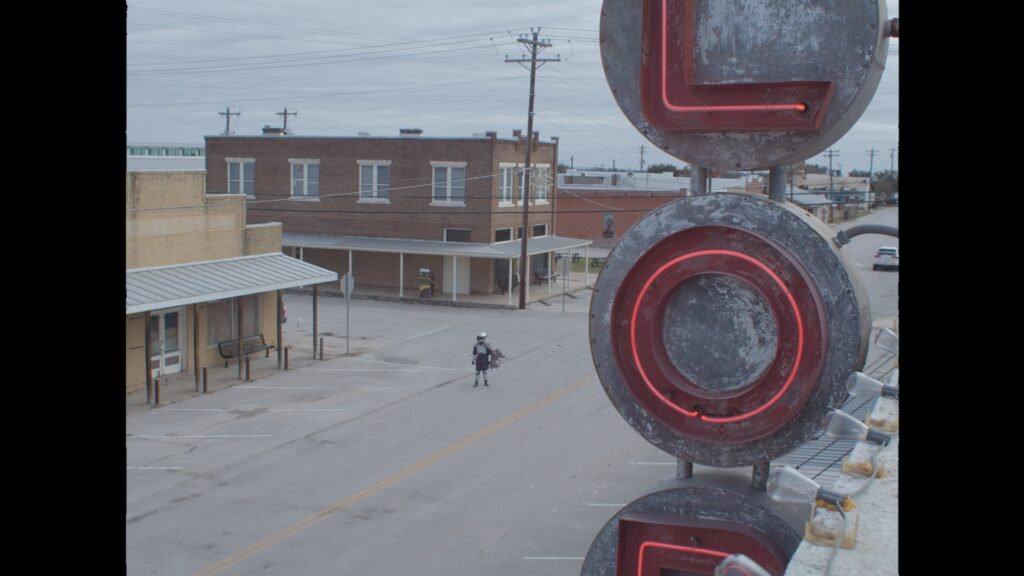
(Still from WHAT WE LEAVE BEHIND, directed by Iliana Sosa)
SXSW 2022 is here! The festival will take place in person from March 11-19, and AFS will have a big presence this year. We are excited to return to SXSW once again with our member showcase. AFS ShortCase is a program of short films made by Austin Film Society MAKE members and is part of SXSW Community screenings. The lineup is curated internally and will be presented at AFS Cinema on Sunday, March 13 at 2:30 pm. The screening is free and provides an opportunity for our members to have their work seen during the 2022 Festival. Visit here for this year’s full schedule.
And we are thrilled to announce that ten projects from AFS-supported filmmakers will be a part of this year’s official roster. Five of those projects making their world premieres were directly funded by the AFS Grant. Opportunities like SXSW shine a spotlight on the very purpose of AFS’s grant program—to support and elevate the incredibly diverse voices of our region’s emerging filmmakers and help them share their stories with Texas and the world. The full list of films is below and you can find the complete schedule at sxsw.com.
AFS Grant Funded Films
WHAT WE LEAVE BEHIND Directed by Iliana Sosa After a lifetime of bus rides to the US to visit his children, Julián quietly starts building a house in rural Mexico. In filming his work, his granddaughter crafts a personal and poetic love letter to him and his homeland. (Documentary Spotlight)
Read more about WHAT WE LEAVE BEHIND in this feature by Chale Nafus for Sightlines magazine
THE UNKNOWN COUNTRY Directed by Morrisa Maltz An unexpected invitation launches a grieving young woman on a solitary road trip through the American Midwest as she struggles to reconcile the losses of her past with the dreams of her future. Cast List: Lily Gladstone, Raymond Lee, Richard Ray Whitman, Lainey Bearkiller Shangreaux, Devin Shangreaux, Jasmine “Jazzy” Bearkiller Shangreaux, Pam Richter, Dale Leander Toller, Florence R. Perrin, Teresa Boyd (Visions)
ACT OF GOD Directed by Spencer Cook and Parker Smith A disabled man’s commute is interrupted by a $100 bill lying on the sidewalk, just out of reach. It flutters away as soon as he moves towards it, leading him on a chase that forces him to reconsider his toxic ideal of self-sufficiency. (Texas Shorts)
BIRDS Directed by Katherine Propper Moments in the lives of Austin teenagers during the heat of Texas summer. (Texas Shorts)
MORE THAN I REMEMBER Directed by Amy Bench One night at her home in southeastern Congo, 14-year-old Mugeni awakes to the sounds of bombs. As her family scatters to the surrounding forests to save themselves, Mugeni finds herself completely alone. (Texas Shorts)
Other Previously Supported Filmmakers and Films
DESCENDANT Directed by Margaret Brown Descendant follows the search for and discovery of The Clotilda, the last known ship to illegally carry enslaved Africans in the United States. Guided by the voices of their ancestors, descendants of The Clotilda’s survivors reclaim their past and examine what justice looks like today. (Festival Favorites)
FACING NOLAN Directed by Bradley Jackson In the world of Major League Baseball no one has created a mythology like Nolan Ryan. Told from the point of view of the hitters who faced him and the teammates who revered him, Facing Nolan is the definitive documentary of a Texas legend. (Documentary Spotlight)
THE SENTENCE OF MICHAEL THOMPSON Directed by Haley Elizabeth Anderson and Kyle Thrash Michael Thompson is the longest serving non-violent offender in the history of Michigan and he is finally up for clemency. After 25 years, 3 appeals, and 2 denied applications for clemency it seems like Michael may finally have a chance at freedom. (Documentary Shorts)
SOFT ANIMALS Directed by Renee Zhan Two ex-lovers cross paths at a train station. (Animated Shorts)
SHOUTING DOWN MIDNIGHT Directed by Gretchen Stoeltje Both cautionary tale and rallying cry, Shouting Down Midnight recounts how the Wendy Davis filibuster of 2013 galvanized a new generation of activists and reveals what is at stake for us all in the struggle for reproductive freedom. (Documentary Spotlight)
This week we bring you our second installment of the Programmer’s Bookshelf. Here, AFS’s Associate Programmer Jazmyne Moreno takes us behind the scenes of a few of her favorite titles and into the minds of a colorful cast of characters.
Changing “Bergman’s muse and collaborator reflects on her life from childhood to her career on the stage and screen. As with any memoir, it’d be a tedious read if Ullmann weren’t so compelling. One of my most prized books, this copy is a special edition, signed by the star herself.”
_________________________________________________________
Retratos Ibéricos “Bigas Luna was an incredible artist and filmmaker. This book offers insight into his creative mind, while providing some rare onset images from the making of The Iberian Trilogy [JAMÓN JAMÓN, GOLDEN BALLS, and THE TIT AND THE MOON].”
Check out Instagram for more images from the book: austinfilm
JAMÓN JAMÓN screens on February 18 & 20, 2022 as part of our Love Month series at the AFS Cinema.
_______________________________________________________ Midnight Baby “There isn’t a more eloquent way to describe the explosive autobiography of the Oscar-nominated singer-songwriter Dory Previn, best known for her composition of the theme song for THE VALLEY OF THE DOLLS, sung by Dionne Warwick, and her connection to Mia Farrow.” Dory Previn’s life was wild, sad, incredible, and her book makes for an amazing read.”
_________________________________________________
All I Need is Love “I don’t need to say much about Klaus Kinski and his incendiary “autobiography.” Featured in BEFORE SUNRISE, read it (if you can get your hands on it) for his version of events on the production of AGUIRRE: THE WRATH OF GOD and check out Jesus Christ Saviour.” Kinski interview in promotion of Jesus Christus Erlöser (Jesus Christ Saviour):
________________________________________________
The Girl of Silence – The Photography “THE GIRL OF SILENCE is a film I’ve never seen. Photographer George Hashiguchi spent two months on set, photographing the cast, and their makeshift family. The images are stark and haunting. Maybe I’ll get around to watching the film, based on the writings of Shungiku Uchida (VISITOR Q), at some point, but for now, this book is enough.”
We’re all about movies, but every so often we love a good book. So, we asked our programmers for a little peek at their bookshelves. This week, AFS’ Lead Programmer Lars Nilsen tells us of the books that changed his life, opened his mind, and gave him a cluckin’ good time.
Psychotronic Encyclopedia “For me, this was the book that sent me on countless expeditions into video stores, hunting for titles I had read about in Mike Weldon’s concise yet opinionated blurbs. It changed the whole idea of what “real” movies are for me and lit up my own movie galaxy with stars like John Carradine, Mamie Van Dorenand Cash Flagg. I am into a lot of different stuff now but this was the book that really grabbed me and didn’t let go. I practically know it by heart.” Nightmare Of Ecstasy “I’m sure everyone reading this is a big fan of Rudolph Grey‘s noise guitar work. Just kidding. I’d be surprised if you ever heard it, but that was what led me to pick up this book, an oral history of Edward D. Wood, Jr.It was eventually optioned and turned into a Disney movie – one of the weirdest things that has ever happened – but the book is way better. You get more of a sense of the guy, his priorities and the family atmosphere that suffused his working life. I wish there were 800 more pages of this stuff.” Are You In The House Alone “It was my plan here not to include books by my friends but I am already breaking that rule, simply because later this month the editor and primary author of this one Amanda Reyes will join us for our first foray into actual television with the History Of Television Masters & Methods series on Austin Public Channel 12. This book is a much-needed resource, a compendium of made for television movie reviews with copious amounts of detail about the production, the people behind them and the social context. It will have you scribbling titles for later viewing. This has been a highly influential volume, as the number of made for television films being released on Blu-Ray now will attest.” Follow The History of Television: Masters & Methods on Twitch
Cluck “OK, this is not a great book but it’s an example of how completely gullible I am when I see an interesting or unusual film book on a shelf. This is a supposedly comprehensive (it’s not really) guide to chickens on film. I will admit that I have never sat up all night and read this one by candlelight, though I will admit to leafing through it occasionally and chuckling.”
On January 29 and 31, AFS presents THE COCA-COLA KID in 35mm as part of its World Cinema Classics series. Very few could have seen this raucous but insightful comedy coming from transgressive Serbian master Dušan Makavejev. Eric Roberts inhabits the part—an Atlanta-based marketing wiz given the assignment to prop up slow Coca Cola sales in the interior of Australia—with great gusto and massive entertainment value. Released in 1985, the film has very slowly gained cult status thanks in large part to Roberts’ gonzo performance and Makavejev’s go-for-broke approach to the subject matter.
Makavejev’s former student and great admirer of his work filmmaker Andrew Bujalski (COMPUTER CHESS, SUPPORT THE GIRLS) will join us to introduce and discuss the film on January 29. Ahead of the screenings, we asked Bujalski to share his thoughts on time with Makavejev.
What has been your experience with the films of Dušan Makavejev?
I think I’d seen THE COCA-COLA KID on the video store shelf and been intrigued by it, but didn’t really know anything about Dušan until I had the extraordinary good fortune to take his production class in college. All of the professors in those hallways seemed like living legends to us, in part I guess because many of them were—and this stooped over Eastern European madman, who seemed somehow simultaneously a lumbering bear and a mischievous kid, was a huge presence. Some of his films screened on campus back then, others I caught up to later in life, and others yet I still hope to encounter. W.R.: MYSTERIES OF THE ORGANISM probably has the greatest reputation, and it does seem to me one of the great moments of alchemy in cinema history—I suspect it’s just as mind-blowing and unique today as it was 50 years ago, because it’s totally unrepeatable. INNOCENCE UNPROTECTED and MONTENEGRO also knocked my socks off….
What has been your experience with Makavejev himself?
As an artist and as a person he had a deep affinity for the anarchic, which as you might imagine made him a rather divisive teacher. Students who craved structure and coherent directives tended to be flummoxed and frustrated in his class. And inevitably I think the students he liked personally had better experiences in the class than the ones he found less interesting. But he was deeply engaged with teaching and generally quite sweet—I adored him, even as I was surely intimidated, and had a blast in his class. When I read some of his writing today it occurs to me that a huge chunk of what I think of as “my” filmmaking philosophy is cribbed wholesale from him…Certainly he was doing nothing to set us on the path to “professional” careers, he was happy for us to risk looking incompetent so long as we looked alive, and that was intoxicating for me.
The last time I saw him in person was shortly after I’d moved to Austin in my early 20s—he was participating in some kind of conference with other Serbian artists and dissidents at UT, and somehow, he knew my address and sent a student to come retrieve me. I remember sitting in my living room trying to figure out how to do my taxes—not sure why that detail sticks—when suddenly there was a young woman standing at my screen door telling me that Makavejev was in Austin, he wanted to see me, and she would lead me to him. What a delightful day. I met some students then that I’m still friends with, and somehow ended the night sitting next to Dušan at a party full of Serbian exiles three times my age having heated political and aesthetic debates with each other that I could not understand a word of, riveted.
THE COCA-COLA KID is very different from Makavejev’s other films. Can you identify as a filmmaker with taking big chances and leaving your comfort zone?
Y’know, back in college I think we all considered THE COCA-COLA KID to be his “sell out” movie, the one with Hollywood performers in it, the one that had been a great commercial success, and the one that was clearly less outwardly provocative and transgressive than, say, SWEET MOVIE with all its writhing, chocolate-covered orgies, etc. But I happened to see it again a couple years ago—one of the last things I saw on a screen before the Covid lockdown—and couldn’t believe how fucking wild it was. I’m not sure if it speaks to how rigid commercial cinema has become since then, but it’s really hard to believe that it was within my lifetime that a movie this delightfully bananas could have been an actual hit, or considered “sell out” in any way shape or form. Certainly, there are aspects of the production that would have been unusual for Dušan, but frankly I don’t know if he had a “comfort zone” per se, I have to believe that he was happiest when things were teetering right on the verge of chaos anyhow, and certainly the resulting movie seems entirely, unmistakably his own. It’s not like a studio director sneaking in the occasional personal touch—it’s top to bottom Makavejev.
How does THE COCA-COLA KID tie in, say, W.R. or SWEET MOVIE? Are the similarities as profound as the differences would seem to be?
Of course. Makavejev was a brilliant dude with a unique mind. Some of the outward signifiers of his supposedly “purer” films may be missing, but the anarchic joy is present and uncut.
How would you describe THE COCA-COLA KID to someone who has never seen it before?
Eh, there’s no preparing anyone for it. Just crack open a refreshing Coke and strap yourself in?
THE COCA-COLA KID screens January 29 and 31 at the AFS Cinema.Get tickets here.
This January and February AFS presents works by renowned contemporary American filmmaker Bill Morrison for its Essential Cinema program. His masterful and critically acclaimed works, constructed from mostly decaying nitrate films, are achieved through extensive archival research as well as close collaborations with some of the world’s most innovative contemporary composers, including William Basinski, Michael Gordon, Julia Wolfe, Philip Glass, Jóhann Jóhannsson, Bill Frisell, and David Lang.
Our series begins with the opening night presentation of DAWSON CITY: FROZEN TIME on January 20 at 7:30 PM. Bill Morrison will join us along with Craig Campbell, Associate Professor of Anthropology at The University of Texas at Austin, to introduce the film and a Q&A afterwards. See the full line-up and get tickets here.
We asked Professor Campbell to provide some context ahead of the series. Here he shares his thoughts on damage, ruin, and decay in relation to the photographic image and the work of Bill Morrison:
The upcoming series of events focused on the filmmaker Bill Morrison is an opportunity to explore a remarkable and unique body of work. Curated by Donato Loia, 2020-2021 Curatorial Fellow at the Visual Arts Center (VAC), we are invited not only to view Morrison’s films and hear him introduce and talk about them during this screening series at the Austin Film Society, but also to encounter the associated exhibition Bill Morrison: Cycles & Loops installed in the VAC gallery and listen to the original score of The Great Floor, a collaboration between Morrison and legendary musician Bill Frisell, which will be presented at the Texas Performing Arts on January 21. From the cinema to the gallery and concert hall, this curated set of events is unlike any I have been involved in before.
As an anthropologist and scholar of archival photography, I have been asked to introduce the film DAWSON CITY: FROZEN TIME on January 20. What fascinates me about Morrison’s work with found footage in DECASIA and DAWSON CITY is the way that he uses damaged images to animate our relationship to the past and in doing so, exposes the double fictions of actors acting in a world that no longer exists, that has become to us unfamiliar and strange.
Visible damage on the surface of a photographic image enacts two fascinating processes: it produces both a radical clarification and a temporal convolution. As with all representations there is a distance between that which once was and what we see now. Looking at a photograph, particularly an old one, I am struck by the absolute particularity of a moment that has been captured. I rush past the representational construct to the thing itself. This photographic encounter, of the camera and the world that stands before it forces itself to the front of my attention. I’m not thinking about the cuts or manipulations but of the piercing eyes, the beautiful motion of the horse, the bodies of the men walking towards me, the curious gestures and gazes looking through the camera, unknowingly across a hundred years to me, here, now. Yet this is complicated when I look at an image that is evidently marked by damage and decay, by ruin.
What follows is an excerpt from an essay I wrote in 2016 titled “The Ephemerality of Surfaces: Damage and Manipulation in the Photographic Image”:
The impossible concealment of the real punctures surface. For example, breaking the fourth wall in theatre effectively reinforces the reality of the everyday by naturalizing its difference: “this is real, this looking at you is the real; the stuff on stage is fiction.” This willing and playful suspension of disbelief in the fantasy of the theatrical production can be repeated through a similar operation in photography. The peeling emulsion on the film is a failed masking, where the artifice of the photograph is too evident. The 2002 collage and found footage film DECASIA by Bill Morrison places damaged film footage at the center of his experimental project. Like Peter Delpeut’s 1990 LYRICAL NITRATE, DECASIA foregrounds the “death of film in motion by using film footage damaged by water, dryness, fungi, discoloration, celluloid acetate degradation or nitrate decomposition” (Cramaaer 2009: 371). The structure of concealment and disclosure that surrounds the truth claims of the documentary photograph is called out through the materiality of damage. Still from DECASIA
The image itself is no less easily secured than its surface. The world inscribed as the photograph becomes murky on the perimeter of the negative. Before being lost to the edge of emulsion the image is often swollen, misshapen, deformed and tortured. Such evidence of material process is typically effaced through active cropping and (later in the technological biography of photography) tighter mechanics so that now a hard edge is natural to the photograph and edge effects are not implicit in the production of the image but added after the fact. How does all this signify? What is the semiotic life of damage, decay, and manipulation? Michael Pierson argues that collage films like those of Morrison and Delpeut draw “spectators to an affective realization of the lived reality of the past” (2009: 19). More than that, just as the age of an image is signaled by the medium (consider for example black and white and sepia photographs) the evidence of the material life of an image can be signaled by the accretion of patina.
In the past twenty years electronic images in conjunction with a ubiquitous and globalized internet infrastructure have led to new post-institutional image archives. These are de-centered archives that are no longer defined around the consignation of artifacts to a particular locale but rather by the surface of the individual images that are constantly forming and re-forming in diffuse relational constellations both on and off the internet. Archival photographs have traditionally been administered by sanctioned gatekeepers—archivists, curators, and historians—whose function, beyond controlling who can see the images, is to interpret them and to generate meaning from them. The instability of images as signifiers of anything other than the everyday is highlighted when they are released from the rarified environment of museums and archives. This is the contemporary cultural scene where formerly circumscribed images are mobilized through digital proliferation.
The myth of the photographic copy is that it returns the same thing in each iteration. The sensuously persuasive evidence of this masks the more significant point: that of image-encounter. This image differs from that for its relational triangulations; its referential ecology. To insist on this radical materiality is to insist on a recalibration of our tools for looking at and writing about the mediated world. I wonder if damaged photographs disrupt the easy path of representation. Barbara Kirshenblatt-Gimblett expresses anxiety over the totalizing discourse surrounding representation and its stubborn obsession with the distance between the real and the representation. She appropriates the term mediation to side-step and keep a curious and analytical spark alive. Quoting Jeffrey Shandler, she writes: “we are interested in ‘the relations among creators of a mediation, its medium and genre, its audience, its critics and epiphenomena, its history of remediation, as well as the form and content of the media work itself’” (Hirsch et al. 2005: 1500). For Kirshenblatt-Gimblett the complexity of human life necessitates intellectual objects that don’t either pretend to exhaust their referent or get irreparably mired in their failure to represent.
What is so exciting about Morrison’s films is that they do not fetishize damage. Rather they dwell in it. They embrace the ruin and play it in the foreground as a technique that complicates the fabulations of belief. This both signals the materiality of film: the death of film in motion and the experience of visual encounter that has the capacity to draw the viewer into an affective realization of the lived reality of the past.
References Cited.
Cammaer, Gerda J. 2009. “Film Reviews: Lyrical Nitrate. Directed by Peter Delpeut, The Netherlands 1990. Decasia. Directed by Bill Morrison, USA 2002.” Convergence: The International Journal of Research into New Media Technologies 15, no. 3 (August 1, 2009): 371–73.
Campbell, Craig. 2016. “The Ephemerality of Surfaces: Damage and Manipulation in the Photographic Image” In Materialities. Curated by Kyler Zeleny. TVC#47. London, UK and Taipei, Taiwan: The Velvet Cell. 57-89.
Hirsch, Marianne, Kishenblatt-Gimblett Barabara, and Taylor Diana. “What’s Wrong with These Terms? A Conversation with Barbara Kirshenblatt-Gimblett and Diana Taylor.” PMLA. Publications of the Modern Language Association of America 120, no. 5 (2005): 1497-1508.
Pierson, Michele. 2009. “Avant-Garde Re-Enactment: ‘World Mirror Cinema, Decasia’, and ‘The Heart of the World.’” Cinema Journal 49 (1): 1–19.
This week, AFS announces the recipients of the 2021 AFS Grant for Short Films. Eight projects by ten director applicants were selected for awards: seven narrative shorts and one documentary short were selected from 125 applicants. Seven of the ten directors will be receiving grants from AFS for the first time. Read on below to find out more about all of the filmmakers and their short films.
Central to our filmmaker support programs, the AFS Grant provides vital resources to Texas independent filmmakers, creating life-changing opportunities for artists from diverse backgrounds that are traditionally underrepresented in the film industry and who are working outside of large coastal centers. AFS Grant selections are made by a panel of industry experts who reside outside of the state of Texas and are integral in selecting exciting new talent. Participants in this year’s panel process included José Rodriguez, programmer at Tribeca, Amanda McBaine, documentary filmmaker and producer (BOYS STATE, MAYOR PETE, THE OVERNIGHTERS), and Cecilia Mejia, producer (YELLOW ROSE, CALL HER GANDA, and LINGUA FRANCA).
Of this year’s short film projects, Cecilia Mejia said, “It was really incredible to see the depth of stories and content that came through. It was difficult to really narrow down the list because there was so much talent and everyone deserved to be recognized in some way. I’m inspired by these storytellers and really in awe of how supportive AFS is of independent film.”
A HAUNTING ACROSS THE GALAXY
Directed by Edwin Oliva
A senior at The University of Texas at Austin studying filmmaking, Edwin Oliva has a passion for visual storytelling with a soft spot for older cheesy B-movies and sci-fi flicks. In his spare time, he produces various short-films for his Youtube channel ‘SA Movie Geeks,’ including a recent documentary short that examined how a local theater in Yoakum, Texas, was being impacted by the pandemic in 2020. The short film was spread throughout the town via social media garnering popularity. Oliva is the recipient of the 2021 Harrison McClure Endowed Film Fund, which awards cash funds to one undergraduate student project as a part of the AFS Grant for short films. Funds from this year’s grant will help him complete his new narrative short film, A HAUNTING ACROSS THE GALAXY, the story of Arkie, an alien archeologist, on a quest to retrieve a living souvenir from Earth but has trouble capturing an uncooperative ghost.
THE FEAR THEY LEFT
Directed by Paloma Martinez and Abby Ellis
Paloma Martinez and Abby Ellis are the co-directors behind this new documentary short centered around the tragic story of 26-year-old Jovany Mercado, who was shot and killed during a mental health crisis on his own driveway by Ogden, Utah police. Reeling from the pain of his son’s death and fearing for the safety of his remaining family, Juan, Jovany’s father, turns their home into a digital fortress against the police. Martinez and Ellis are both established documentary filmmakers with award-winning projects and THE FEAR THEY LEFT is their first documentary project together.
Paloma Martinez is an award-winning documentary filmmaker and educator from Houston. She first picked up a camera as a labor organizer in Texas where she worked to improve working conditions for corporate office janitors. Her short documentaries, ENFORCEMENT HOURS, CRISANTO STREET, and THE SHIFT have been distributed in The New York Times Op-Docs, The Guardian, and The Atlantic and screened at top festivals including SXSW and AFI Docs.
Abby Ellis is an award-winning journalist, documentary producer, director and editor. She is currently the Filmmaker-in-Residence at FRONTLINE, where she is completing SHOTS FIRED (Fall 2021), her third film for the outlet. Previously, she wrote, produced and directed FLINT’S DEADLY WATER, about Flint’s lead poisoning crisis. The film was recognized by the Scripps Howard Foundation with the Jack R. Howard Award for Broadcast and was nominated for an Emmy, a Peabody, and was a finalist for both the IRE awards and Livingston awards.
IN TOW
Directed by Sharon Arteaga
Sharon Arteaga is a first-generation Mexican American filmmaker from Corpus Christi. Arteaga has won many short film competitions, including being selected as a 2019 Tribeca Chanel Through Her Lens finalist for her new narrative short film project IN TOW, winner of numerous awards including the Jury and Audience Award for Best Made in Texas Film at Cine Las Americas International Film Festival and the Premio Mesquite Award at CineFestival. She is a recipient of an AFS Grant for short film PLANE PRETEND and part of the directing team who just received a 2021 AFS Grant for Feature Films for new narrative feature, THE UNTITLED TEXAS LATINA PROJECT. Support from this year’s grant will help her see IN TOW—about a self-involved teen and her overworked, single mom who come to a head with their differences as their mobile home is repossessed with them inside of it—through to completion.
LAST HAWAIIAN SUGAR
Directed by Déjà Cresencia Berhardt
Déjà Cresencia Berhardt is an Austin-based filmmaker raised in Maui and in Bali where her family now lives. She draws upon her diverse heritage, finding inspiration to tell both narrative and documentary stories that open hearts and connect people to their global and indigenous communities. Her films have screened in festivals worldwide and won numerous awards, but more importantly, catapulted humanitarian work into the forefront of the global public eye. Bernhardt’s feature documentary, GUERILLA MIDWIFE, shines a light on the work of her mother, Ibu Robin Lim. It propelled Lim to win CNN’s ‘Hero of the Year’ and use the opportunity to bring efforts to underserved and underrepresented communities. Bernhardt is currently in post-production with her new project LAST HAWAIIAN SUGAR, a prelude narrative short for her feature HALF ANGELS, named one of the top ten best unproduced screenplays by Coalition for Asian Pacifics in Entertainment and The Black List. Support from this year’s grant will help her complete the short about 12-year-old Nua, who makes peace with the mixed emotions she has about the land she lives on when she learns the sugar plantation she calls home will be closed forever.
OBSCURA
Directed by Tay Mansmann
Tay Mansmann (he/they) is a queer storyteller and advocate from Devon, Pennsylvania. They aim to foster connection and mindfulness through their work, to draw us back to nature, and to expand representation in front of and behind the camera. He is a student of magical realism and draws inspiration from a lineage of subversive thinkers and everyday queerdos. Mansmann holds a BA in English and Film & Media Studies from Georgetown University, and is currently completing their MFA at UT Austin for Film Production. He received a 2021 AFS Grant for his new narrative short film OBSCURA—after discovering a surreal camera obscura built into an abandoned crop house, two queers at a crossroads in their relationship must overcome projections of their deepest desires and fears made manifest by their perverted scarecrow doppelgangers.
THE VIOLINIST
Directed by Katy McCarthy
An artist, filmmaker, and educator based in Austin, Katy McCarthy films explore psychology and feminist history from a surrealist perspective, including her recent shorts THE POSERS, MARY TODD LINCOLN OR WHY I COULDN’T FINISH THE VIDEO IN TIME, and SUCH LONELY COUNTRY. Her films have been screened at The Every Woman Biennial Film Festival, Boulevard Film Festival, CUNY Film Festival, NurtureART’s Single Channel: Video Art Festival, and at numerous galleries and museums. Support from this year’s grant will help her complete her new narrative short, THE VIOLINIST, about a conservative Texas state senator who struggles with his anti-abortion stance after being kidnapped and surgically connected to a violinist whom he must keep alive with his own body for nine months.
little trumpet
Directed by Megan “Megz” Trufant Tillman
Megan “Megz” Trufant Tillman is a writer-creative-musician whose work explores her Southern roots and centers on Black life and culture as well as the Black South. A Katrina baby hailing from New Orleans, she is a storyteller with more than just words. Her works include episodic pilot and runner-up in the 2019 New Orleans Film Festival Screenplay Competition for ALL FRONTS and her new narrative short film, little trumpet. Tillman currently serves as a creative director for various artistic projects—she is co-founder and member of jazz/neosoul/hip hop outfit Magna Carda, and founder and editor of Water, a Black literary arts magazine. She most recently served as script consultant and writer on the music video for Oscar-winning song “Fight For You” by H.E.R. (title song for 2021’s JUDAS AND THE BLACK MESSIAH) and Amazon’s H.E.R. Prime Day episode. She received a 2021 AFS Grant for little trumpet, which centers on a nine-year-old loner who wants his brother to teach him to play the trumpet…in the 7th Ward of New Orleans, where that is not so simple.
SKATAS
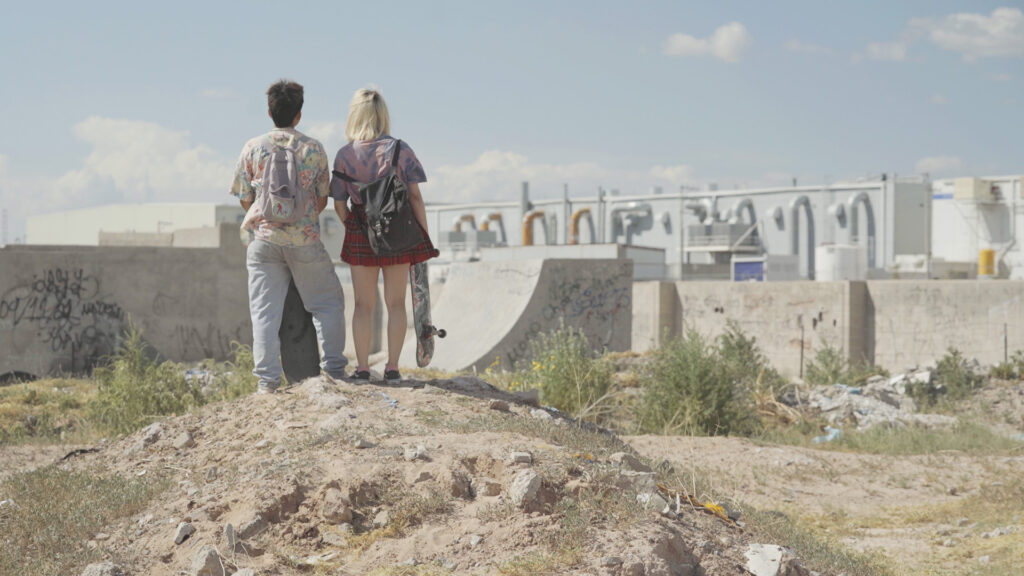
Directed by Iris Diaz and Alejandra Aragón
2021 AFS Grant recipient SKATAS is a new narrative short film by prolific artists and filmmakers Iris Diaz and Alejandra Aragón, both from Ciudad Juárez, México. The film centers on two friends searching for a place to skate in a city that is not designed for skateboard wheels nor their bodies or dreams.
Iris Diaz is an audiovisual and digital artist born in El Paso and raised in Ciudad Juárez. She has developed as an artist mainly on the Mexican side of the border and has been part of several group exhibitions including “Sin Línea” for “The Wrong” at the 2015 Digital Art Biennial and the “Conservatory of Women Photographers on the Border,” held at the Museo de Arte de Ciudad Juárez in 2019. Diaz works mostly works with video, photography, drawing and digital art, frequently mixing them with arte povera and recycled art. Her work deals with topics such as everyday life, memory, loneliness, deterioration, home, motherhood, among others; sometimes approaching them from the absurd.
A past AFS Grant recipient, Alejandra Aragón is a multidisciplinary artist from Ciudad Juárez, México. As a photographer, she participated in the Photographic Production Seminar of the Centro de la Imagen in Mexico City in 2017 and was a member of the 2020 World Press Photo’s Joop Swart Masterclass. As a filmmaker her first documentary LAS NOCHES INVISIBILES was part of the “Coordinates” program of the 2018 Ambulante Film Festival. In 2019, she received support from AFS for her documentary short DISRUPTED BOARDERS. Since 2021, the film has screened at festivals across the U.S., including the Cleveland International Film Festival, Philadelphia Film Festival, Cine Las Americas, and the New Orleans Film Festival.
On December 17, Spaceflight Records joins AFS for a special evening of sight and sound with a big screen presentation of John Carpenter’s 1974 debut feature DARK STAR. As a non-profit, the Austin-based record label provides equitable access to the many different aspects of the recording industry often way out of reach for marginalized musicians. An important part of that mission is being a launch pad for emerging artists and bringing Austin’s creative scenes together through events like this. Why DARK STAR? It’s a genuinely funny sci-fi farce about a junky starship, manned by bored misfits, dispatched to find and destroy unstable planets, and an all-time favorite of the label’s team. It is also in keeping with the theme of Spaceflight’s namesake—the evening promises to be a fun, multi-sensory exploration of one of the many interpretations of outer space…plus astronauts in Addidas sneakers.
Ahead of the event, AFS spoke with Spacefilght Records’ Brett Orrison and Sam Douglas to find out more.
Spaceflight Records Presents John Carpenter’s DARK STAR on December 17 at 7PM at the AFS Cinema. Join us beforehand for a live performance by Galactic Protector. Get tickets.
Tell us a little about Spaceflight Records.
Spaceflight Records is the first 501(c)(3) non-profit record label of its kind in America, organized and operated exclusively for charitable and educational purposes. It was created to develop, promote and advance the appreciation of Austin, Texas musicians and their music by providing access to commercial record label services and music business revenue streams which are so vital to a musician’s success. Spaceflight provides marketing, radio promotion, video content creation, legal services, sync licensing opportunities, album release management, artist development and distribution. We provide these services at no cost to the artists, giving them an opportunity for success without incurring large amounts of debt. We are a launch pad for emerging music.
What inspired you to create a non-profit record label?
Spaceflight was created to provide equitable recording contracts and artist development services to marginalized recording artists. We believe stripping down the economic barriers of promoting and distributing music will increase representation, diversity and access to the industry.
Why the film DARK STAR for this event? DARK STAR is a campy, psychedelic unpredictable sci-fi comedy. It’s John Carpenter’s first film, but it feels like it was co-directed by Robert Downey, Sr. And, I love that all the astronauts are wearing Addidas sneakers. How could you not wanna see this on a big screen with 200 of your closest friends?
What can audiences expect on 12/17 at the AFS Cinema?
This will be an exploration into one of the many interpretations of outer space. A live performance by Galactic Protector will start and end the show. His songs could be described as spaceship lounge music and downbeat electronic. We are hoping it will be an event full of people that are as inspired by the exponential possibilities of spaceflight as we are.
We love this event! Does Spaceflight host similar events around Austin?
This event is the first of its kind for us. AFS is doing wonderful things for Austin’s creative community and we are proud to be involved. We plan on creating more events that focus on bringing the film and music scene together.
(Still from Rosine Mbakam’s Two Faces of a Bamiléké Woman. Courtesy Icarus Film)
Starting December 7, AFS presents a special series of three award-winning documentaries by Cameroonian Belgian-based filmmaker Rosine Mbakam, who NPR recently described as “…the filmmaker reinventing how African women are portrayed in movies.” Her films capture intimate accounts of African women’s lives in Belgium and in her home city of Yaoundé, Cameroon including the three we’ll be screening: TWO FACES OF A BAMILÉKÉ WOMAN (December 7), Mbakam’s autobiographical account of a trip home to Cameroon to visit her mother; and her most recent feature, DELPHINE’S PRAYERS (December 15), the story of a west African immigrant woman in Belgium who spent most of her life in prostitution; and CHEZ JOLIE COIFFEUR (December 12), a revealing verité portrait of a Cameroonian beauty salon in Belgium and its proprietor. Rosine Mbakam will join us for a virtual Q&A following the screening of CHEZ JOLIE COIFFEUR.
The immediacy of Mbakam’s camera image and her utterly unique approach to perspective has quickly propelled her into a rising global auteur. Her films have been New York Times Critic’s Picks and won awards around the world, and earlier this year, she was celebrated with a retrospective at the Museum of Modern Art in New York. For a closer look, we’d like to share an excerpt from an interview with Mbakam in her own words, which appeared on MoMA’s blog, post: notes on art in a global context this past July. You can read the full interviewhere.
Excerpt from MoMA’s blog, post: notes on art in a global context:
Delphine’s Prayers is the first film I shot after film school, but it’s being released as my third feature. I met Delphine twelve years ago when I came to Europe to study cinema. We were connected by a mutual acquaintance as fellow Cameroonians who had recently arrived in Brussels, and we became friends. After five years at INSAS (Institut national supérieur des arts du spectacle et des techniques de diffusion de la Fédération Wallonie-Bruxelles), she introduced me to Sabine, who became the subject of Chez Jolie Coiffure (2019), when I became interested in making a film in the shopping center nearby. As I was preparing to shoot Chez Jolie Coiffure, Delphine asked me to make a film about her first. I was a little bit surprised, telling her, “You are my friend. I don’t want to make a film about your life.” But she replied, “You don’t know anything about my life.” Two days later, we began filming, and she started telling me her story.
Chez Jolie Coiffure
2018. Courtesy Icarus Film
Excerpt from MoMA’s blog, post: notes on art in a global context:
“In film school, you learn that you have to know the story you want to tell, that you have to go through all kinds of preparations in order to make a film. But experience has shown me that sometimes, you have to abandon preparations and take what life gives you. And that’s what I experienced with Delphine. Had I waited and gone through the motions of planning before starting, had I been there with a crew, I would not have the same story. I would not have this spontaneous outpouring. And the film is also the film of the moment—of that moment in particular, when Delphine was moved to speak about what she had been through—and not a later date in accordance with a production schedule. I had to respect the moment. I hope one senses that in the film.
As African filmmakers studying in Belgium, we are taught Western cinema. I’ve had to deconstruct this to find my own cinema, because the way cinema is made in the West is not my way of doing cinema. It’s not the same reality. If I take the Western approach to making movies, I will destroy the singularity of the story that I want to film. I have to find, each time, the right way of filming the situation, story, or subject at hand. We even joked about it: Delphine asks me if I’m ready, if I have my “carnet de bord,” my logbook. And at the start of the film, she is the one directing me to sit next to her—rather than me occupying this other kind of position behind the camera. The mise-en-scène mirrors our friendship. It was similar with Sabine. She asked me in the first scene to enter the salon, to physically be a part of her world with my camera, not to film it from the outside. Sabine knows her space better than I do, she knows her story better than I do . . . and, as a filmmaker, I have to respect that. If I want to tell Sabine’s story, or Delphine’s story, I have to respect their gaze and what they have asked me to do.
I filmed Delphine at home for ten days. It wasn’t really a question of directing. Delphine knew exactly what she wanted to tell me and the way in which she wanted to say it. Throughout, I questioned my own role and place. I didn’t want to assert power over her story; I wanted to just be silent and listen, and to ensure that she was comfortable. Quickly, the bed became the focal point of our sessions. That was the place of confidence for her, where she was at ease and sheltered from the outside world— not least from her husband and children, who were on the other side of the apartment. Usually, we say that the director has the final word, but with Delphine, after ten days, the shoot ended as suddenly as it had started. One day I showed up with my camera, we talked for a little bit, and she told me that she’d said everything there was to say. No planning, the film shoot was over.
I did a first edit in 2015 and it wasn’t right. At that time, I was carrying around a kind of rage, born of my situation here, by my experience as a lone Black filmmaker in the film school, and I edited that film with my anger. I can say that. And it was not the story of Delphine, but rather the story of my bitterness. But that is not the kind of work I want to make, and so I set the footage aside and started working on a project about my mother, which would become Two Faces of a Bamiléké Woman (2016). It was only in 2019 that I felt I was ready to edit the film. The experience of Chez Jolie Coiffure and Two Faces gave me the maturity to see Delphine’s story in the right way. When I started the editing, the choice of sequences and the process was really simple because the moment was right. I was no longer seeing Delphine through my lived experiences, but just seeing her as she was and is and . . . and everything was evident to me and to the editor. After editing, I asked Delphine to come and watch the film, and she saw it and told me, “I want people to see it now.” For me, this was a huge relief as I wanted to respect her voice and testimony.”
AFS presents EL PLANETA, the debut feature film by Amalia Ulman November 3 -11 at the AFS Cinema.
Part of our Best of the Fests series, visual artist Ulman mines the devastation of post financial-crisis Spain to craft this imaginative and biting contemporary mother-daughter comedy, a selection of the New Directors/New Films and Sundance Film Festivals. With hilarious turns by Ulman and her real-life mother, Ale Ulman; a down-on-her luck designer and her one-time socialite mother try to keep up their decadent lifestyle in spite of their rapid descent from the bourgeoisie.
Here AFS Associate Programmer Jazmyne Moreno asks the question:
Just Who Is Amalia Ulman?
“Scammer.”
“Genius.”
“Provocateur.”
A few years ago, a read of the headlines and Instagram mentions would leave the uninitiated just as confused as intrigued.
Perfectly encapsulating the malaise of the times, EL PLANETA with its mother-daughter scammer duo living life on the edge in the sleepy resort town of Gijon, Spain is a cleverly wry, modern reworking of Lubitsch that will leave you asking, “just who is Amalia Ulman and when can I see more from her?”
For more on Amalia Ulman visit: https://amaliaulman.eu/
(Still from Tramaine Townsend’s FRAMES., part of Ghosts of Lost Futures)
On November 8, AFS and Austin-based Experimental Response Cinema reunite to present Ghosts of Lost Futures—a look at what happens to history when it goes into an archive and comes out the other side, fifty years later.
This special program features new video works by 10 artists commissioned by the G. William Jones Film and Video Collection, housed at Southern Methodist University. It was intended to celebrate the 50th Anniversary of the archive’s founding in 1970, but due to the COVID-19 pandemic and the resulting lockdowns, it was not completed until Spring 2021. The artists were given access to the same cache of footage from the WFAA Newsfilm Collection shot in Dallas and complete freedom in how they re-interpreted the footage. The resulting works are profound meditations on mourning, melancholy, disaster, and various reinterpretations of the events of 2020 and 2021 through images of Dallas’ past.
Ahead of the event, AFS spoke with the Experimental Response Cinema team—Jennifer Stob, Liz Rodda, and Ana Trevino—and project curator Mike Morris to find out more.
Ghost of Lost Futures takes place Monday, November 8, 7PM at the AFS Cinema. Get tickets.
Tell us a little about Experimental Response Cinema.
Experimental Response Cinema was launched in February 2012 by Caroline Koebel, Ekrem Serdar, Scott Stark, and Rachel Stuckey. This team quickly established ERCATX as one of the most important venues for moving image art in Central Texas. Past programmers include Nayantara Bhattacharya, Phil Fagan, and Jarrett Hayman. Our current programming team is Liz Rodda, Jennifer Stob, and Ana Trevino.
As an itinerant microcinema, we hold screenings at locations generously provided by a variety of partner organizations. We love being hosted by AFS and are so proud of our past collaborations! Together we brought amazing programs to life featuring artists like Peggy Ahwesh, Chantal Akerman, and Stan Brakhage.
ERCATX screens rare and precious experimental film in all formats: 35mm, 16mm, analog video, digital video and more. Our shows are always uncommon, infrequent, intimate, and worth it! We mix activism and art, we share our platform with guest curators, we welcome internationally-renowned filmmakers, and we organize local showcases to uplift artists in our own community.—Jennifer Stob, co-programmer
Where did the idea for this particular project come from? Why this archive as subject/source material?
This project was originally conceived by archivists Jeremy Spracklen and Scott Martin of the G. William Jones Film and Video Collection. Jeremy and Scott have been eager to put this collection in the hands of artists and filmmakers as a way of providing access to the rich history of Dallas, as told through the local journalism of the WFAA television station’s reporting.
The makeup of the collection is fascinating in that it consists of raw 16mm footage that was shot by reporters at WFAA, used for a single broadcast, and then set aside before arriving at the Jones archive. That is to say, we don’t know what parts of this material ever made it onto television and what didn’t, but the films are well preserved and have been digitized by the archive in-house and they document many interesting (and sometimes baffling) moments in the city’s history.
My job was to select 10 artists who would all be given the same cache of footage to work from, without any restrictions. The program yields charged juxtapositions of the past with the COVID shutdows of 2020, the outpouring of rage during the George Floyd rebellions, and the over-mediated anxiety of the end of the Trump administration. Even so, some of the videos included in the program are also deeply personal, formally experimental, and think deeply about different forms of mediation. —Mike Morris, curator
How was this presented to the filmmakers/artists?
I tried to select those that either had a history of using found footage in their work, or some who didn’t that I thought might be interestingly challenged by a project of this nature. I presented it as an opportunity to work with this rich material in an unrestricted way, with total freedom of how to treat the history depicted in the footage–whether to make use of the historical narrative it is attached to as part of the raw material, or to ignore it completely and create their own interpretations.
I knew that what resulted would be a totally new re-making of that history in either case. Some artists had connection to the region and some were from far away, having spent little or no time in Dallas. —Mike Morris, curator
Did the title ‘Ghosts of Lost Futures’ emerge before the project or after?
I came to the title ‘Ghosts of Lost Futures’ as the new videos were starting to come together. I’ve been thinking about/with archives in my own work for some time, but at that moment I’d been reading Mark Fisher’s interpretation of Derrida’s concept of ‘hauntology’, or the notion that the past haunts the present in a number of ways. The concept comes from Derrida’s mourning of the desire for radical change in the postmodern period.
Fisher uses this concept in a similarly melancholic way, lamenting that we seem to be stuck in a period of perpetual recycling that forecloses the notion of a future that could be better than the present. He writes of the necessity to dream beyond this end of history. The works in the program feel, to me at least, haunted with the need for change in our current realities.—Mike Morris, curator
For the second straight year the various COVID protocols dictated that the Toronto International Film Festivaloffered a virtual version of the international festival, albeit one that lacked access for certain of the more interesting titles. Still, there were a lot of films to be seen and we saw a few dozen of them. Here’s hoping that we’ll be able to visit Toronto again next year and see some of our far-flung and probably much grayer film-biz associates soon. Here are some of the best films I saw while sitting on my couch. – Lars Nilsen, AFS’s Lead Film Programmer
Directed by Antoneta Alamat Kusijanović
Antoneta Alamat Kusijanović’s first film, winner of the Cannes Camera d’Or, is a fraught four-hand ensemble piece that takes place on the Croatian coast. A teenage girl, desperate to escape the constricting confines of her ambitious and controlling father, sees a possible escape route when a very wealthy friend of the family – a handsome man of the world who offers to pay for her college education – visits their seaside home. Complicating matters is the attraction felt between the girl’s former beauty queen mother and the visitor. The film is tense, urgent and full of rich visual storytelling. This is the kind of Cinema that charges the batteries and awakens the senses.
Directed by Stanley Nelson
Stanley Nelson is to Ken Burns what Howard Zinn is to a high school history textbook. For years now he has documented the American experience particularly as it pertains to Black Americans and has done it with a scholarly rigor that puts other documentarians to shame. This, his latest, must surely be the definitive statement about the 1971 Attica Prison Rebellion, in which prisoners protested their shocking living conditions by taking over the prison and for which they paid dearly in lives and blood by the time it was all over. In addition to interviewing the survivors, Nelson and his associates have gone through the available material and much of the footage included here is searing – prison guards shouting “white power” for instance, or a recorded conversation between New York Governor Nelson Rockefeller and President Nixon in which Nixon is reassured to hear that the prisoners killed were Black. This is history that is undigested, history that sticks in the throat, history that we can’t go forward without understanding.
Directed by Céline Sciamma
With her latest, Céline Sciamma continues to impress as a filmmaker whose style meshes serendipitously with her story choices. This film could not be more different from GIRLHOOD and PORTRAIT OF A LADY ON FIRE, but her touch with the smallest details is completely in tune with her purposes. The story is about the connections between generations of women in a family, and it is achieved with a bold narrative gambit, which I will not spoil here. The point of view character is a child, and the world pulses with the mystery and wonder of childhood. It’s a very good film and one that deserves to be watched as carefully as it was made.
Co-directed by Saul Williams and Anisia Uzeyman
Speaking of bold narratives, this is a film that seems to have more ideas per minute than any other film I have seen in years. Written by Saul Williams and co-directed with the Rwandan-born artist Anisia Uzeyman, this film is a colorful melodrama/pageant/allegory of Afrofuturist aesthetics, set against the backdrop of a colonial mining community in Burundi. Bursting with music, poetry, radical political and cinematic ideas, it leaves the viewer feeling supercharged with exciting ideas about alternate futures that do not invariably place humankind on a collision course with oblivion.
Starting this Thursday, AFS presentsThe Wilder Touchas October’s Essential Cinema series—featuring some of the most timeless comedies ever to show on screen by the incomparable and celebrated director Billy Wilder, including A FOREIGN AFFAIR (1948), LOVE IN THE AFTERNOON (1957), THE APARTMENT (1960), IRMA LA DOUCE (1963), and beloved classic SOME LIKE IT HOT (1959). We’ll be joined by Noah Isenberg, chair of the University of Texas at Austin’s Radio-Television-Film department and guest programmer for this series, at select screenings for introductions and discussions beginning with A FOREIGN AFFAIR on Saturday, October 2. Professor Isenberg is an editor of Billy Wilder on Assignment and author of a forthcoming book on SOME LIKE IT HOT.
We asked Professor Isenberg, the Billy Wilder expert, for some context to the five films we’ll be showing in the series:
Although it was Ernst Lubitsch, that master of subtle humor, sly innuendo, and an unmistakable air of European sophistication, who is most often thought to hold exclusive rights on the touch, his equally acclaimed disciple Billy Wilder—whose Beverly Hills office famously displayed a sign with the credo “How Would Lubitsch Do It?” in reverent cursive letters—most certainly had a touch of his own. The five films selected for this series point to the enduring legacy of the Berlin-born Lubitsch, whose BLUEBEARD’S EIGHTH WIFE (1938) and NINOTCHKA (1939) were co-written by Wilder, and who passed away in Hollywood in November 1947, at the age of fifty-five, just as the younger director was hitting his jaunty stride. They also reveal a few illustrative moments along the career path of a writer-director whose achievements have found few rivals in motion-picture history.
As the embers of the Second World War continued to burn, the Galician-born and Viennese-raised Wilder returned to Berlin, where he’d lived and worked as a young journalist and budding screenwriter throughout the late Weimar years, 1926-1933 (much of his writing from that era is contained in the newly published Billy Wilder on Assignment). As part of the U.S. Army’s Psychological Warfare Division in Bad Homburg, he witnessed the mountainous ruins left in the wake of the Allied air bombings —footage of which is intercut in the opening sequence of A FOREIGN AFFAIR (1948), his dark comedy of the U.S. occupation—and the mountains of bodies left in the death camps (his mother, step-father, and other relatives are believed to have perished in Auschwitz). Together with Czech director Hanuš Burger, he made DIE TODESMÜHLEN (DEATH MILLS, 1945), a documentary short aimed at re-educating the German masses, produced just months after he and his crew at Paramount had wrapped on THE LOST WEEKEND, his adaptation of Charles Jackson’s bestselling novel, which would earn him his first pair of Oscars (Best Director and Best Adapted Screenplay, shared with writing partner Charles Brackett).
In many ways a bittersweet nod to his days as a journalist in Berlin and to the city’s famed nightlife, A FOREIGN AFFAIR afforded Wilder the chance to work with Marlene Dietrich, whom he regarded as a lifelong friend and whose breakout performance as nightclub singer Lola Lola, in Josef von Sternberg’s DER BLAUE ENGEL (THE BLUE ANGEL, 1930), seems to haunt the entire film. Early on, Charles Lang’s camera takes us into the raucous Lorelei nightclub, where Dietrich’s performance, as ex-Nazi chanteuse Erika von Schlütow, features composer Friedrich Holländer seated at the piano, sharing a few drags of her cigarette—a throwback to their initial pairing on THE BLUE ANGEL and also a tacit acknowledgment of the friendship Holländer enjoyed with Wilder, when he, Peter Lorre, and several other refugees from Hitler were holed up in Paris at the Hotel Ansonia waiting for passage to America. The camera, still lavishing attention on the nightclub stage, reveals a drum kit with the Eden Hotel emblazoned upon it, the same hotel where Wilder worked as a dancer for hire, possibly a gigolo, in the mid-1920s, writing a three-part, tell-all series for his readers at the Berliner Zeitung am Mittag.
One of the many memorable profiles that Wilder wrote as a cub reporter in Berlin and Vienna was of the Swiss-French writer Claude Anet (né Jean Schopfer), whose 1920 novel Ariane, jeane fille russe, he later adapted to the screen and produced, as Love in the Afternoon (1957), starring Audrey Hepburn, in the first of a dozen charmed collaborations with writer I.A.L. Diamond. Fittingly enough, Wilder ends his 1927 profile of Anet with a couple of sentences taken from the author himself and that seem, almost uncannily, to anticipate Gary Cooper’s performance as the philandering Frank Flanagan in Wilder’s film three decades later: “The lady-killer disappears after his victory. Then the women curse the hour he was born, yet they regret not that he came, but that he went.”
In their next collaboration, Wilder and Diamond returned once more to a few evergreen sources from the late 1920s, their chosen setting for SOME LIKE IT HOT (1959), in which Prohibition-era Chicago has more than a mere waft of Wilder’s Berlin, known at the time—in a quip attributed to Mark Twain—as Chicago on the Spree. When he was just shy of his twentieth birthday, Wilder wrote a piece on the internationally acclaimed all-girl dance troupe from Manchester, England, The Tiller Girls, and their arrival in Vienna (“This morning, thirty-four of the most enticing legs emerged from the Berlin express train when it arrived at the Westbahnhof station”). It was an image Wilder never quite forgot, certainly not when he and Diamond dreamed up Sweet Sue and Her Society Syncopators. Their own variation at the Chicago train station has Tony Curtis and Jack Lemmon in full drag for the first time—coached, as fate would have it, by the Round Rock-native drag artist Barbette (né Vander Clyde), a performer Wilder knew from her Berlin tours of the 20s—and Marilyn Monroe and her dangerous curves sauntering by in a form-fitting skirt and flapper hat (“a whole different sex”).
The last pair of sex comedies selected for the series both feature Jack Lemmon and Shirley MacLaine: THE APARTMENT (1960) and IRMA LA DOUCE (1963), the former a film for which Wilder would wrack up another three Oscars (Best Picture, Best Director, Best Screenplay) and the latter among his most commercially successful films of his career. In both instances, the Wilder touch is evident in ways that harken back to his early apprenticeship with Lubitsch and also to his years as a freelance writer, barely eking out a living, in Berlin and Vienna. In Volker Schlöndorff’s documentary BILLY WILDER SPEAKS (2006), the German filmmaker notes how the sense of alienation and loneliness, not to mention the self-deprecating mordant wit, that defines Lemmon’s character of C.C. Baxter in THE APARTMENT recalls quite vividly Wilder’s own art of getting by in the big city. Finally, Shirley MacLaine’s performance as the title role of Irma la Douce gives a second life to Fran Kubelick, the elfin elevator girl, and a chance for Wilder to entertain, even to tease, an American audience eager to appreciate his more libertine, continental sensibility.

 After a lifetime of bus rides to the US to visit his children, Julián quietly starts building a house in rural Mexico. In filming his work, his granddaughter crafts a personal and poetic love letter to him and his homeland. (Documentary Spotlight)
 An unexpected invitation launches a grieving young woman on a solitary road trip through the American Midwest as she struggles to reconcile the losses of her past with the dreams of her future. Cast List: Lily Gladstone, Raymond Lee, Richard Ray Whitman, Lainey Bearkiller Shangreaux, Devin Shangreaux, Jasmine “Jazzy” Bearkiller Shangreaux, Pam Richter, Dale Leander Toller, Florence R. Perrin, Teresa Boyd (Visions)
 A disabled man’s commute is interrupted by a $100 bill lying on the sidewalk, just out of reach. It flutters away as soon as he moves towards it, leading him on a chase that forces him to reconsider his toxic ideal of self-sufficiency. (Texas Shorts)
 Moments in the lives of Austin teenagers during the heat of Texas summer. (Texas Shorts)
 One night at her home in southeastern Congo, 14-year-old Mugeni awakes to the sounds of bombs. As her family scatters to the surrounding forests to save themselves, Mugeni finds herself completely alone. (Texas Shorts)
 Descendant follows the search for and discovery of The Clotilda, the last known ship to illegally carry enslaved Africans in the United States. Guided by the voices of their ancestors, descendants of The Clotilda’s survivors reclaim their past and examine what justice looks like today. (Festival Favorites)
 In the world of Major League Baseball no one has created a mythology like Nolan Ryan. Told from the point of view of the hitters who faced him and the teammates who revered him, Facing Nolan is the definitive documentary of a Texas legend. (Documentary Spotlight)
 Michael Thompson is the longest serving non-violent offender in the history of Michigan and he is finally up for clemency. After 25 years, 3 appeals, and 2 denied applications for clemency it seems like Michael may finally have a chance at freedom. (Documentary Shorts)
 Two ex-lovers cross paths at a train station. (Animated Shorts)
 Both cautionary tale and rallying cry, Shouting Down Midnight recounts how the Wendy Davis filibuster of 2013 galvanized a new generation of activists and reveals what is at stake for us all in the struggle for reproductive freedom. (Documentary Spotlight)
 _________________________________________________________




 Still from DECASIA