To celebrate the Criterion Collection’s long-awaited home release of Bill Forsyth’s LOCAL HERO, the film that launched the 2019 Jewels in the Wasteland series, you can now watch all of Linklater’s introductions and discussions from this year’s installment, including LOCAL HERO, VAGABOND, LOST IN AMERICA, and CHAN IS MISSING.
One of AFS’s most popular programs, Jewels in the Wasteland is a series designed to spotlight some of the best overlooked films made during the 1980s. The series is programmed and hosted by AFS Founder and Creative Director Richard Linklater.
Editor’s Note: After we posted this original article on September 11, 2019 to celebrate the legacy of Daniel Johnston, Richard Linklater was inspired to share his memories in this thoughtful tribute.
Such sad news about Daniel Johnston’s passing. I’ll always remember Daniel as the creative supernova taking Austin by storm in that crazy summer of ’85. The day I met him is actually on film, in Lee Daniel and my short film Woodshock. Always attracted to a camera, he started following us around at that music festival, badgering us to be filmed. He was handing out tapes of “Hi How Are You?” so that’s what ended up being in the movie. I remember listening to the tape late that same night in the car heading back to Austin. Holy crap—I think everyone of that era can remember when they first heard Daniel and the connection that took place, the amazing discovery they’d just made.
Daniel had an instinct for spotting a future Daniel Johnston fan before they even knew who he was. Cool, sensitive, seeking… they were everywhere in Austin. After some college, some moving around and a carney tour, he knew he’d landed in the right place at just the right time. Because it meant so much to him what you thought of his music, you felt obliged to go find him and tell him how much you liked it. He was easy to find, working at the McDonalds on the drag where, if he thought you seemed interesting, you just might find a “Yip/Jump Music” or a “Retired Boxer” tape along with your fries. So open, honest, funny, and vulnerable, you wanted to offer support in any way you could, and he’d treat everyone who seemed to connect with his music like they were the most important fan in the world to him. There was a hustle to it, but there was also a purity to it—he wasn’t some politician running for office, he was an artist seeking connection, both artistically and personally, and he was finding it everywhere, becoming a full-blown local phenomenon. You’d walk by a car where some people were hanging out and you’d realize they were listening to a Daniel tape. He’d easily finagle his way into shows and onto bills, most famously when MTV came to town later that summer and he went from being not a part of the scheduled lineup to stealing the show. It was amazing to witness.
At that time, he lived in a little apartment practically on campus, near the PCL. It was all music and artwork. There was always a tape in the dubbing process, and I’ll go on the record remembering an actual “master cassette” he was dubbing from. There have been rumors over the years that it was just an ever-degrading dub-from-a-dub process, but no, he wanted it to be the best it could be within his means (he did use the cheapest, 3-for-a-dollar cassettes though). He was always out and about and would regularly drop by where I was living, the “Finger-Hut/film house/Janis Joplin house” (it was called a bunch of different things) on Nueces right behind and sharing a parking lot with Inner Sanctum records and the infamous Mad Dog and Beans hamburger joint. He had worked it out where they would give him a half of a Blue Bell milkshake every day when he came by, but it was really like 3/4 of one for half the price. What would become the Austin Film Society was in its earliest stages at our house, and Daniel liked the idea of film, coming to screenings both in our living room and at the Dobie Theater where we’d show films on the weekends (though nothing we ever showed could compete with King Kong in his book). He would make and leave all kinds of drawings that might end up on a wall or above the editing bench. I remember him asking me how I was able to “live so well,” which must have meant how does one, even with a mattress on the floor and no kitchen sink, happen to have both a junky car AND a working telephone, which he certainly liked to use whenever he was over. He thought he should maybe have a camera on him all the time, and I honestly can’t say if it’s a good or bad thing we all missed the Daniel Johnston reality show by a generation. I did work up a scene with him in the Super 8 feature I was making during this time, and he most definitely would have been in Slacker but wasn’t really around that summer in ’89.
I remember early on walking into a house party with him where we knew only a few people who were going to be there. He completely switched from a guy who could have an intimate conversation into a much more extroverted personality, introducing himself to everyone with a big mischievous grin and an “I’m Daniel Johnston and I’m famous!” “For what?” someone would ask. By the end of the party he was pretty famous—I remember two young ladies walking out kinda chanting “I’m Daniel Johnston and I’m famous.” Somewhere along the way he informed me that God told him he couldn’t get into heaven unless he was famous. Where was this all going to end, I wondered? Well, it didn’t really end, and I don’t think, even with him now gone, it ever will. He’ll probably become an even bigger mythological character, but my hope is that it’ll be for his music and art and not his mental health struggles. We’ve lost a creative genius, one of the great songwriters, and there will never be another like him. I feel blessed that, through sheer timing and location, I can always remember the young Daniel that was a really sweet, friendly guy… a total romantic. We’ll always have the music, and while I was writing this I was listening to his 2001 album, “Rejected Unknown” and Kathy McCarty’s incredible album of his songs, the mesmerizing “Dead Dog’s Eyeball.” So, listen away and forever remember this unique artist that shared everything he had to share.
We are very saddened to hear the news of Daniel Johnston’s passing today. To celebrate his legacy, we wanted to share AFS Founder and Artistic Director Richard Linklater’s first short film from 1985, WOODSHOCK. Before it became “The Live Music Capital of the World,” Austin, Texas was home to an alternative music festival known as Woodshock, the first taking place in 1981. The 1985 Festival included performances by local (and otherwise) musicians Daniel Johnston, Texas Instruments, Dharma Bums, the U-Men, Glass Eye, Cargo Cult (fronted by Biscuit of Big Boys), The Reivers, Poison 13, and the festival’s unofficial mascot, The Hickoids. (–Dangerous Minds). Below is the full video of Linklater’s WOODSHOCK featuring a young Daniel Johnston.
On this episode of the AFS Viewfinders podcast, Chale Nafus, former Director of Programming at AFS, talks with Karen Grumberg, Director of UT’s Center for Middle Eastern Studies, about upcoming film series Children of Abraham/Ibrahim: Films from the Middle East and Beyond featuring new films CAPERNAUM, HARMONIA, THREE FACES, and MARJOUN AND THE FLYING HEADSCARF (directed by Susan Youssef, recipient of several AFS grants). Erica Deiparine-Sugars also joins in the conversation to talk about the AFS grant and its impact on women in independent film. Now in its 13th year, the Children of Abraham/Ibrahim film series is guest programmed by Nafus and Grumberg and continues to feature some of the best new cinema coming from the Middle Eastern region. From the retelling of a story from the Book of Genesis to a coming of age film that follows a Muslim American teenager in Little Rock, Arkansas, this year’s films will touch both your heart and mind as well as create a deeper understanding of a region that we may often only experience in newscasts. Listen in as Nafus and Grumberg discuss the 2019 line-up what to expect from this essential film series.
On this episode of the AFS Viewfinders podcast, we visit with the team behind the American Genre Film Archive (AGFA)—Director Joe Ziemba, Head of Film Preservation Sebastian del Castillo, and Director of Business Affairs Alicia Coombs. Now in its 10th year, the Austin-based non-profit was formed to preserve the legacy of genre movies, the more obscure the better. Specializing in horror, sleaze, action, and independent regional filmmaking, as well as international genre cinema with an emphasis on films from Hong Kong, AGFA has quickly become one of the most sought-after archives in the world. The archive counts among its board members and advisors Alamo Drafthouse founders Tim and Karrie League, filmmakers Nicolas Winding Refn and Paul Thomas Anderson, film fans, and Austin area film programmers including AFS’s Lars Nilsen. Housing over 6,000 film prints—some of which are the only copies in existence—a 4K film scanner, and theatrical and home video distribution arms, AGFA will never rest until genre movies rule the world.
In this conversation, Lars Nilsen talks with Joe, Sebastian, and Alicia about going on ten years strong, how it all got started in a cluttered projection room of the Drafthouse Village, and current projects like the newly released films of Sarah Jacobson, Queen of the ’90s Underground Cinema.
On August 3-4, AFS will partner with John Doe, of LA band X, to present a special weekend of films at the AFS Cinema including, X: THE UNHEARD MUSIC,ROCKERS, and GEORGIA. Come early and stay late as Doe will be in attendance all weekend. Purchase tickets.
On this episode of the AFS Viewfinders podcast, we visit with John Doe, one of the leaders of the seminal Los Angeles punk band X. Since the band’s beginning in the late 1970s, Doe has carved out a special place for himself in music history. But that’s only half the story. The same love of storytelling and characterization that makes his songwriting come alive has also produced a multi-decade career as an actor, often in small but important character roles. In this conversation, Doe talks with AFS’s Lars Nilsen about growing up in Baltimore and knowing John Waters, how he got into music and film, the LA years, and going to see movies. Bill Morgan, director of X: THE UNHEARD MUSIC, will join Doe in a Q&A following the screening on August 3.
The second annual Contrast Film Festival—a celebration of gender-defying, forward-thinking, and accessible art with an emphasis on female and queer filmmakers—takes place this weekend, July 18 – 21, at the AFS Cinema. The creators of the Festival, Tish Sparks and Jeremy von Stilb, also make up the programming team behind Homo Arigato, AFS’s ongoing film series focused on rare and beautiful queer films. Following the success of last year, the 2019 Contrast Fest will bring more Texas film premieres and unique performances, including an opening night screening of Jack Smith’s 1963 seminal queer art film FLAMING CREATURES on Thursday, July 18, at 8 PM. For this special event, the film will be presented with an original live score by Austin-based musicians Thor Harris, Peggy Ghorbani, and Sarah Gautier who perform together under the moniker THOR & FRIENDS.
AFS sat down with Tish and Jeremy to talk about the Festival and what to expect this year:
HOW WOULD YOU DESCRIBE THE CONTRAST FILM FESTIVAL?
Jeremy: It’s four days of mind-bending, boundary-pushing, outlandish, and exciting cinema, performance, and comedy.
HOW DO YOU SELECT THE FILMS TO SCREEN AT CONTRAST FEST?
Jeremy: We are drawn to things that unusual or adventurous. Sometimes experimental films can mean watching things that test one’s patience though, so I think we still want to showcase films that are filled with joy and are invigorating to the audience. We try to find a balance between challenging and entertaining.
Tish: We are also always kind of looking for films that are a bit under the radar or are not likely to play at other festivals around town. We want to create a unique experience for the audience and give them an opportunity to see films that they maybe wouldn’t be able to see in a theater otherwise. And when we get those audiences to the cinema, we also aim to present work that will spark conversations afterwards. Whether the audience loves or hates something they see at the festival, we at least want them to feel something! There is nothing worse than bland films that elicit tepid responses.
WHAT MAKES CONTRAST DIFFERENT THAN OTHER FILM FESTIVALS?
Jeremy: It’s a film festival programmed by Tish and I who first got our start DJ’ing and doing music events but both went to film school. I think there’s a lot of cross over in our own creative approaches and the festival reflects this. It’s not wall to wall sitting in a theater, there is a lot of live performance and audience engagement.
Tish: I think the thing that is exciting about Contrast is that people could have totally different experiences attending the same festival. Like, if you are more of a music and performance person you could have a pretty full weekend of just taking in those events but if you are more of a cinephile, you can see six or seven films in a weekend too. And if you are someone who likes to take in a little bit of everything – a film here, a show there, a panel discussion in the evening, a wild club experience inside of a school….we’ve got you covered too!
WHAT INSPIRED YOU TO START THE FESTIVAL?
Tish: Contrast grew out of our work over the years curating live music, programming the monthly film series Homo Arigato, and producing parties and other types of events. We wanted a way to combine our varied interests and offer our communities an opportunity to see great work, make friends and connections, feel inspired, and hang out over a weekend.
WHAT CAN YOU SAY ABOUT THE FILMS AND EVENTS FEATURED THIS YEAR?
Tish: We are doing some really special things this year that we are super excited to share with audiences! When we first conceptualized this festival a couple of years ago, one of the ideas we had was to do a live re-score of Jack Smith’s seminal queer art film FLAMING CREATURES, and we are actually getting to do it this year. The film is such a pivotal moment for queer film but it is rarely screened outside of museums. We wanted to make the film more accessible by bringing it back into the cinema and pairing it with contemporary music. There are so many ideas in the film that are still relevant, so we wanted to try to find a way to help modern audiences connect with the work.
We are also presenting Texas premieres of so many great films. The Sundance standout ADAM by director Rhys Ernst, the really wonderful, Teddy Award-nominated film SO PRETTY (that was shot on 16mm film!), Midnight Shorts by Bertrand Mandico (THE WILD BOYS) and Yann Gonzalez (KNIFE+HEART), several films from Brazil focused on queer and trans experience, and more!
There are a few performance-based events on the lineup that are super unique and fun as well. We are doing a ‘late night adult multiplex’ at the Austin School of Film that will feature a performance from avant-hip hop artist Saturn Risin9, drag performers, VJs, and three microcinema spaces that each have their own theme and design. The festival will also feature a web series screening and discussion with filmmakers, and we will close out the festival with a comedy & music event called Yes You Can! That event is kind of a riff on wellness culture (but is also actually meant to inspire and motivate!) featuring a performance from NYC-based, multidisciplinary artist Bunny Michael and lots of locals, so it should send us off until next year with positive vibes.
WHAT DO YOU HOPE VIEWERS TAKE AWAY FROM THE FESTIVAL?
Jeremy: I want the films and events to let people exist in an alternative reality for a few days where they can imagine a world that could be rather than the world as it is. I want to fantasize about a world where women, queer people, and those that are typically marginalized are empowered and free. I think that’s what links all of the work we are showing.
The gunfight at the OK Corral was a legend made famous by Hollywood studio westerns over many decades, from John Ford’s MY DARLING CLEMENTINE (1946) all the way to George Cosmatos’ ‘90s blockbuster, TOMBSTONE. In his provocative documentary, filmmaker Mike Plante examines the Hollywood legacy of Wyatt Earp through the many films that rewrote history to immortalize him. Plante will be in attendance for the screening on July 17 and also participate in a Moviemaker Dialogue at Austin Public on July 18.
Here he shares his thoughts on what inspired him to make the film and some of the questions it poses:
What is it about the story of Wyatt Earp that inspired you to make this film?
I grew up in western Colorado, so besides seeing western movies and reading tons of books about the “real” wild west, I was always running around ghost towns. It was fun as a kid, but strange too. Going to a fully formed city that was super rich for a few years that had collapsed into a shell was surreal. It was also beautiful, and sad and broken—a mysterious comic book come to life.
As an adult I realized how insane these frontier towns were. The immense circumstances that everyone had to overcome, the harsh locations, the mountains, the deserts. The community that had to come together to survive. I also realized the brutal politics of manifest destiny. The complicated history of the individuals involved, both good and bad. The truth is far more fascinating than the mythology.
In the late ‘80s I moved to Tucson, Arizona, and lived there for a decade. Tombstone is nearby and I became more interested in that specific town history. There were not that many duel-style gunfights in the west, most were myths, so the OK Corral stuck out even more.
After I learned that Wyatt lived long enough to go to Hollywood and visit movie sets, this particular story became even more surreal. Lots of western characters reinvented themselves in their own lifetime—but for Earp to go to filmmakers in Hollywood and ask them to make a movie about him, to help form his legacy, that’s next level.
Were there specific films you watched growing up that influenced your understanding of the Wyatt Earp story better than others?
I grew up in the ‘70s and ‘80s so the western was not a popular genre at that moment. It was western characters in outer space instead. I saw the older Earp films on TV. I liked them but they felt like a bygone era that was completely removed from modern times, closer to King Arthur than Al Capone.
The old films really blended together over time—one of the ways movies create American mythology. You start to think that this many movies on one subject couldn’t possibly lie to you, which is absurd. And then the revisionist DOC is from 1971 but was never talked about, I never saw it on TV. Something like MCCABE AND MRS. MILLER (1971) is incredible, not about a historical person yet so realistic and deep. But I never saw it on TV. We didn’t have a revival movie theater in town, and these weren’t the big VHS tapes of the moment.
There were a few non-Earp westerns that really influenced me in terms of their style, films that felt absolutely true and vital even though they were not realistic. The spaghetti westerns ONCE UPON A TIME IN THE WEST (1968) and MY NAME IS NOBODY (1973) are still amazing to me. They paid off in terms of overboard action and big story, but they’ve got complex characters in the middle of them.
In ONCE, Henry Fonda is heroic and beautiful but a terrible villain. Claudia Cardinale is a strong female lead fighting for her land, this ain’t a 1930s western. NOBODY is a satire but succeeds in the same way, with Fonda (in his last western) even stating, “there were never any good ol’ days.” It’s with these films that I started to think maybe the west was much more advanced, weird, and messy, and that people in their day were very modern.
When THE LONG RIDERS (1980) came out, I was obsessed with it. Again, a modern movie with stylish camera and editing, with characters more nuanced into a grey hat, rather than a white-hat black-hat simplicity. But this time the characters had the names of real people (the James-Younger gang). What I wanted as a kid was not clean propaganda, but messy realism. What did it look like to be in the same place as these people? Including all the mundane moments. That film is almost a musical, the soundtrack is not booming but true to life, complete with a wedding dance and characters playing instruments.
So then when I saw the Earp films again as an adult, GUNFIGHT AT THE OK CORRAL (1957) for example, they felt strange. The style was great—Technicolor-delicious—but the acting was really stilted and the story was so jumbled. There’s some fascinating stuff, like how the town had gun control and some awesome gambling scenes. But there’s a lot of forced romance and no bad language. The fun parts were fun, but the G-rated-ness made you wonder what happened in real life.
As a film fan doing historical research for years, I started to piece together the scenes and the lasting effect movies have had on history. Once I started seeing incredible found-footage movies, like Craig Baldwin’s TRIBULATION 99 (1992) and Naomi Uman’s REMOVED (1999), or even Cindy Sherman’s photography, I got a blueprint for the ideas. I’m working in the vein of Thom Anderson’s LOS ANGELES PLAYS ITSELF(2003), just ‘Wyatt Earp Plays Himself.’
By the way, I don’t think I’m anywhere near the level of these filmmakers! I’m just standing on shoulders.
Why do you think Hollywood has returned again and again to the retelling of Earp, Tombstone, and the gunfight at the OK Corral?
Money. That’s the main goal of studios, Hollywood is a business. Westerns fall in and out of popularity, but they can always relate to the current times in one way or another, and action films make a lot of money. This story made money before, it can again.
But you can also look to individuals who really believed in the story and the complexity, who then had enough pull in the industry to get a film made, like Kurt Russell and Kevin Costner. They seem to understand the modern connections between today and the wild west, not only in social issues but in the type of people who reinvent themselves into legends.
And it’s probably a helluva a lot of fun to make a western.
Throughout it, the film explores the blurring of lines between reality and fiction. In the end, is that distinction important, or does it no longer matter?
I think it matters. We need to believe in history. I think it starts to matter more because people run with what they want to believe, and that is what I’m trying to explore.
Even if an elevator doesn’t put the number 13 on the buttons… there is still a 13th floor. Why do we do that to society? I’m really interested in how that blurring happens and how it’s often just accepted. Humans want to feel safe on this huge planet and we create things to be comforted.
The mythology of the past can be incredibly artistic and inspirational. I think most people know that when you read about the past, there is a layer of interpretation involved. From the writer sharing the information to the person reading it. So, you figure out what is trustworthy when you need to, and what is just fun and entertaining. And that’s why professional journalists and serious historians and librarians really matter.
In the film, I give my take on what happened, but I don’t tell the audience what to think about the events or how the films have warped history. This is a poem about Wyatt Earp, not an encyclopedia. I’m giving you the information and we should all have a discussion about it. The real danger is not talking about history.
At the same time, let’s have fun. I often wonder if people with opposing opinions would get along once they realized that they all believe in UFOs.
The film also takes us through the very beginning of film and its evolution as a means of storytelling – in this instance the story of a real historical person. What do you think is the next wave of Westerns and filmmaking technology and why is it important that moviegoers continue to be interested in history?
We like to remember our own lives as movie scenes so it’s not a surprise to keep making these connections to history as entertainment. Some historical figures are so nuts, so fun, it makes a great movie. Let’s laugh and cry and learn together, that’s what both movies and history are for.
The western is such an enduring genre and filmmakers keeps pushing the limits of drama, comedy and action. I love to see crossovers with other genres. The Zellner Brothers’ DAMSEL (2018) is great, basically a romantic dark-comedy in the west. The ONCE UPON A TIME IN CHINE series by Tsui Hark should be counted among the great westerns. Or just more stories with unique characters, like Kelly Reichardt’s MEEK’S CUTOFF (2010). And I’m definitely not the first to explore the western in a documentary—everyone should be watching Neil Diamond’s REEL INJUN (2009). Nor am I the first to do a remix, like the amazing short by Peter Tscherkassky, INSTRUCTIONS FOR A LIGHT AND SOUND MACHINE (2005).
We need the dystopian western. The technological advancement of the old west was ridiculous, fueled by the gold rush. Like THE CITY OF LOST CHILDREN (1995) by Jeunet and Caro—you can’t even tell if that’s the past or the future, it’s so magical.
And why not more bombastic spaghetti westerns?? Just don’t use real historical names and make it weird.
(Above: Annie Silverstein, Johnny McAllister, Monique Walton at the Cannes premiere party for BULL.)
Fresh off of a trip to the 2019 Cannes Film Festival, Austin Film Society CEO Rebecca Campbell shares some of the highlights from one of the biggest annual events in film and reflects on how AFS is a critical part of that dialogue.
Having been at the helm of AFS for 21 years now, I had a thought that I ought to one day make the pilgrimage to Festival de Cannes, the Mecca of film. I’m so grateful to a team who supported me in turning that brief thought into reality this year—the experience profoundly reinforced for me why AFS’s work is so important.
In the baggage claim at Nice, I ran into AFS Advisory Board member Mike Simpson and his lovely wife, Nancy. This got me a free ride to Cannes and great conversation with the nicest guy in Hollywood. You’d never know from his down-to-earth attitude (and love of Texas: he’s a graduate of UT Austin) that he was there to premiere films with two of the greatest directors working today, Quentin Tarantino and Bong Joon-Ho.
Some other highlights:
It was a profound thrill to see Annie Silverstein listed on the schedule of films in competition, alongside Pedro Almodovar, Ken Loach, Jim Jarmusch and the like. AFS has been supporting Annie’s artistic vision for several years through grants and our Artist Intensive, both for her breakout short SKUNK as well as BULL. At their classy premiere party, I grabbed a shot of Annie, writer / producer Johnny McAllister and producer Monique Walton. And speaking of Almodovar, PAIN AND GLORY is a stone-cold masterpiece.
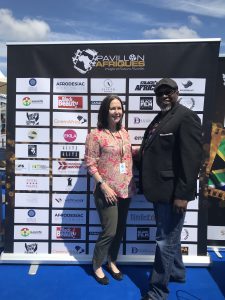
Due to the quirkiness of the ticket system, I never ended up seeing BULL, but I look forward to celebrating it in Austin when the time is right. During one attempt to get in, I found myself in line with Winston Williams of the Capital City Black Film Festival, and when we were turned away due to the high demand, we made the most of it by visiting at the Pavillon Afriques. (Below: Rebecca Campbell and Winston Williams)
Walking the red carpet at the Grand Lumiere theater for the premiere of BACURAU, a powerful film by Kleber Mendonça and Juliano Dornelles. From this perspective, it becomes clear that the ritual is about so much more than generating stock photos of movie stars. The whole presentation—from the atmosphere to the reverence with which the audience greets the filmmakers and surrounds them for their bow—is how the French show the world that cinema is an art form that rivals all others.
Hanging out with AFS board member Riki Rushing and producer Tara Wood…Tara has brought her documentary QT8, about the first eight films of Quentin Tarantino, to the market after many unexpected twists and turns. Given Austin’s particular love for Quentin and his long history with AFS, I certainly look forward to seeing this doc!
Dinner with Alfred Cervantes of the Houston Film Commission, producer Sandhya Shardanand and actor Jonny Mars.
The credits rolled to an end for BACARAU with a statistic about the 800+ jobs it supported and this declaration: “Culture is Identity and Industry.” Like AFS’s tag line, MAKE WATCH LOVE FILM, I thought this captured in the most succinct way what makes film such a vital, humanist art form for our times. It was a great honor to spend five days so close to the heartbeat, and I am reinvigorated for all that AFS is doing and wants to do on behalf of strong film culture.
KABUL, CITY IN THE WIND screens tomorrow, Saturday, June 1 at 1PM, part of the Doc Days festival at the AFS Cinema this weekend. It is the first feature film from Aboozar Amini, a Dutch-Afghan director. He left Afghanistan at the age of 14 at the outset of the U.S. war there and now lives in Amsterdam. KABUL opened the International Documentary Film Festival Amsterdam (IDFA) in November where it won a Special Jury Award. Our Doc Days co-programmer Todd Savage caught up with Amini recently to talk about the making of the film. The following is an edited transcript:
What was the origin of the film, and what was your intention at the outset?
The basic intention was to give a realistic image of life today in Kabul, to tackle all the cliché, stereotyped images we know about Afghanistan and at least for once to let the people tell the story. Let’s focus on the life of the people, not all the big overarching topics in the mass media we know about Afghanistan. Those are quite misguided. Once it comes to the humanity and to the dignity of people it becomes readable for whoever on this planet, so that was the basic idea. There are many people in Kabul, many filmmakers, especially young ones of my generation, who are pretty tired about the films made in Afghanistan in the past 17 years, with prefixed perceptions, prefixed agendas. So, they want to take the microphone themselves for once and tell the story.
Before you came to shoot, you’d been back to Kabul a number of times. How was the experience to return to your home country?
I left right when America attacked Afghanistan. It was in 2009 when I went back for the first time to Kabul. The city was totally unknown for me. I couldn’t connect to any part of the town anymore. My image about Afghanistan, the image which was designed in my mind by the media. I thought that’s Afghanistan, that’s the new Afghanistan I’m going to. When I arrived there, it was pretty much far from reality. Not all men in Afghanistan are misogynists and not all of them are oppressing their family, their women, their wives, their daughters. There are a few of them, of course, those fundamentalists exist, but for me it was hard to find. What I found easily on the street were hard-working people, hard-working men and women who were working 12 or 14 hours per day to feed a family, to pay the school for their daughters—and this is the majority. There are many, many of them, so I thought this is the reality we are missing in the world. The image we get about Afghanistan does not help Afghanistan, it damages Afghanistan even deeper. Perhaps it helps some parties, some stakeholders in Afghanistan, some international stakeholders to legitimize their existence and their presence in Afghanistan, but it doesn’t support Afghan people at all.
I thought okay, where can I see this reality? The bus, the old same bus which I took when I was a kid was existing again, and they were the same broken buses. To refresh my memories, I took those buses every day for a month without any destinations. It was the only place I liked the most because I could hear little stories from the people. I didn’t need to follow all the stories, just the little tiny bits. But all together it gives me a very strong beautiful texture of the city, plus this old melody which comes from the broken radio from the bus, which gives another layer to the to this dusty, misty city.
How did you choose to follow Abas, the bus driver in the film?
After a while everybody knew me, all those drivers knew me. So Aboozar is coming, and he’s going to sit all the way back in the bus. He does nothing, just sitting there. Some days when I was walking on the street, they were beeping at me and [calling] ”don’t need a ride?” I was filming with my iPhone; smartphones are very good tools for documentary. It breaks the ice between you and the protagonist. It’s small, they don’t mind, and they get used to the camera.
Most the drivers were trying to pretend and act like those Bollywood heroes from the ‘70s, because there is a camera and there is a guy who’s filming. Except Abas. He was himself. He was just impulsive and funny and sincere, but also sneaky sometimes, trying to trick you. I thought, this guy is very interesting for me, and I mean he is very interesting to viewers. The Coen Brothers would love to make a movie with him. [laughs]
How did you find the two boys?
I was looking for a tank—there are many tanks still from the Soviet Union time—but this particular one is still pointing at the city. I wanted to go and take a look. It’s in far west Kabul, but it was heavily snowing, and we got lost. Suddenly I came across some 40-50 kids throwing snowballs. We joined them, and at the end I asked them if anybody knows the way to the tank. Afshin was the most popular amongst them and he showed us the way. I was still filming with the phone, and back in Amsterdam, I re-watched the material and I thought okay, this is amazing. The boy, I want to see the city through his eyes. So, I went back and found him again and I followed his life.
Did your characters feel comfortable with you following them so intimately?
It’s difficult to film with kids, but I have some experience and am quite good with kids. At the same time, Afshin was just the same age as I left Afghanistan. I understand them very well. They understand me very well. The trust was between us, and they felt totally free when I was filming. But the driver was a bit difficult because he is from another generation who experienced the civil war and I kind of don’t understand them. They can be difficult and complicated, so it took me some time to establish this trust feeling between us.
While you were there, but was there anything else that you learned about life in Kabul today?
They are hard-working people. They don’t give up. They just want to live, to establish a very simple normal life. That’s what they want. They have no clue what’s going on around them: who is fighting against whom, which part they should take actually. They have lost their trust in the Taliban, in the government, in the foreign troops, in anybody. They don’t trust anyone, because every day the policy about one group or another changes. They thought that America is coming to defeat the Taliban, but now they are starting to negotiate and give the country back to the Taliban. They thought that the government is a democratic one, but the government is tribal and ethnic in a very fanatic way. We have no idea what’s going on around us, and all we know is that there is a huge business going on. There is a huge international business going on.
I know that you made a kind of a deliberate decision to not present any kind of violence. Can you talk about that and why you made that decision?
[sighs] When the name of Afghanistan comes up, it come up with a lot of violence. We don’t need to see that again because we’ve seen enough. We have been numbed about violence in Afghanistan already. It’s not in the nature of human to handle so much violence. When we hear every day this amount of people who got killed, that amount of people got killed, after a very short time we become senseless, indifferent about that. Because it’s gonna be for us never-ending stories and that was one of the main reasons.
I was on 23rd of July 2016 in Kabul filming a demonstration. It was a peaceful demonstration. It’s a civil movement. So I joined them. This is one big step for progress in the society, but then two huge suicide bombs happened, and I lost some friend and 86 people got killed and 400 people got injured. So I shot that, but then I thought if I use this and show it to the world, what is the difference between me and those terrorists representations? I deliberately decided to not show any kind of violence in this movie, but just focus on life and on the life of the people.
What’s your hope say for an American audience to take out of this film?
First of all, I hope that American people watch this film. They have the right to see the life in a country that they invested with their taxes for such a long period of time. We should for once give them another image which is closer to the people of that place, instead of all these frontline stories, all these stereotypes of war stories. Weeks ago, the American who was in charge of the statistics in Afghanistan for the American government said that we invested $1 trillion dollars in the Afghanistan years. I don’t even know how many zeros that has. I cannot even count it, but I asked myself: What did we achieve with that one trillion dollars, except killing many British soldiers many American soldiers, many civilians and, of course, many fundamentalists at the same time? Did we did we make it a safer place? The amount of opium which gets produced in Afghanistan since 2001 is 100 times worse. Today the Taliban is 10 times stronger than 2001. There is not only Taliban but there are 21 different kind of terrorist groups operating in Afghanistan. What did we achieve with one trillion? Where did it go wrong? I think that people of America have the right to ask this question, and to watch another type of film.
Did you have any particular influences guided the look of the film?
Well, my background is Italian Neo-realist cinema. That was also my Masters thesis in London film school. You don’t only tell the story of one particular character, but you capture a part of history of your country or some place. Images are very important to me; in the end cinema is image and sound, so I don’t really like those interview-style documentaries. Film is film, and even if it is documentary it can be very creative. I’ve tried to capture the city as I see it. Kabul is colorful, but after living three years the colorful image of the city became grayer to me as the maker this film.
If you come from out of the country you will be seeing a very colorful sunny, happy people. These people are smiling. Afghan people are very friendly, they smile. But that is only the surface; that is the touristic image. That’s why that was my biggest challenge: to get rid of this touristic image of Afghanistan. I filmed ordinary people on streets, hundreds of them. I asked them: Could you just look into my lens for one and a half minutes without saying anything? At first, they smile. But one and a half minutes is a long time if you don’t say anything. So after 30 seconds the smile disappears. And after 30 seconds, the real face appears. That deep gaze in their eyes tells everything about the recent history of Afghanistan. They are shattered by war and violence. This is what I mean by getting rid of that surface and digging deeper in the society, and you will see another image which is closer to reality.
Is there anything else you would like us to know about the making the film?
Well, I always like to explain that this film has been made with local young filmmakers who are really passionate about cinema and they want to make better films in Afghanistan. I’m really thankful and very hopeful because I’m not alone in that. I didn’t bring anybody from outside Afghanistan except myself. The thing is that even if we had proper financing from Europe and I could bring experts from Europe, it wasn’t a good choice, because every film, every location has its own soul. You need people on your team who know the soul of that place, who know the time, who know the code of that place.
I met young people who just graduated from film school in Iran, Pakistan or Indonesia. Some were from Europe, who then came back to Afghanistan. They all want to tell better stories. They all want to tell different types of stories. We had difficulties with financing so all of them were putting their love and their passion into this film to make it happen and right now they are very happy. I registered a small production company in Kabul called Kino Kabul and the idea is to produce and develop a local project with local experts.
Doc Days, AFS’s second annual mini-festival of outstanding new non-fiction films from around the world with filmmakers in attendance, takes place next week from May 30 through June 2. In addition to our favorite new documentaries from the festival circuit, the weekend will include events, parties, discussions, and Q&As moderated by Austin’s documentary film community.
Doc Days is a highlight of this season after the success of last year’s inaugural festival, which saw three of the seven festival selections (MINDING THE GAP; OF FATHERS AND SONS; HALE COUNTY, THIS MORNING, THIS EVENING) go on to be nominated for Best Documentary Feature at the Academy Awards. The festival is an opportunity for Austin’s vibrant documentary community, filmmakers and audiences, to come together, see new work, and meet with visiting filmmakers.
Come celebrate the series kick off on Thursday, May 30 with a performance by jazz musician Jeff Lofton at 6:30 PM prior to the screening of MILES DAVIS: BIRTH OF THE COOL by Stanley Nelson. Producer Nicole London will introduce the film, which chronicles the unusual life of one of the premiere figures in the history of jazz through rare archival footage and interviews. Following the screening, we invite you to stay for an after party featuring records spun by Violet Sound and cocktail specials.
During the festival, filmmakers will join us for these screenings:
On Friday, May 31, AFS welcomes director Benjamin Berman to present his film THE AMAZING JOHNATHAN DOCUMENTARY—a truly bizarre and often hilarious journey into the making of a documentary about a strange comedian.
Director and AFS Grant recipient Jeffrey Peixoto will present his mesmerizing film OVER THE RAINBOW on Saturday, June 1. It’s an insider’s look at the belief systems of those practicing Scientology and other newer religions.
Roberto Minervini, the director of WHAT YOU GONNA DO WHEN THE WORLD’S ON FIRE?, will attend the festival on June 1 with his meditation on the state of race in America through the eyes of residents in New Orleans. The film won four major awards at last year’s Venice Film Festival.
On Sunday, June 2, AFS welcomes director Jesse Sweet to present his film CITY OF JOEL, the story of a conflict between a Hasidic Jewish community and their secular neighbors in the Hudson Valley.
Director and AFS Grant recipient Juan Pablo González will present his film CABALLERANGO on June 2—an intimate portrait of a local tragedy in a small village in Mexico. Producer Makena Buchanan will also be in attendance.
Additional not-to-be-missed screenings over the weekend include Julia Reichert and Steven Bognar’s AMERICAN FACTORY and COLD CASE HAMMARSKJÖLD by Mads Brügger. Both films were recipients of directing awards at the 2019 Sundance Film Festival. DARK SUNS by Canadian filmmaker Julien Elie, was just awarded a top prize at CPH:DOX in Copenhagen. Another CPH:DOX winner, KABUL, CITY IN THE WIND, also won a major prize at its world premiere at the International Documentary Festival Amsterdam (IDFA) in the fall.
Passes are available to attend the entire program and individual tickets will be sold to each film. Member discounts apply to all screenings and passes. For more information, tickets and passes, visit austinfilm.org/doc-days.