In preparation for our upcoming Essential Cinema series at the AFS Cinema, Half Angel: The Essential Cinema of Jean Arthur, we’ve compiled a list of a few things we love about Jean Arthur so that you can fall in love with her as well. An incredibly charming presence despite her notorious stage fright, Jean Arthur was a complex Hollywood star whose acting still resonates with us today.
FROM GLADYS TO JOAN
Originally named Gladys Greene, Jean Arthur was pressed by Hollywood to choose a stage name. She drew inspiration from two idols: Joan of Arc (Jeanne d’Arc) and King Arthur (The New York Times).
SHE NEVER GAVE UP
Landing fresh on the scene with a one-year contract from Fox Film Studios, Jean Arthur was remodeled and advertised as a flapper to interest the new Jazz Age audiences. However, her early performances in silent films fell flat. She states that she “was acting like a mechanical doll personality” in order to fit a mold. She was left feeling disheartened and wanting to leave the film industry altogether, but stayed due to her contract. She ended up taking roles in comedy shorts for the remaining time, where she developed the comedic timing that would later serve her screwball comedy career.
20 WESTERNS IN 2 YEARS
After her disappointing performances with Fox Film Studios, Arthur ended up impressing the owner of the B-western studio Action Pictures, Lester F. Scott Jr. He decided to take a chance on her, so she was cast in over twenty westerns in a two-year period, only receiving a measly $25 per picture. To top it all off, the westerns were shot on location in the hot California desert.
HALF ANGEL, HALF HORSE
Highly self-conscious, Jean knew exactly which camera angles would flatter her the best, and she worked hard to make sure they were featured. At one point, “director Frank Capra recalled producer Harry Cohn’s description of Jean Arthur’s imbalanced profile: ‘half of it’s angel, and the other half horse.’”
SHE KNEW HER WORTH
Well-known for her anxious yet steadfast personality, Arthur went against the typical Hollywood grain once she began landing lead roles. Due to this, she was often suspended by Columbia Pictures for rejecting roles because, according to her, she “just couldn’t act in a bad picture” (The New York Times). Talk about headstrong.
A NEW TYPE OF LEADING LADY
Arthur’s strong personality brought her more than just studio troubles – it also attracted roles that reflected a new type of character—a more independent, modern woman. In the “man’s world” of the 1930s, she could hold her own and then some. This would prove to be one of her greatest assets.
PAYING IT FORWARD
Once retired from her acting career, she began teaching at a few different universities. While at Vassar, she had a promising young pupil named Meryl Streep, whom she predicted would go far. Many thanks, Jean.
These are just a few of the countless things to love about Jean Arthur. She was a powerful actress, all the more impressive considering she was effortlessly masking her anxiety, stress and self-consciousness. In this sense, she was just downright relatable and in a lot of cases that is what made her acting all the more genuine.
Her distaste for the limelight and commitment to a private life may account for why Jean Arthur lacks the notoriety of some of her contemporaries, but her performances will endure long after her fame has faded. Trust us when we say you don’t want to miss this powerhouse of a woman in some of her most endearing roles at our upcoming series, Half Angel: The Essential Cinema of Jean Arthur.
On August 3-4, AFS will partner with John Doe, of LA band X, to present a special weekend of films at the AFS Cinema including, X: THE UNHEARD MUSIC,ROCKERS, and GEORGIA. Come early and stay late as Doe will be in attendance all weekend. Purchase tickets.
On this episode of the AFS Viewfinders podcast, we visit with John Doe, one of the leaders of the seminal Los Angeles punk band X. Since the band’s beginning in the late 1970s, Doe has carved out a special place for himself in music history. But that’s only half the story. The same love of storytelling and characterization that makes his songwriting come alive has also produced a multi-decade career as an actor, often in small but important character roles. In this conversation, Doe talks with AFS’s Lars Nilsen about growing up in Baltimore and knowing John Waters, how he got into music and film, the LA years, and going to see movies. Bill Morgan, director of X: THE UNHEARD MUSIC, will join Doe in a Q&A following the screening on August 3.
BLUE NOTE RECORDS: BEYOND THE NOTES runs July 19 – 24 at the AFS Cinema. Join us for a Blue Note Records DJ set by Violet Sound following the Friday, July 19, 7 PM screening, and a post-movie discussion with jazz trumpeter Jeff Lofton on Saturday, July 20 after the 4:30 screening. Purchase tickets.
Known under many different aliases—most notably Quasimoto and one half of the duo Madvillian—DJ, producer and MC Madlib is an artist that isn’t afraid to march to his own beat. Working with names as big as Kanye West, J Dilla and Erykah Badu, Madlib’s influence runs deep throughout today’s hip-hop scene.
Wanting to reach a wider audience and reframe its revolutionary music, in 2003 Blue Note Records tasked the unpredictable and eclectic Madlib with creating a “remix” project out of their vast master tapes archive. Home to groundbreaking artists such as Miles Davis, Thelonious Monk and John Coltrane, Madlib had free range to sample some of the most influential music ever produced. Innovative and refreshing, Madlib’s creation is an album that highlights a wide range of the label’s rebellious impulses—an excellent way to “sample” one of the heaviest catalogues of the 20th century. Listen here.
The second annual Contrast Film Festival—a celebration of gender-defying, forward-thinking, and accessible art with an emphasis on female and queer filmmakers—takes place this weekend, July 18 – 21, at the AFS Cinema. The creators of the Festival, Tish Sparks and Jeremy von Stilb, also make up the programming team behind Homo Arigato, AFS’s ongoing film series focused on rare and beautiful queer films. Following the success of last year, the 2019 Contrast Fest will bring more Texas film premieres and unique performances, including an opening night screening of Jack Smith’s 1963 seminal queer art film FLAMING CREATURES on Thursday, July 18, at 8 PM. For this special event, the film will be presented with an original live score by Austin-based musicians Thor Harris, Peggy Ghorbani, and Sarah Gautier who perform together under the moniker THOR & FRIENDS.
AFS sat down with Tish and Jeremy to talk about the Festival and what to expect this year:
HOW WOULD YOU DESCRIBE THE CONTRAST FILM FESTIVAL?
Jeremy: It’s four days of mind-bending, boundary-pushing, outlandish, and exciting cinema, performance, and comedy.
HOW DO YOU SELECT THE FILMS TO SCREEN AT CONTRAST FEST?
Jeremy: We are drawn to things that unusual or adventurous. Sometimes experimental films can mean watching things that test one’s patience though, so I think we still want to showcase films that are filled with joy and are invigorating to the audience. We try to find a balance between challenging and entertaining.
Tish: We are also always kind of looking for films that are a bit under the radar or are not likely to play at other festivals around town. We want to create a unique experience for the audience and give them an opportunity to see films that they maybe wouldn’t be able to see in a theater otherwise. And when we get those audiences to the cinema, we also aim to present work that will spark conversations afterwards. Whether the audience loves or hates something they see at the festival, we at least want them to feel something! There is nothing worse than bland films that elicit tepid responses.
WHAT MAKES CONTRAST DIFFERENT THAN OTHER FILM FESTIVALS?
Jeremy: It’s a film festival programmed by Tish and I who first got our start DJ’ing and doing music events but both went to film school. I think there’s a lot of cross over in our own creative approaches and the festival reflects this. It’s not wall to wall sitting in a theater, there is a lot of live performance and audience engagement.
Tish: I think the thing that is exciting about Contrast is that people could have totally different experiences attending the same festival. Like, if you are more of a music and performance person you could have a pretty full weekend of just taking in those events but if you are more of a cinephile, you can see six or seven films in a weekend too. And if you are someone who likes to take in a little bit of everything – a film here, a show there, a panel discussion in the evening, a wild club experience inside of a school….we’ve got you covered too!
WHAT INSPIRED YOU TO START THE FESTIVAL?
Tish: Contrast grew out of our work over the years curating live music, programming the monthly film series Homo Arigato, and producing parties and other types of events. We wanted a way to combine our varied interests and offer our communities an opportunity to see great work, make friends and connections, feel inspired, and hang out over a weekend.
WHAT CAN YOU SAY ABOUT THE FILMS AND EVENTS FEATURED THIS YEAR?
Tish: We are doing some really special things this year that we are super excited to share with audiences! When we first conceptualized this festival a couple of years ago, one of the ideas we had was to do a live re-score of Jack Smith’s seminal queer art film FLAMING CREATURES, and we are actually getting to do it this year. The film is such a pivotal moment for queer film but it is rarely screened outside of museums. We wanted to make the film more accessible by bringing it back into the cinema and pairing it with contemporary music. There are so many ideas in the film that are still relevant, so we wanted to try to find a way to help modern audiences connect with the work.
We are also presenting Texas premieres of so many great films. The Sundance standout ADAM by director Rhys Ernst, the really wonderful, Teddy Award-nominated film SO PRETTY (that was shot on 16mm film!), Midnight Shorts by Bertrand Mandico (THE WILD BOYS) and Yann Gonzalez (KNIFE+HEART), several films from Brazil focused on queer and trans experience, and more!
There are a few performance-based events on the lineup that are super unique and fun as well. We are doing a ‘late night adult multiplex’ at the Austin School of Film that will feature a performance from avant-hip hop artist Saturn Risin9, drag performers, VJs, and three microcinema spaces that each have their own theme and design. The festival will also feature a web series screening and discussion with filmmakers, and we will close out the festival with a comedy & music event called Yes You Can! That event is kind of a riff on wellness culture (but is also actually meant to inspire and motivate!) featuring a performance from NYC-based, multidisciplinary artist Bunny Michael and lots of locals, so it should send us off until next year with positive vibes.
WHAT DO YOU HOPE VIEWERS TAKE AWAY FROM THE FESTIVAL?
Jeremy: I want the films and events to let people exist in an alternative reality for a few days where they can imagine a world that could be rather than the world as it is. I want to fantasize about a world where women, queer people, and those that are typically marginalized are empowered and free. I think that’s what links all of the work we are showing.
FUNAN opens Friday, June 21 at the AFS Cinema. Purchase tickets.
Cambodia, April 1975. Chou is a young woman whose everyday world is suddenly upended by the arrival of the Khmer Rouge regime. During the chaos of the forced exile from their home, Chou and her husband are separated from their 4-year-old son, who has been sent to an unknown location. As she navigates her new reality, working in the fields day and night under the careful watch of soldiers, and surviving the small indignities and harrowing realities of the increasingly grim work camps, Chou remains steadfast in her determination to reunite her family – even if it means risking everything. A NY Times Critic’s Pick and winner of the top prizes at the Annecy Animation Festival and the Animation is Film Festival, FUNAN is a searing and remarkable debut from filmmaker Denis Do, who uses his own family history as inspiration for a thrilling story of love, loss and enduring hope in the most trying of times. Featuring the voices of Bérénice Bejo (The Artist) and Louis Garrel (The Dreamers).
REVIEWS
“A realistic and moving account of a major 20th century atrocity.” – Jordan Mintzer, Hollywood Reporter
“By embracing hand-drawn animation as a tool for tactful re-creation, “Funan” director Denis Do provides audiences a unique window into this relatively under-represented 20th-century horror, one that serves as an act of witnessing even as it avoids directly showing the violence on-screen.” – Peter Debruge, Variety
“Heart-wrenching yet absolutely beautiful, this anime film movingly illustrates a tumultuous period of Cambodian history that’s relatively unknown to Western viewers.” – Joyce Slayton, Common Sense Media
“Do demonstrates a masterful amount of restraint, and his narrative minimalism maximizes the emotional and intellectual power of the story.” – William Bibbiani, TheWrap
HALSTON opens this Friday, June 14 at the AFS Cinema. Purchase tickets.
Fashion designer Halston combined talent, notoriety, and sheer fabulousness to become a legend. From humble beginnings in Des Moines, Iowa, his first brush with fame came when he designed Jackie Onassis’s famous pink pillbox hat. Whether he was popularizing hot pants, creating elegant but comfortable women’s wear, launching a perfume line, traveling with a gaggle of models to China, or having hedonistic fun with Liza Minnelli at Studio 54, Halston built a reputation and an empire—and was responsible for many iconic moments in American fashion and culture in the ’70s and ’80s.
This new film tells the story of a complicated man—in both his craft and his business decisions—from the mouths of those who knew the man best. Frédéric Tcheng, a great documentarian of fashion luminaries like Valentino, Diana Vreeland, and Raf Simons, takes an unconventional approach to the bio-doc by creating a narrative (starring Tavi Gevinson, a fashion icon of a different generation) through which to frame the story of this enigmatic designer, which allows Tcheng to delve deeper into this comprehensive exploration of the designer’s rise, fall, and enduring influence.
REVIEWS
“When it reverts to conventional documentary storytelling… HALSTON is thrilling stuff for fashion nerds, as well as a poignant character study of a misfit ultimately undone by his excessive hunger to prove himself.” – Guy Lodge, Variety
“A roller coaster of fabulousness and folly.” – David Rooney, Hollywood Reporter
“It’s a quintessential cautionary tale, supported by reams of glamorous archival footage and the recollections of longtime friends” – Leah Greenblatt, Entertainment Weekly
(Above: Annie Silverstein, Johnny McAllister, Monique Walton at the Cannes premiere party for BULL.)
Fresh off of a trip to the 2019 Cannes Film Festival, Austin Film Society CEO Rebecca Campbell shares some of the highlights from one of the biggest annual events in film and reflects on how AFS is a critical part of that dialogue.
Having been at the helm of AFS for 21 years now, I had a thought that I ought to one day make the pilgrimage to Festival de Cannes, the Mecca of film. I’m so grateful to a team who supported me in turning that brief thought into reality this year—the experience profoundly reinforced for me why AFS’s work is so important.
In the baggage claim at Nice, I ran into AFS Advisory Board member Mike Simpson and his lovely wife, Nancy. This got me a free ride to Cannes and great conversation with the nicest guy in Hollywood. You’d never know from his down-to-earth attitude (and love of Texas: he’s a graduate of UT Austin) that he was there to premiere films with two of the greatest directors working today, Quentin Tarantino and Bong Joon-Ho.
Some other highlights:
It was a profound thrill to see Annie Silverstein listed on the schedule of films in competition, alongside Pedro Almodovar, Ken Loach, Jim Jarmusch and the like. AFS has been supporting Annie’s artistic vision for several years through grants and our Artist Intensive, both for her breakout short SKUNK as well as BULL. At their classy premiere party, I grabbed a shot of Annie, writer / producer Johnny McAllister and producer Monique Walton. And speaking of Almodovar, PAIN AND GLORY is a stone-cold masterpiece.
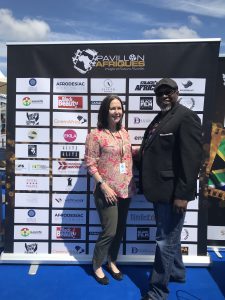
Due to the quirkiness of the ticket system, I never ended up seeing BULL, but I look forward to celebrating it in Austin when the time is right. During one attempt to get in, I found myself in line with Winston Williams of the Capital City Black Film Festival, and when we were turned away due to the high demand, we made the most of it by visiting at the Pavillon Afriques. (Below: Rebecca Campbell and Winston Williams)
Walking the red carpet at the Grand Lumiere theater for the premiere of BACURAU, a powerful film by Kleber Mendonça and Juliano Dornelles. From this perspective, it becomes clear that the ritual is about so much more than generating stock photos of movie stars. The whole presentation—from the atmosphere to the reverence with which the audience greets the filmmakers and surrounds them for their bow—is how the French show the world that cinema is an art form that rivals all others.
Hanging out with AFS board member Riki Rushing and producer Tara Wood…Tara has brought her documentary QT8, about the first eight films of Quentin Tarantino, to the market after many unexpected twists and turns. Given Austin’s particular love for Quentin and his long history with AFS, I certainly look forward to seeing this doc!
Dinner with Alfred Cervantes of the Houston Film Commission, producer Sandhya Shardanand and actor Jonny Mars.
The credits rolled to an end for BACARAU with a statistic about the 800+ jobs it supported and this declaration: “Culture is Identity and Industry.” Like AFS’s tag line, MAKE WATCH LOVE FILM, I thought this captured in the most succinct way what makes film such a vital, humanist art form for our times. It was a great honor to spend five days so close to the heartbeat, and I am reinvigorated for all that AFS is doing and wants to do on behalf of strong film culture.
KABUL, CITY IN THE WIND screens tomorrow, Saturday, June 1 at 1PM, part of the Doc Days festival at the AFS Cinema this weekend. It is the first feature film from Aboozar Amini, a Dutch-Afghan director. He left Afghanistan at the age of 14 at the outset of the U.S. war there and now lives in Amsterdam. KABUL opened the International Documentary Film Festival Amsterdam (IDFA) in November where it won a Special Jury Award. Our Doc Days co-programmer Todd Savage caught up with Amini recently to talk about the making of the film. The following is an edited transcript:
What was the origin of the film, and what was your intention at the outset?
The basic intention was to give a realistic image of life today in Kabul, to tackle all the cliché, stereotyped images we know about Afghanistan and at least for once to let the people tell the story. Let’s focus on the life of the people, not all the big overarching topics in the mass media we know about Afghanistan. Those are quite misguided. Once it comes to the humanity and to the dignity of people it becomes readable for whoever on this planet, so that was the basic idea. There are many people in Kabul, many filmmakers, especially young ones of my generation, who are pretty tired about the films made in Afghanistan in the past 17 years, with prefixed perceptions, prefixed agendas. So, they want to take the microphone themselves for once and tell the story.
Before you came to shoot, you’d been back to Kabul a number of times. How was the experience to return to your home country?
I left right when America attacked Afghanistan. It was in 2009 when I went back for the first time to Kabul. The city was totally unknown for me. I couldn’t connect to any part of the town anymore. My image about Afghanistan, the image which was designed in my mind by the media. I thought that’s Afghanistan, that’s the new Afghanistan I’m going to. When I arrived there, it was pretty much far from reality. Not all men in Afghanistan are misogynists and not all of them are oppressing their family, their women, their wives, their daughters. There are a few of them, of course, those fundamentalists exist, but for me it was hard to find. What I found easily on the street were hard-working people, hard-working men and women who were working 12 or 14 hours per day to feed a family, to pay the school for their daughters—and this is the majority. There are many, many of them, so I thought this is the reality we are missing in the world. The image we get about Afghanistan does not help Afghanistan, it damages Afghanistan even deeper. Perhaps it helps some parties, some stakeholders in Afghanistan, some international stakeholders to legitimize their existence and their presence in Afghanistan, but it doesn’t support Afghan people at all.
I thought okay, where can I see this reality? The bus, the old same bus which I took when I was a kid was existing again, and they were the same broken buses. To refresh my memories, I took those buses every day for a month without any destinations. It was the only place I liked the most because I could hear little stories from the people. I didn’t need to follow all the stories, just the little tiny bits. But all together it gives me a very strong beautiful texture of the city, plus this old melody which comes from the broken radio from the bus, which gives another layer to the to this dusty, misty city.
How did you choose to follow Abas, the bus driver in the film?
After a while everybody knew me, all those drivers knew me. So Aboozar is coming, and he’s going to sit all the way back in the bus. He does nothing, just sitting there. Some days when I was walking on the street, they were beeping at me and [calling] ”don’t need a ride?” I was filming with my iPhone; smartphones are very good tools for documentary. It breaks the ice between you and the protagonist. It’s small, they don’t mind, and they get used to the camera.
Most the drivers were trying to pretend and act like those Bollywood heroes from the ‘70s, because there is a camera and there is a guy who’s filming. Except Abas. He was himself. He was just impulsive and funny and sincere, but also sneaky sometimes, trying to trick you. I thought, this guy is very interesting for me, and I mean he is very interesting to viewers. The Coen Brothers would love to make a movie with him. [laughs]
How did you find the two boys?
I was looking for a tank—there are many tanks still from the Soviet Union time—but this particular one is still pointing at the city. I wanted to go and take a look. It’s in far west Kabul, but it was heavily snowing, and we got lost. Suddenly I came across some 40-50 kids throwing snowballs. We joined them, and at the end I asked them if anybody knows the way to the tank. Afshin was the most popular amongst them and he showed us the way. I was still filming with the phone, and back in Amsterdam, I re-watched the material and I thought okay, this is amazing. The boy, I want to see the city through his eyes. So, I went back and found him again and I followed his life.
Did your characters feel comfortable with you following them so intimately?
It’s difficult to film with kids, but I have some experience and am quite good with kids. At the same time, Afshin was just the same age as I left Afghanistan. I understand them very well. They understand me very well. The trust was between us, and they felt totally free when I was filming. But the driver was a bit difficult because he is from another generation who experienced the civil war and I kind of don’t understand them. They can be difficult and complicated, so it took me some time to establish this trust feeling between us.
While you were there, but was there anything else that you learned about life in Kabul today?
They are hard-working people. They don’t give up. They just want to live, to establish a very simple normal life. That’s what they want. They have no clue what’s going on around them: who is fighting against whom, which part they should take actually. They have lost their trust in the Taliban, in the government, in the foreign troops, in anybody. They don’t trust anyone, because every day the policy about one group or another changes. They thought that America is coming to defeat the Taliban, but now they are starting to negotiate and give the country back to the Taliban. They thought that the government is a democratic one, but the government is tribal and ethnic in a very fanatic way. We have no idea what’s going on around us, and all we know is that there is a huge business going on. There is a huge international business going on.
I know that you made a kind of a deliberate decision to not present any kind of violence. Can you talk about that and why you made that decision?
[sighs] When the name of Afghanistan comes up, it come up with a lot of violence. We don’t need to see that again because we’ve seen enough. We have been numbed about violence in Afghanistan already. It’s not in the nature of human to handle so much violence. When we hear every day this amount of people who got killed, that amount of people got killed, after a very short time we become senseless, indifferent about that. Because it’s gonna be for us never-ending stories and that was one of the main reasons.
I was on 23rd of July 2016 in Kabul filming a demonstration. It was a peaceful demonstration. It’s a civil movement. So I joined them. This is one big step for progress in the society, but then two huge suicide bombs happened, and I lost some friend and 86 people got killed and 400 people got injured. So I shot that, but then I thought if I use this and show it to the world, what is the difference between me and those terrorists representations? I deliberately decided to not show any kind of violence in this movie, but just focus on life and on the life of the people.
What’s your hope say for an American audience to take out of this film?
First of all, I hope that American people watch this film. They have the right to see the life in a country that they invested with their taxes for such a long period of time. We should for once give them another image which is closer to the people of that place, instead of all these frontline stories, all these stereotypes of war stories. Weeks ago, the American who was in charge of the statistics in Afghanistan for the American government said that we invested $1 trillion dollars in the Afghanistan years. I don’t even know how many zeros that has. I cannot even count it, but I asked myself: What did we achieve with that one trillion dollars, except killing many British soldiers many American soldiers, many civilians and, of course, many fundamentalists at the same time? Did we did we make it a safer place? The amount of opium which gets produced in Afghanistan since 2001 is 100 times worse. Today the Taliban is 10 times stronger than 2001. There is not only Taliban but there are 21 different kind of terrorist groups operating in Afghanistan. What did we achieve with one trillion? Where did it go wrong? I think that people of America have the right to ask this question, and to watch another type of film.
Did you have any particular influences guided the look of the film?
Well, my background is Italian Neo-realist cinema. That was also my Masters thesis in London film school. You don’t only tell the story of one particular character, but you capture a part of history of your country or some place. Images are very important to me; in the end cinema is image and sound, so I don’t really like those interview-style documentaries. Film is film, and even if it is documentary it can be very creative. I’ve tried to capture the city as I see it. Kabul is colorful, but after living three years the colorful image of the city became grayer to me as the maker this film.
If you come from out of the country you will be seeing a very colorful sunny, happy people. These people are smiling. Afghan people are very friendly, they smile. But that is only the surface; that is the touristic image. That’s why that was my biggest challenge: to get rid of this touristic image of Afghanistan. I filmed ordinary people on streets, hundreds of them. I asked them: Could you just look into my lens for one and a half minutes without saying anything? At first, they smile. But one and a half minutes is a long time if you don’t say anything. So after 30 seconds the smile disappears. And after 30 seconds, the real face appears. That deep gaze in their eyes tells everything about the recent history of Afghanistan. They are shattered by war and violence. This is what I mean by getting rid of that surface and digging deeper in the society, and you will see another image which is closer to reality.
Is there anything else you would like us to know about the making the film?
Well, I always like to explain that this film has been made with local young filmmakers who are really passionate about cinema and they want to make better films in Afghanistan. I’m really thankful and very hopeful because I’m not alone in that. I didn’t bring anybody from outside Afghanistan except myself. The thing is that even if we had proper financing from Europe and I could bring experts from Europe, it wasn’t a good choice, because every film, every location has its own soul. You need people on your team who know the soul of that place, who know the time, who know the code of that place.
I met young people who just graduated from film school in Iran, Pakistan or Indonesia. Some were from Europe, who then came back to Afghanistan. They all want to tell better stories. They all want to tell different types of stories. We had difficulties with financing so all of them were putting their love and their passion into this film to make it happen and right now they are very happy. I registered a small production company in Kabul called Kino Kabul and the idea is to produce and develop a local project with local experts.
Doc Days, AFS’s second annual mini-festival of outstanding new non-fiction films from around the world with filmmakers in attendance, takes place next week from May 30 through June 2. In addition to our favorite new documentaries from the festival circuit, the weekend will include events, parties, discussions, and Q&As moderated by Austin’s documentary film community.
Doc Days is a highlight of this season after the success of last year’s inaugural festival, which saw three of the seven festival selections (MINDING THE GAP; OF FATHERS AND SONS; HALE COUNTY, THIS MORNING, THIS EVENING) go on to be nominated for Best Documentary Feature at the Academy Awards. The festival is an opportunity for Austin’s vibrant documentary community, filmmakers and audiences, to come together, see new work, and meet with visiting filmmakers.
Come celebrate the series kick off on Thursday, May 30 with a performance by jazz musician Jeff Lofton at 6:30 PM prior to the screening of MILES DAVIS: BIRTH OF THE COOL by Stanley Nelson. Producer Nicole London will introduce the film, which chronicles the unusual life of one of the premiere figures in the history of jazz through rare archival footage and interviews. Following the screening, we invite you to stay for an after party featuring records spun by Violet Sound and cocktail specials.
During the festival, filmmakers will join us for these screenings:
On Friday, May 31, AFS welcomes director Benjamin Berman to present his film THE AMAZING JOHNATHAN DOCUMENTARY—a truly bizarre and often hilarious journey into the making of a documentary about a strange comedian.
Director and AFS Grant recipient Jeffrey Peixoto will present his mesmerizing film OVER THE RAINBOW on Saturday, June 1. It’s an insider’s look at the belief systems of those practicing Scientology and other newer religions.
Roberto Minervini, the director of WHAT YOU GONNA DO WHEN THE WORLD’S ON FIRE?, will attend the festival on June 1 with his meditation on the state of race in America through the eyes of residents in New Orleans. The film won four major awards at last year’s Venice Film Festival.
On Sunday, June 2, AFS welcomes director Jesse Sweet to present his film CITY OF JOEL, the story of a conflict between a Hasidic Jewish community and their secular neighbors in the Hudson Valley.
Director and AFS Grant recipient Juan Pablo González will present his film CABALLERANGO on June 2—an intimate portrait of a local tragedy in a small village in Mexico. Producer Makena Buchanan will also be in attendance.
Additional not-to-be-missed screenings over the weekend include Julia Reichert and Steven Bognar’s AMERICAN FACTORY and COLD CASE HAMMARSKJÖLD by Mads Brügger. Both films were recipients of directing awards at the 2019 Sundance Film Festival. DARK SUNS by Canadian filmmaker Julien Elie, was just awarded a top prize at CPH:DOX in Copenhagen. Another CPH:DOX winner, KABUL, CITY IN THE WIND, also won a major prize at its world premiere at the International Documentary Festival Amsterdam (IDFA) in the fall.
Passes are available to attend the entire program and individual tickets will be sold to each film. Member discounts apply to all screenings and passes. For more information, tickets and passes, visit austinfilm.org/doc-days.
AFS is proud of our internship program, which recruits only the best and the brightest, eager to learn about the behind-the-scenes of Austin Film Society. Our interns work hard each week to help fuel the machine that is AFS. Each intern brings a new perspective and we enjoy learning from them as much as they learn from us.
In the spirit of Richard Linklater’s Jewels in the Wasteland, a series that spotlights some of the best films made during the 1980s, we thought it was a great opportunity to ask some of the AFS interns their favorite films from the ’80s.
Be sure to join us for Jewels in the Wasteland at AFS Cinema, and you might bump into an intern hard at work and/or enjoying a new found favorite film from the 1980s.
Here are some of their favorites from the ’80s:
Zephyr Gunter, Office Intern
POSSESSION (1981) dir. Andrzej Zulawski
“This film is really bonkers. What is it about, really? I don’t know! But I love it and respect it and worship it. Pure insanity, that’s all I can say.”
KOYAANISQATSI (1982) dir. Godfrey Reggio
“Ethereal, out of body, psychedelic, meditative, contemplative. Scored by Philip Glass. Zero dialogue. A moving masterpiece.”
POLYESTER (1981) dir. John Waters
“A mockery of the domestic, American lifestyle. Hilarious, genius, and ridiculous. It’s John Waters, what else could you want?”
Annissa Calvillo, Office Intern
SIXTEEN CANDLES (1984) dir. John Hughes
“It’s a timeless comedy with the always moody, yet stylish Molly Ringwald. Even watching it now, it’s like a breath of fresh air. Every person can relate to the key characters in some way. For me, it was Molly Ringwald’s best friend telling her to “stop feeling sorry for [herself].” I mean let’s be honest, Samantha was kinda melodramatic about the whole, “my family forgot my birthday” thing. I could go on, but it will always be my favorite 80s film!”
Jack McLain, Senior Intern for the Video & Special Media Department
HOME OF THE BRAVE: A FILM BY LAURIE ANDERSON (1986) dir. Laurie Anderson
“This is Laurie Anderson’s world and we’re all just living in it.”
Seve Canales, Senior Intern for the Video & Special Media Department
NATIONAL LAMPOON’S VACATION (1983) dir. Harold Ramis
“A classic.”
DAS BOOT (1981) dir. Wolfgang Peterson
“Das good.”
Glenn Fraser, Senior Intern for the Marketing Department
PROJECT A-KO(1986) dir. Katsuhiko Nishijima
“The end result of a series of enthusiastic ‘sure, why not?’ decisions, PROJECT A-KO goes beyond being a zany, over-the-top parody of 80’s anime and becomes something wholly enjoyable on its own.”
ROBOCOP(1987) dir. Paul Verhoeven
“In the whole collective of 80’s films it’s hard not to bring up something like ROBOCOP. It’s the kind of movie that has all the trappings one would expect: The memorable one-liners, the over-the-top violence, copious amounts of cocaine, etc. What sets this film apart is a soulful performance by Peter Weller, who puts his all into what is a very physically demanding performance, and an undercurrent of wit and intelligence supplied by Paul Verhoeven. Thank goodness Martine Tours retrieved the script from the trashcan that fateful day.”
Sara Tynan, Senior Intern for the Marketing Department
AN AMERICAN WEREWOLF IN LONDON (1981) dir. John Landis
“What can I say that hasn’t already been said about this film? Nothing. It’s perfect.”
Bonus favorite film from our wonderful Office Coordinator, Lily Angelle
THE FLY (1986) dir. David Cronenberg
“Jeff Goldblum embraces a monkey and turns into a fly… need I say more? It has a scene involving acid vomit that you just cannot unsee, in the best way possible. It might just be the greatest/saddest love story of all time.”
DEAD SOULS screens this month at AFS Cinema. Buy Tickets.
Wang Bing discusses his masterwork DEAD SOULS, the definitive documentary about Maoist purges in mid-century China
Among the biggest highlights at AFS this month are several films by Wang Bing, a global visionary whose timely work carries deep insights into the politics and social realities of China. DEAD SOULS, which begins showing at AFS this Thursday, recalls the scale, artistry and historic scope of the Claude Lanzmann Holocaust masterpiece, SHOAH. Read on for more about Wang Bing’s approach to this incredible work, and see it at AFS this Thursday (with part 2 showing next Thursday).
WOMAN AT WAR is both a surreal dark comedy and an uplifting film about urgent environmental activism bound to appeal to fans of Aki Kaurismäki and Ruben Östlund (FORCE MAJEURE). The fact that the tuba-heavy score to the film is provided entirely by onscreen musicians – who are invisible and inaudible to the film’s characters – should give you a hint that this is not your typical Icelandic eco-terrorism saga. – AFS Lead Programmer Lars Nilsen
Watch this interview with director Benedikt Erlingsson at Cannes Critics’ Week in which he discusses why he made a comedy, the role of the on-screen soundtrack, surveillance societies, and more.
WOMAN AT WAR opens April 5th at the AFS Cinema. Purchase tickets.