We’ve been very fortunate here at AFS to have some remarkable guests join us at the Cinema. In 2018, we were joined by one of our favorite filmmakers Olivier Assayas. The occasion was the restoration and rerelease of Assayas’ 1994 film COLD WATER. AFS Artistic Director Richard Linklater did the honors of hosting the event – a double screening of COLD WATER and SOMETHING IN THE AIR – and the audience was treated to a very special meeting of the minds. Here, for those of you who were not able to make it then, is a video of their discussion and Q&A session.
If you haven’t seen COLD WATER yet, don’t worry — the restored version COLD WATER is available right now on the Criterion Channel. Plus, if you’re an AFS member who hasn’t tried the streaming service yet, we have a limited time offer where you can receive 50% off your first three months. If you missed the code, reach out to our membership team here to get it — the offer expires August 31.
As we’ve mentioned before, the Texas Archive Of The Moving Image site is one of the best portals on the whole internet to disappear into for an hour or two of fascinating video. One of the best corners of the archive, for us, is the Carolyn Jackson collection. As the host of a talk show on KTBC (now Fox 7) and, later, at the station that is now KXAN 36, Jackson frequently attended press calls on the coasts or in Dallas that were set up by the film studios for publicity purposes. These junkets have produced some notoriously terrible interviews, particularly as the talent becomes more and more bored, but Jackson’s work is a cut above the usual standard. She is clearly prepared, asks smart questions at the right time, and makes a personal connection with each guest. It’s a pleasure to watch these interviews.
Here are a pair of interviews with SILVER STREAK (1976) stars Richard Pryor and Gene Wilder for a start.
First is Pryor, always candid, debunking some of the lies that appear in his official bio, and talking about his creative method as writer and performer. (WATCH >>)
Then it’s Gene Wilder’s turn. Jackson finds a great rapport with him here as they talk about the impulse to entertain. (WATCH >>)
And, if you’re wondering what has become of Jackson, here’s a piece from earlier in the year where she reminisces about some of the old days in Austin broadcasting.
Today, Don Hertzfeldt is one of the best-known and most highly acclaimed makers of animated films in the world. He has won hundreds of international prizes and been nominated for multiple Academy Awards. Back in the year 2000 however, he was a relatively unknown commodity, toiling away at an old-school 35mm animation rig in his home workshop. That was the year of his big breakthrough, a short film called REJECTED that was an immediate hit with festival audiences and became one of the first pre-YouTube viral videos – shared via email and on message boards over slow dial-up connections – it was certainly worth the 10-minute download.
Back in February, Don Hertzfeldt joined us at the AFS Cinema to reflect on those early years, how his creative method has evolved, and, as is generally the case with Hertzfeldt, his memories and anecdotes are simultaneously as humorous and as philosophical as is his film work. We are eager to welcome Don back to the Cinema after the pandemic has passed, but in the meantime we are proud to present this discussion with him for your entertainment and edification.
See more of Hertzfeldt’s films and find out more about his work here.
On stage or on screen, Eartha Kitt was a mesmerizing talent. And, as we can see in this 2001 interview, she was also a conversationalist with few peers. The performance aspects of great conversation come to the fore here, as she tells her best stories and, along the way, provides a master-class in stage presence.
Don’t start watching this if you don’t have 27 minutes to sit riveted in front of the screen, because she is truly a magnetic force of personality, using her speaking – and purring – voice, her limbs and her eyes with the flair of a great artist.
Topics covered: Orson Welles, Katherine Dunham’s dance company (watch the impromptu moves she uses to illustrate Dunham’s style), her tough upbringing, the resonance of the Catwoman character, her experiences with Black activism, Lady Bird Johnson, the CIA file that called her a “sadistic nymphomaniac,” and more.
This week we announced a special member discount on the Criterion Channel, the streaming service to which we are 100% addicted (you can learn more about the partnership and our member discussion series here). For those just starting out on the channel, AFS Head of Film & Creative Media Holly Herrick has some suggestions, including some rare gems, for the months of July and August.
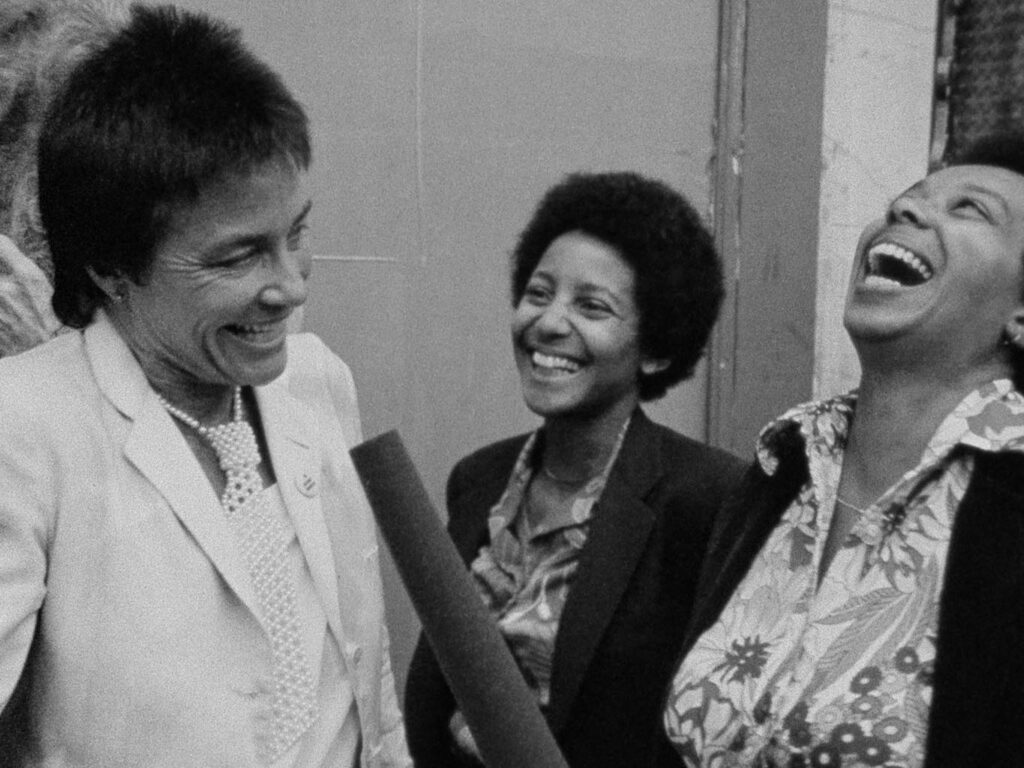
AUDIENCE (1982) by Barbara Hammer
Part of programmer Nellie Killian’s brilliantly curated feminist “Tell Me” series on Criterion Channel, avant garde icon Barbara Hammer investigates the relationship between art and viewer by destabilizing the artist’s perspective, filming her mostly female, mostly queer audience as they engage with Hammer directly about her work. I loved this film not only because it captured a female subculture that is usually absent in films of the era, but because of pandemic-related theater closures, it reminded me what it’s like to present films to a live audience, and to be a member of one.
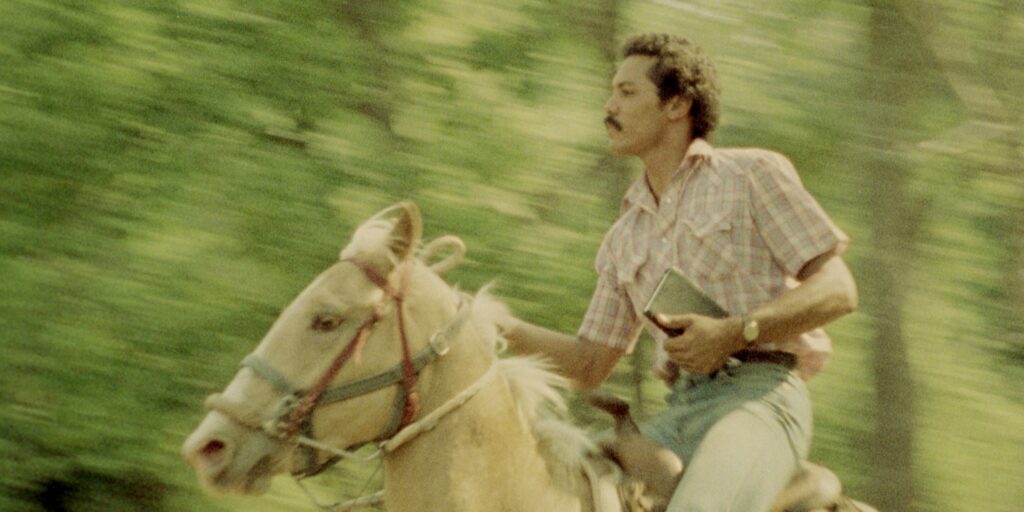
CANE RIVER (1982) by Horace Jenkins
Part of our line-up for our first member Criterion Channel discussion (more on that here), CANE RIVER was nearly a ‘lost’ film until the negatives were discovered in the archives of DuArt, and the film was released in theaters just before the pandemic. A sun-drenched chronicle of a romance between a young man from a well-to-do Creole community in rural Louisiana, and a striving student from a nearby working-class town, CANE RIVER’s close-up portrait of a rural pocket of Louisiana is spellbinding. Intrepidly weaving together local history and cultural traditions that influence the lives and choices of the characters, the film also insightfully addresses class and colorism through dynamic performances from the two stunning leads (Richard Romain and Tommye Myrick). After you watch it, sign up for our member discussion about the movie.
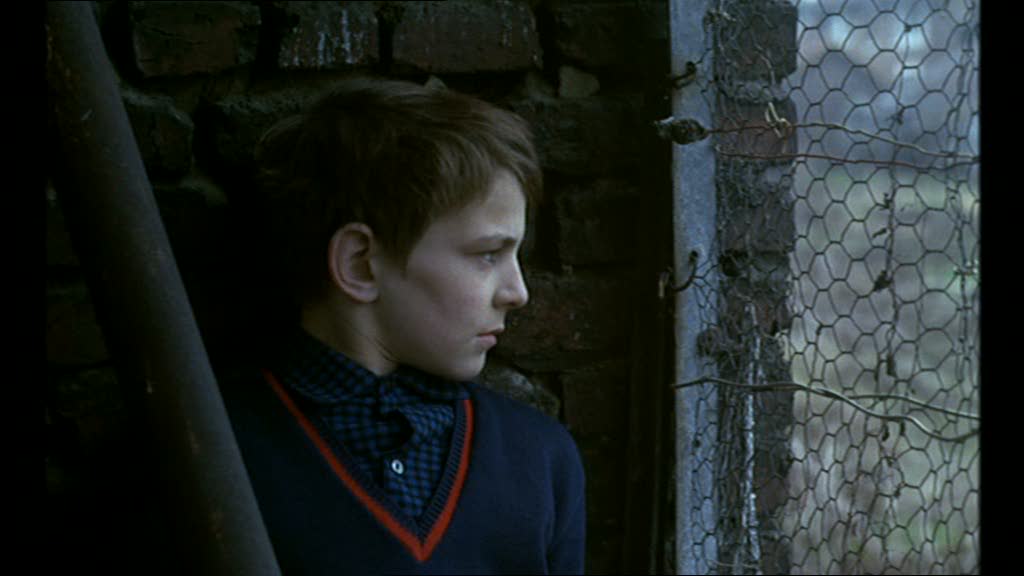
L’ENFANCE NUE (1968) by Maurice Pialat
While he was a Palme D’or winner, French iconoclast Maurice Pialat was always somewhat of an industry outsider, which may account for the relative obscurity of some of his meticulously crafted films. In this, his film about a troubled foster child, setting, framing and performance convey a hopeless misalignment of behavior and desire. Pialat’s images are vivid, lush and bitter, and the spiritual connection to the films of John Cassavettes and Pier Paolo Pasolini should be noted, as if you like those films, you’ll like his, too. For the moment, nearly all of his work is streaming on Criterion, and L’ENFANCE NUE is a great place to start.
Five Films by Mati Diop
As the niece of Senegalese master filmmaker Djbril Diop Mambéty, French-Senegalese filmmaker Mati Diop was born into “cinema royalty”. She began her own career as an actor and starred in a string of critically-lauded films, such as Claire Denis’ 35 SHOTS OF RUM, while becoming a director in her own right. She debuted her stunning feature film, ATLANTICS (Netflix), at Cannes last year; but prior to this had a body of remarkable short films that express her interest in desire and self-actualization within globalized contexts. Her short film A THOUSAND SUNS is a particularly fascinating cine-experiment —a docu-fiction following the star of TOUKI BOUKI, Magaye Niang, as he revisits his only major role and the alternate narratives he imagines.
I SHOT JESSE JAMES (1949) by Samuel Fuller
The greatest and noblest battle, for Samuel Fuller’s masculine heroes, is a moral reckoning. Fuller examines Robert Ford’s conscience in this beautifully performed anti-western, mining the modern dilemmas imbedded in the historic narrative. Fuller also opens up the stories of the women too often at the fringes of this tale, and finds these female heroes making weighty existential decisions equal to their male counterparts. This is in the Criterion Channel’s Western Noir collection, which includes some other wonderful titles like Fritz Lang’s RANCHO NOTORIOUS and Robert Wise’s BLOOD ON THE MOON.
MY BROTHERS WEDDING (1983) by Charles Burnett
Part of our line up for our first member Criterion Channel discussion (more on that here), MY BROTHER’S WEDDING is the second feature film by legendary ‘LA Rebellion’ independent filmmaker (and AFS Advisory Board member) Charles Burnett. It’s the story of Pierce, who is stuck working for his family’s dry cleaning business in South Central LA, while his successful brother prepares for marriage into an upper middle-class family. Capturing the community and neighborhood in specific detail, the film is a defining portrait of 80s Los Angeles and yet refreshingly contemporary in its comedic and political notes. MY BROTHER’S WEDDING was a major influence on AFS-supported film MISS JUNETEENTH, and that film’s director, Channing Godfrey Peoples, will join the AFS Discussion Club event as a featured speaker.
THE WATERMELON WOMAN (1996) by Cheryl Dunye
Cheryl Dunye’s debut feature is a genuinely hilarious, viciously sharp, insightful and essential comedy of the 90s. Cheryl (played by Dunye herself to low-key comedy perfection), is a very awkward lesbian video store employee and aspiring filmmaker attempting to get her first film off the ground, about a mysterious, uncredited Black actress in early Hollywood. Along the way, she’s stymied by her nagging sidekick, a worsening crush on a white girl, and of course the trials and tribulations of no-budget filmmaking. If your quarantine taste buds are craving brilliant and substantive comedy, put this one on your list. Added bonus—a selection of wonderful short films by Dunye are also currently streaming.
THE WHITE BALLOON (1995) by Jafar Panahi
A great feature of Criterion Channel is the Saturday Matinée series, which are films you can watch with the whole family. Not only are these good choices for young viewers, but they are perfect for multi-generational gatherings and general audiences. A gem of this section is Jafar Panahi’s THE WHITE BALLOON, which claims it’s place in the canon of great movies about children’s inner lives, alongside Satyajit Ray’s PATHER PANCHALI, Ingmar Bergman’s FANNY AND ALEXANDER and Victor Erice’s THE SPIRIT OF THE BEEHIVE. Following a little girl on a quest to buy a goldfish in Tehran, the film exalts childhood innocence and human connection.
Today we raise a glass to one of classic Hollywood’s great leading men, William Powell, who was born on July 29th, 1892. Powell rose to fame during the silent era, sharing the screen with superstars like Bebe Daniels, Evelyn Brent, Kay Francis, and “It Girl” Clara Bow (who also deserves a birthday shout-out today). Early in his career he was often typecast as a villain, but off-screen, Powell was known to be exceedingly gentle, kind, and self-effacing. When the transition to talkies came, unlike so many of his contemporaries, Powell’s career further blossomed, owing to his richly resonant voice. His roles quickly shifted, and he was frequently cast as a suave, intelligent leading man.
Eventually Powell would star opposite Myrna Loy in the career-defining Thin Man franchise as the lovable lush Nick Charles. Given that Nick and Nora’s liquor of choice was gin, we felt it would be a fitting tribute to share the AFS Cinema’s delicious twist on the G&T for you to enjoy (responsibly) at home.
The AFS Cinema G&T
2 oz Highborn Gin
0.5 oz Lillet Rose
0.25 oz Lime Juice
2 oz Elderflower Tonic
Add the lime, Lillet, gin and ice to a double rocks glass. Stir until chilled (15 seconds). Top with elderflower tonic (AFS Cinema uses Fever Tree). Gently swizzle. Garnish with a lime wheel, juniper berries, and a sprig of mint.
At the dawn of the 2000s, documentary maverick Errol Morris set his sights on the small screen, granted free-reign by the Bravo Network (and later IFC) to direct a series exploring Morris’ many eclectic interests. First Person seats a wide cross-section of guests in the crosshairs of Morris’ “Interrotron,” his patent filming device that uses a teleprompter-like setup to project the interviewer’s face right over the camera’s lens, giving the audience a first-person perspective as Morris conducts his interviews.
The series is an entertaining foray into Morris’ characteristically unusual, frequently morbid fascinations (Morris’ first film project, after all, was an unfinished study of the PSYCHO inspiration, serial killer Ed Gein). In First Person, interview subjects include a crime scene janitor, a cryogenic immortality advocate, a person who was pen-pals with the Unabomber, and an authority on giant squid. In its nonfiction focus on the sensational and culturally taboo, the series could certainly be seen as an influential precursor to today’s proliferation of true crime podcasts and tv series, but as usual, Morris elevates his interviews beyond the blood and guts to grapple with some overarching societal questions.
Sibling filmmakers Bill and Turner Ross have built a reputation in the nonfiction genre with their keen eye for rich, humanistic details and an exhilarating storytelling flow. Beginning with their auspicious 2009 SXSW hit 45365, which New York Times critic Jeannette Catsoulis called “a beguiling slice of Midwestern impressionism,” the Ross brothers have found universal emotions in unassuming locations. Their latest film, BLOODY NOSE, EMPTY POCKETS (opening this Friday), is both a distillation of their past and a leap into new territory, as they blend narrative and nonfiction techniques to stage, then document, the closing night of a beloved neighborhood bar.
We spoke to them about their unconventional approach, and they shared a fascinating clip reel of classic dive bar cinema that served as a guide during their elaborate pre-production process.
VF: You were in pre-production on this movie for quite awhile, and then shot the entire thing in real time, the 18 hours in which the story itself unfolds. Can you describe what the inside of those 18 hours looked like? felt like?
We prepared copiously for the shoot, pre-producing it much like a fiction film (casting, locations, set dec, shot list, lighting, sound…), with production itself more like a sporting event. Once the thing started we were determined not to break the spell. We wanted the cast of characters to claim ownership of their space and the narrative, responding only to the provided stimuli and each other. That meant Bill and I had to be prepared to capture everything as it happened while also keeping in mind what we needed to capture in order to illustrate the underlying themes, the time of day, the evolution of the space… We had to be incredibly tuned in, and we were. It was winning time.
VF: We love the inspiration reel you made– including scenes from films like BARFLY and THE DEER HUNTER. What were the bars, or bar moments from your own lives that you brought up to each other when creating this?
So much of the film’s inspiration comes from lived experiences and notes written on bar napkins (it’s a theme we referenced in the interstitials throughout). But it’s also an homage to the cinema and art and literature and theater – a whole historical canon of works – that take place in establishments of commiseration. We reference some of these within the film directly through the televisions and set pieces, but also in our colors and textures and title sequences. We’re not the first in this, neither in form nor content, and the whole film is imbued with that sentiment. Underneath that, though, this film is deeply personal.
VF: We have to ask the Texas question– tell us more about what, if anything, you took from Texas filmmaker Eagle Pennell’s iconic and similarly low-budget Texas film about a last night at a beloved bar, LAST NIGHT AT THE ALAMO?
Embarrassingly, we didn’t see Last Night at the Alamo until after we had shot the film. Louis Black sagely sent us a copy after we’d told him what we were up to. It’s an incredible film, a masterful predecessor of mayhem outsider art. What an inspiration.
VF: The movie has many poetic inquiries and avenues to explore, one that seems to come up a lot is whether bars are a cure for loneliness. How would you answer that?
A bar is a certain kind of antidote. So are religion, sports. But the social lubricant in a bar can also lead to loneliness and despair. It’s a quandary. As Bruce said most eloquently, “It’s a place where you can go to when nobody else don’t want your ass.”
Austin-based film/TV composer Kyle Dixon (a member of the expansive synth outfit S U R V I V E and 1/2 of the duo behind the culture-shifting Stranger Things score) has graciously assembled a grounding collection of minimalist compositions for our Viewfinders blog. Dixon leans into his ambient influences, sourcing sounds that span decades and continents for this mix of “minimal or calm music for staying home, mostly but not exclusively centered around one instrument.” Give it a deep listen and let your mind roam far from the boundaries of your quarantine zone.
Track list:
Maria Teresa Luciani, “Poor Neighborhoods”
Boli Group, “How To Play”
David Chesworth, “The Unattended Serge 1978 Pt 4”
Kimpu-Ryu, Tozan-Ryu, Kikusui-Ryu, “Koku”
Gurdjeiff & de Hartmann, “The Struggle of the Magicians Fragment No 3”
Shiho, “Ki No Nagare”
Tangerine Dream, “Bus Station / Mae’s Theme (Excerpt)”
It’s a little hard to believe, but Bette Davis, whose acting career spanned nearly 60 years and whose talents produced so many sublime performances, was not an instant hit. As she explains to Joan Bakewell in the following 1972 interview, it took some time for Hollywood to adapt to her look and her peculiar skill set.
She describes the first few years as “heartbreaking” and recounts something her mother told her: “it’s the best fruit that the birds pick at.”
This video is fairly short but it is a catalogue of small joys – Davis’ understated way of registering disapproval, her explosive laugh, the way she talks about Steve McQueen. Her personality is enormous, and she plays the part of a movie star very well. Enjoy these few minutes with a legend.
It’s no secret that we at AFS love, love, love the great screen star Barbara Stanwyck. She is not only one of the best technicians of the actor’s art in all of classic Hollywood, she exemplifies a sort of independence and self-reliance that we think are always worth admiring and emulating.
A few years back we dedicated three successive Augusts to seasons of Stanwyck’s films:
Precode Stanwyck:
Stanwyck In Her Prime:
And Stanwyck Noir:
And don’t worry. We’ll show much, much much more.
Recently we stumbled across this interview with Miss Barbara Stanwyck (as she was invariably billed in her later years). It appeared in the New York Times at the time that the Film Society at Lincoln Center was welcoming the Brooklyn-born Stanwyck back to the five boroughs for a retrospective of her work. She doesn’t disappoint. Tough, unsentimental, quintessentially Stanwyck. We only wish it were longer:
Some samples:
“Barbara Stanwyck withdrew into Hollywood shadow a decade ago, after her Western television series, ”The Big Valley,” ended. Recluse? She shakes her head determinedly. ”I’m not a yesterday’s woman. I’m a tomorrow’s woman. If I don’t have a job, what am I going to give interviews about? ‘And then I did… And then I did…’ Who the hell cares?”
“Sitting straight as a ramrod, she takes a cigarette from a gold Art Deco case decorated with the sunburst of her face and a ruby, her birthstone. It was a present from Robert Taylor, early in their marriage. That marriage ended in divorce as did her first marriage to Frank Fay, the comedian who starred at the Palace Theater in New York but shriveled in the shadow of his wife in Hollywood. She caresses the cigarette case. ”Losing somebody you love by death or divorce is hard. But if they decide they want to be free, there’s nothing to battle for. You have to let go. Bob and I didn’t stay friends. We became friends again.” She lifts her chin in a jaunty gesture, and the husky voice is a remembrance of dozens of films. ”Time does take care of things.”
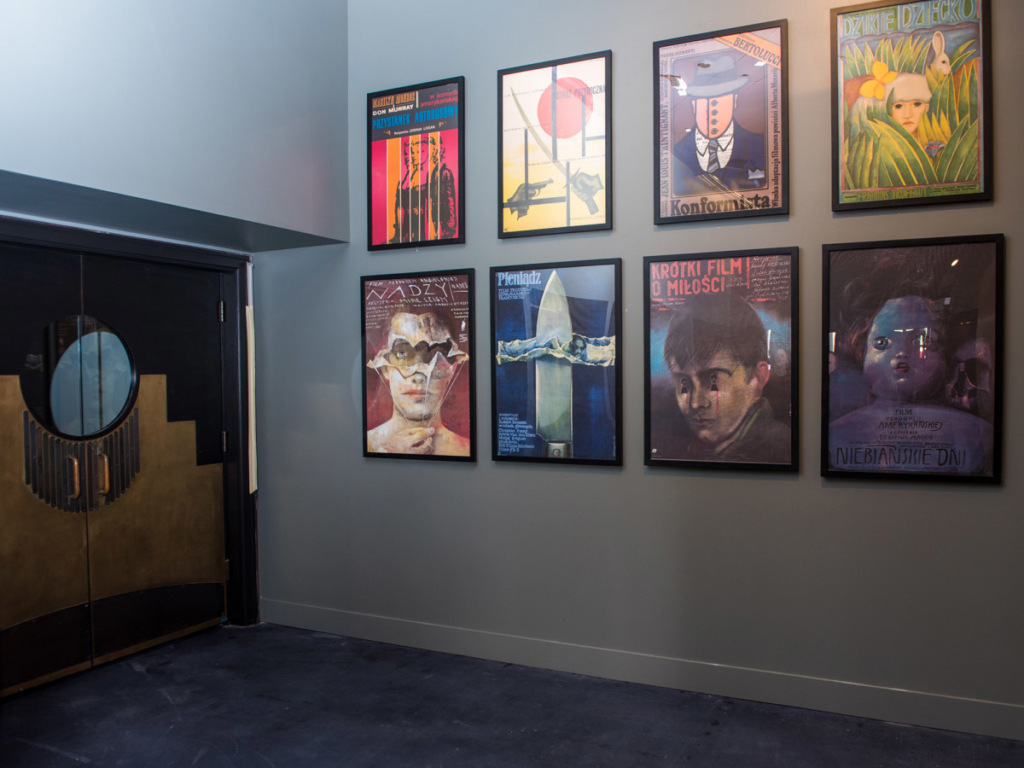
To the patrons of AFS Cinema, it’s no secret that we love a good movie poster. Richard Linklater’s collection of golden-age film ephemera adorns our walls with bold, creative design and illustration from heavyweights like Saul Bass, Bill Gold, and a host of others. But sometime around the advent of Photoshop things took an aesthetic nosedive, and for the last few decades, creativity has become an outlier in the design-by-marketing-department era of celebrity headshot collages. Thankfully, artists like Akiko Stehrenberger are reversing the course and ushering in a new epoch of imaginative illustration.
If you’ve ever passed one of our light boxes and been taken in by a gorgeous, hand-illustrated poster with a clever visual concept, chances are you’ve seen Akiko’s work. Over the last decade or so, she has been on the vanguard of some of the best arthouse and independent films’ marketing campaigns, making sure they grab the attention they deserve with her eye-catching, evocative art. You could fill a hefty book with her prolific output, which in fact she did this spring.
We were thrilled to have the chance to interview Akiko Stehrenberger about what it’s like working in the fast-paced, niche industry of movie poster design….
VF: Take us back to the beginning of your career. Did you set out to be a film poster designer, or did the career choose you?
It was accidental. I had been working in NY doing spot illustrations for music and entertainment magazines. When I moved back to LA, I needed any job because my student loans were knocking on my door. A good friend of mine was working at a movie poster advertising agency and told me they were in need of a receptionist. I interviewed for the job but at the last minute, decided to bring along that month’s SPIN magazine which had my illustration in it. When I showed one of the owners of the company my piece (he was a painter himself), he asked if I’d ever be interested in being a junior designer of movie posters instead. I’d never really used a computer and knew very little about graphic design, but somehow we both agreed to give it a shot. The rest is history.
VF: Describe your typical process, starting from when a studio or shop first contacts you. How do you go about the task of narrowing down a 2 hour story into one single compelling image?
I’m brought on at so many different stages of a film’s production. If I’m lucky, I’ll get a screener, but I’d say that only happens 1/3 of the time. I’m usually only given a script, a short synopsis, or a trailer, and it’s usually up to me to fill in the gaps. Sometimes I’m given a loose direction in mind, other times it is wide open creatively. The first day on any project, I spend thinking. I write down ideas, sketch, and look at inspiration online, which could come from all types of places: photography, fine art, music. Sometimes, I’ll even just google key words that come to my head when I think of the film’s theme. If there are any assets, like unit photography of the film, they can also help spark ideas.
It’s more on the rare side that I work directly with the director unless it’s a smaller budget film. It’s usually the movie studios marketing team I work with, or if I’m hired by a movie poster advertising agency, I’m working with its creative director. From the ideation stage, I then go to a thumbnail sketch presentation that I provide to see which ideas resonate with my client.
Distilling a 2 hour movie into one single image is no easy feat. Alternative posters you may see on the internet have an easier time because they are dealing with properties that the audience is familiar with. My job is to intrigue someone and introduce them to something new. I do think my background as an editorial illustrator definitely was an asset for this line of work, since I basically would have to summarize a whole article in one image too.
VF: You’re incredibly prolific, having worked on at least a dozen major film and TV projects within the last year, by my count. And almost all of your work involves detailed, hand-drawn illustration – not exactly something you can rush. How do you balance quantity and quality and keep your ideas fresh? Any tips for dealing with creative blocks?
Oh, thank you so much!
I try my very best to manage my clients’ expectations from the very start. Since I am doing everything by myself, I let them know that with me, they are getting a very focused and limited presentation. I don’t present multiple painted options. What I do present is multiple ideas in a rough sketch form and really try to get them to narrow things down before I even start to paint.
My illustrations do take quite a bit of time, although I do consider myself fast compared to illustrators not in this field. I’m constantly teaching myself new tricks to work more efficiently, without cutting any corners.
I have creative blocks all the time and it is next to impossible to keep my ideas fresh all the time. I’ve been doing this for 16 years now and have estimated creating over 9,000 pieces during this time. Very few make it to the end. I am used to my work being thrown in the trash (although luckily I’m always compensated for my time). However, the ideas are never completely thrown away. I keep them archived in my brain for an opportunity to blow the dust off and remix them for another project. I can’t tell you how many times I presented the rainy window idea before the film “After the Storm” finally allowed me to do it. And the fist head for “Da 5 Bloods”, I’ve had a version of that idea for a while but this film finally presented me with the perfect opportunity.
For “Portrait of A Lady on Fire”, I always present optical illusions for a project whenever I can. Anyone that claims their ideas are always completely original and fresh is lying to themselves. Yes, there may be a handful of truly out there concepts you can come up with, but to put that kind of pressure on yourself to sustain that, is unrealistic and I think, impossible. Everything has been done before. It’s just how you do it that makes a difference.
VF: There are lots of nods to the golden age of poster design in your work. Who are some artists and designers that have inspired you, and what is it about their work that excites you? Is there a desert island poster that you could look at again and again and never grow tired of?
Bob Peak definitely inspired me. Not only do I love his work, I admired him for his versatility to adapt to all genres. Not many artists during his era (if any) did that. Because my role is not that of just an illustrator, I am also an art director and designer, it’s very important that the style of illustration serves the film, instead of just serving me. As far as contemporary artists and designers, I have so many really great friends in this field that constantly inspire me. I also see a lot of illustrators crossing over from alternative posters to real ones and it’s so exciting for me. Not only because I love this new wave of illustrated posters, but I also have to be kept on my toes because now other illustrators are seeing my work, not just art directors who may not have a drawing background.
A WALL OF POLISH POSTERS AT AFS CINEMA
As far as a desert island poster I could never grow tired of Polish posters in general. They were my first influence in this field and continue to be.
VF: Is there a film or filmmaker that you’re dying to create a poster for?
I’ve been really lucky to work on projects for most of the directors I truly admire. My interest lies in the up-and-coming directors who will challenge me to think outside of the movie poster box. 🙂




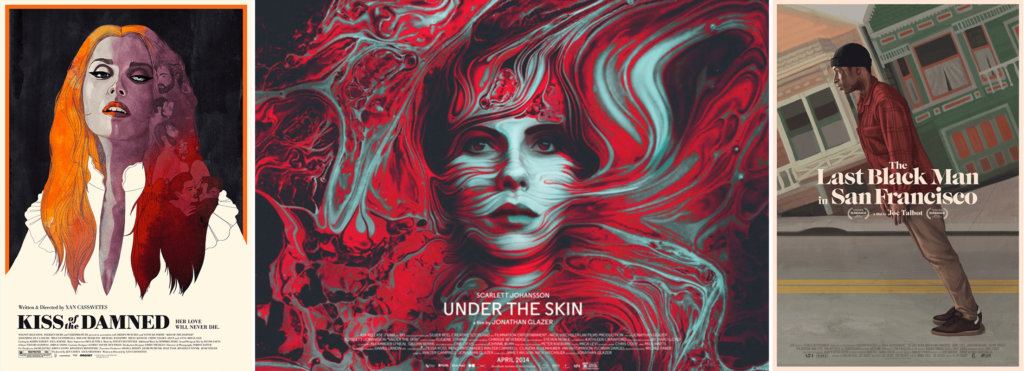
 It was accidental. I had been working in NY doing spot illustrations for music and entertainment magazines. When I moved back to LA, I needed any job because my student loans were knocking on my door. A good friend of mine was working at a movie poster advertising agency and told me they were in need of a receptionist. I interviewed for the job but at the last minute, decided to bring along that month’s SPIN magazine which had my illustration in it. When I showed one of the owners of the company my piece (he was a painter himself), he asked if I’d ever be interested in being a junior designer of movie posters instead. I’d never really used a computer and knew very little about graphic design, but somehow we both agreed to give it a shot. The rest is history.
 VF: Describe your typical process, starting from when a studio or shop first contacts you. How do you go about the task of narrowing down a 2 hour story into one single compelling image?
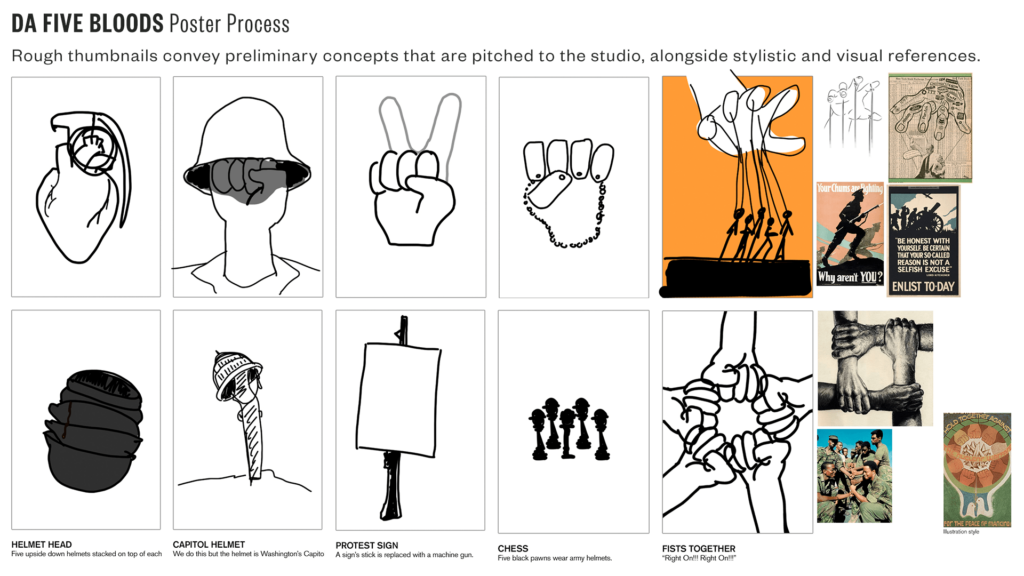 Distilling a 2 hour movie into one single image is no easy feat. Alternative posters you may see on the internet have an easier time because they are dealing with properties that the audience is familiar with. My job is to intrigue someone and introduce them to something new. I do think my background as an editorial illustrator definitely was an asset for this line of work, since I basically would have to summarize a whole article in one image too.
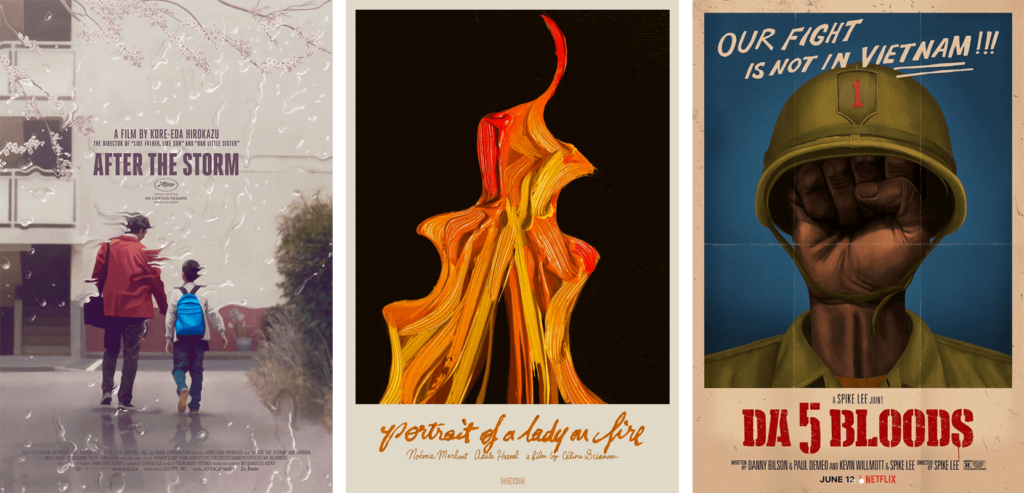 I have creative blocks all the time and it is next to impossible to keep my ideas fresh all the time. I’ve been doing this for 16 years now and have estimated creating over 9,000 pieces during this time. Very few make it to the end. I am used to my work being thrown in the trash (although luckily I’m always compensated for my time). However, the ideas are never completely thrown away. I keep them archived in my brain for an opportunity to blow the dust off and remix them for another project. I can’t tell you how many times I presented the rainy window idea before the film “After the Storm” finally allowed me to do it. And the fist head for “Da 5 Bloods”, I’ve had a version of that idea for a while but this film finally presented me with the perfect opportunity.
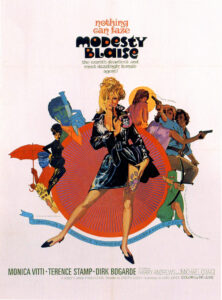 Bob Peak definitely inspired me. Not only do I love his work, I admired him for his versatility to adapt to all genres. Not many artists during his era (if any) did that. Because my role is not that of just an illustrator, I am also an art director and designer, it’s very important that the style of illustration serves the film, instead of just serving me. As far as contemporary artists and designers, I have so many really great friends in this field that constantly inspire me. I also see a lot of illustrators crossing over from alternative posters to real ones and it’s so exciting for me. Not only because I love this new wave of illustrated posters, but I also have to be kept on my toes because now other illustrators are seeing my work, not just art directors who may not have a drawing background.